

Listen to the audio version of this article. (Generated by A.I.)
Seven years into researching sucker control in hazelnuts, Marcelo Moretti, an associate professor in the College of Agricultural Sciences at Oregon State University (OSU), is on the verge of what he believes could be a breakthrough.
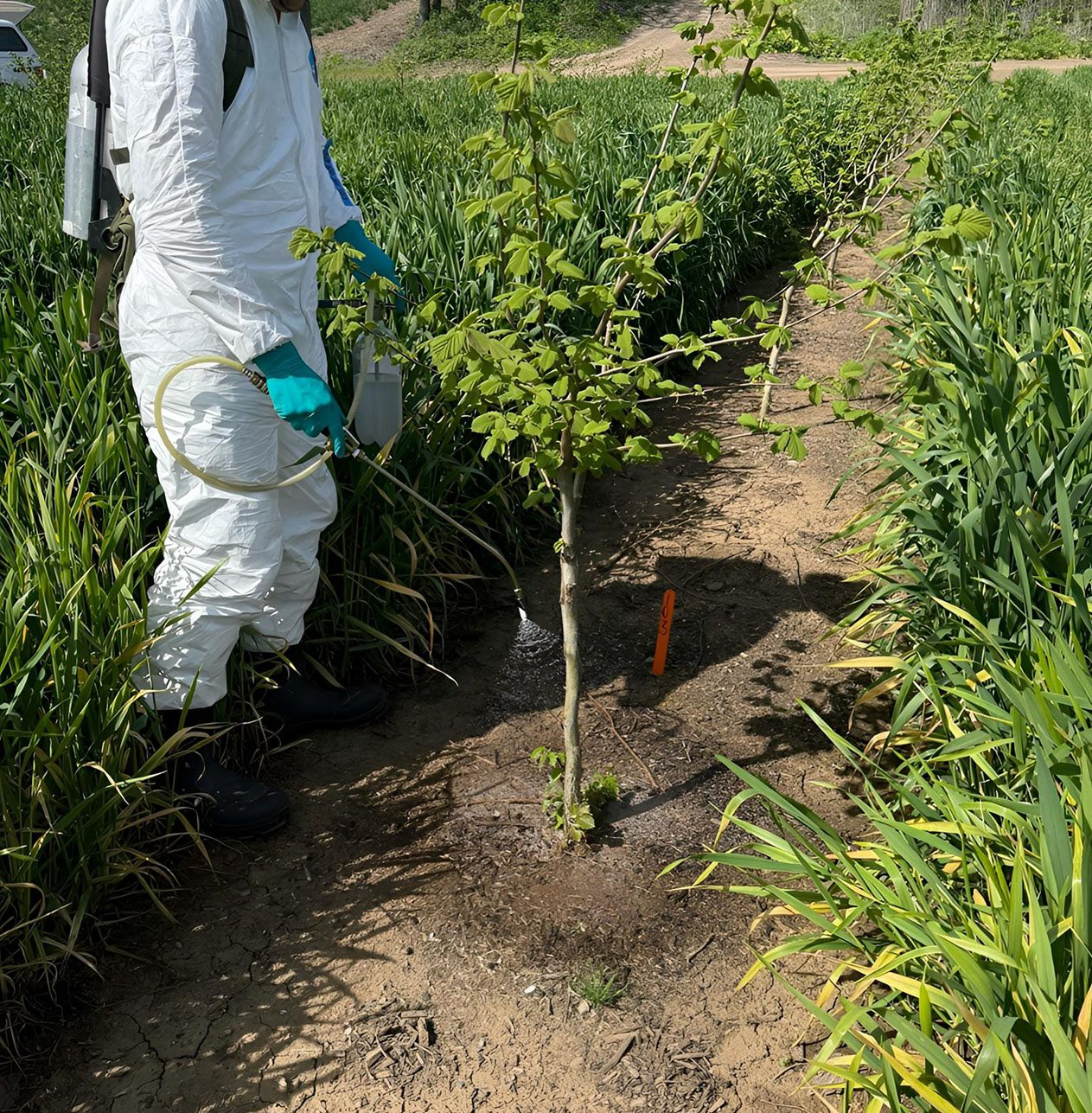
Instead of banding herbicides four or five times a year, Moretti believes growers may be able to obtain season-long control of suckers, and perhaps even longer, with one spray-to-wet application of a plant growth regulator (PGR).
Granted, Moretti said, the per-acre cost of spraying the PGR naphthaleneacetic acid, or NAA, is significantly higher than that of a herbicide. But the savings gained through a reduction in the number of applications needed for sucker control could more than make up for the increased cost of material, he said.
At 0.9 grams per acre, a rate that provided season-long sucker control in an experimental orchard this past year, Moretti said it will cost growers $70 an acre. He is now looking to see if he can get that same level of control at half or even a quarter of the rate, shrinking the cost dramatically.
“If I can cut it to $35 an acre, which I think I can, then we’re talking $35 versus $5 or $10 an acre to band a herbicide,” he said. “And this PGR can give me season-long sucker control with just one spray. So, I think this is going to be cheaper in the long run.”

Priority Concern
Next to eastern filbert blight (EFB), sucker control is probably the biggest management issue for hazelnut growers, according to OSU Extension Orchard Specialist Nik Wiman.
“Suckers consume energy from the tree, diverting it from potential nut production and other energy sinks that are important to vegetative growth,” Wiman said. “Suckers reduce orchard accessibility, limiting the potential to cross-work the orchard floor and making it more difficult to manage the canopies. At harvest, they trap nuts and reduce ability to blow nuts for windrowing with a sweeper.”
In a research project at OSU’s Lewis-Brown Farm in Corvallis, researchers found that three-year-old hazelnut trees with sucker control had 40% higher yields than trees without sucker control. Researchers also found that in year three, tree growth was 30% greater in trees with sucker control than in trees without sucker control.
Wiman added that a study done by former OSU horticulture professor Harry Lagerstedt in the 1960s showed mature hazelnuts that were trained as multi-stem consistently produced fewer nuts than single-trunk hazelnuts, again showing benefits of sucker control.
Moretti further noted that, left uncontrolled, suckers can provide a haven for EFB.
“This new growth is much more sensitive to eastern filbert blight, and if the EFB starts in there, it will go to the main trunk much faster than if it starts in one of the side shoots,” Moretti said. “So, particularly now that we have this new strain [of EFB], sucker removal is very important.”
Moretti said he has also found that it is important to control suckers relatively early in the season, rather than waiting until late July or even August.
“If you remove suckers between April and early July, we get almost the same results as removing suckers year-round,” he said. “But if you wait and just do it in August, it’s almost the same as not doing anything. So, in the springtime, when there is a lot of growth going on with the plants, you don’t want to have suckers.”
Also, he said, if a grower waits too long in the season to control suckers, they will get too big to control chemically, and crews can sometimes wound trees when cutting suckers by hand, increasing a tree’s susceptibility to diseases.
Multiple Approaches
Among approaches that researchers are pursuing for sucker control is the development of suckerless rootstocks or rootstocks that sucker less than traditional cultivars.
“We are currently looking at the potential for suckerless rootstocks that may also be resistant to EFB,” Wiman said.
Wiman noted nurseries also can help reduce suckering through pruning of root balls before trees are sold.
Moretti, a weed scientist, said he started focusing on sucker control in hazelnuts in 2018.
“This is the No. 1 priority I’ve been working on,” he said. “Growers are telling me, ‘Forget about the weeds, it’s suckers.’”
Moretti said the fact that PGRs are widely used for sucker control in apples and other crops prompted him to look at them in hazelnuts.
Learning how to use PGRs in hazelnuts, however, was difficult, he said, in part because hazelnut trees are very susceptible to PGRs, and even slight overapplication can kill a young tree.
“It took me years to understand what to do because this is very different than what we do in apples. In apples, you spray once and it’s easy to control suckers. Hazelnuts are hard because they’re not a tree. They’re a bush. So, they want to be a bush, and we are fighting it back. In apples, you kill suckers once and that’s it.”
Moretti said he has dropped the use rate considerably since he started on the research.
“I started with 15 grams per hazelnut tree and worked my way all the way down to 1 gram. I found that at 15 grams, you’re not going to have suckers,” he said, “because you won’t have a tree.
“It is very easy to overapply with a single wand,” he said. “We are talking about a split second where you can go from the correct rate to twice the rate.”
Moretti said a pesticide manufacturer has secured a registration for use of NAA on nonbearing hazelnut trees, and he hopes to have rate recommendations for the PGR dialed in by 2027.
“I have a company donating me 30 gallons of this product,” he said. “I’m going to separate it into 1-gallon increments, find 30 growers and have a very simple protocol. We are going to spray 0.9 grams, half of that and a quarter of that, and then we are going to count how many trees have suckers over time. And that is going to cover a lot of ground, a lot of varieties, soil type and ages. So, by 2027, I hope to have clear recommendations for using this product.”
The product is now in the pipeline to be registered for use in bearing trees as well, Moretti said.
“We have everything in place,” he said. “The efficacy is there. We are doing the residue analysis. The manufacturers support it. So, I think in a few years, we are going to have a label for bearing trees.”