


Listen to the audio version of this article. (Generated by A.I.)
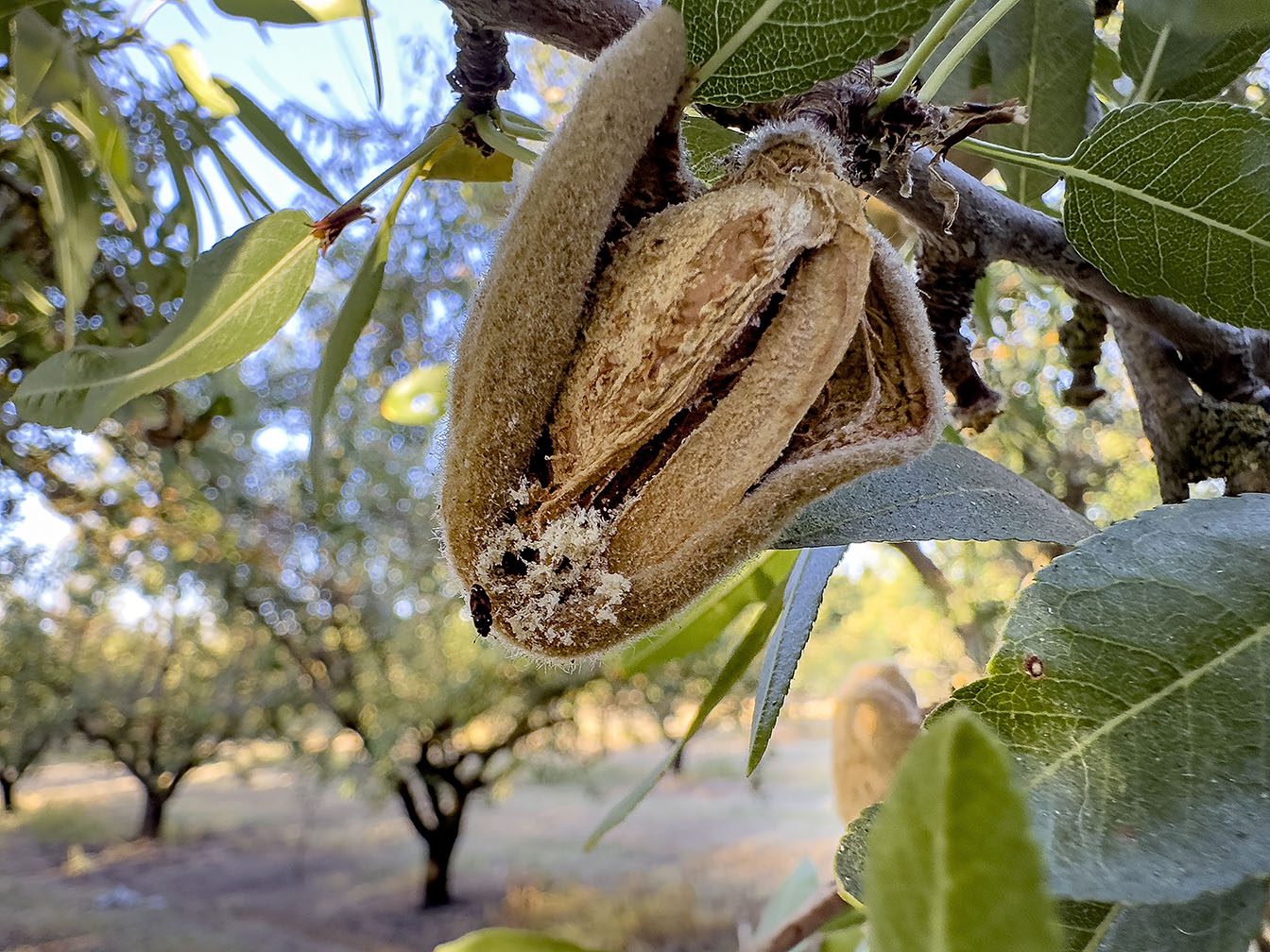
A newly recognized insect threat is spreading quietly through California’s tree nut orchards, but researchers and processors say there’s no cause for panic yet. The Carpophilus beetle (Carpophilus truncatus), officially detected in California in 2023, has shown up in almonds and pistachios across the San Joaquin Valley. It has been confirmed in a walnut orchard but has not been found commonly yet. Processors’ damage report levels remain low in most orchards, but double-digit damage has been documented in a few. It is certainly capable of causing high damage, and the pest’s biology suggests growers should be alert going into winter sanitation.
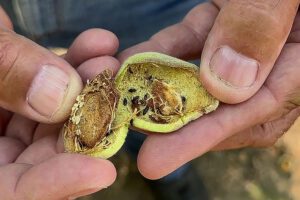
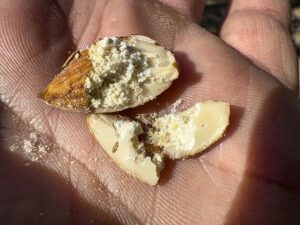
Research led by UCCE IPM Advisor Jhalendra Rijal shows both adult and larval Carpophilus beetles feed inside the nut, breaking down kernels into a fine powder. Unlike navel orangeworm (NOW), which often leaves large frass and webbing, Carpophilus damage can appear clean and flour-like.
“The beetle’s presence is expanding, and in some orchards the damage can escalate quickly,” Rijal said in a recent presentation at the 2025 Crop Consultant Conference. “Sanitation, especially targeting ground mummies, will be critical.”
Early Patterns and Unanswered Questions
Blue Diamond Growers in Modesto is tracking Carpophilus rejects in almond deliveries. So far, the pest has not emerged as a major economic driver.
“It is a very small component of total damage,” said Mel Machado, chief agricultural officer at Blue Diamond. “We have only seen a handful of deliveries where the beetle was the majority cause of the rejects within the load.”
The inconsistency has processors and PCAs scratching their heads.
“I’ve seen deliveries where Carpophilus accounts for 50% of the rejects in a load. But the total reject level was only 0.7%. Then a load from a different grower will have 10% rejects and fully 30% of the damage was caused by Carpophilus,” he said. “That’s significant for that one orchard, but it’s just one guy.”
Even more confusing, a lot of similar-looking beetles can sometimes be found in orchards but cause no damage to the nuts.
“I cracked a nut open at hull split and dozens of adults came running out, literally running down my arm, but that orchard had no Carpophilus damage,” Machado said. “Go figure.”
In hindsight, he said, they were likely other types of Carpophilus beetles, but not C. truncatus, the species considered to be the primary concern for tree nut growers. They were simply too large. What is clear, Machado added, is the pest is more widespread than many growers realize.
“It is everywhere. It is out there,” he said. “We are still trying to understand it.”
Broader Host Range Raises Concern
While most reports so far have been in almonds and the beetle has also been observed in walnuts, pistachios may present a greater concern because Carpophilus is drawn to split hulls and dense clusters where humidity remains high.
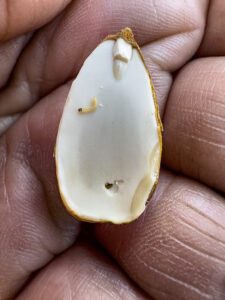
In a 2024 Merced County pistachio orchard, Rijal reported an average of 4.5% damage, though neighboring orchards showed no signs of the pest. He also noted multiple beetles can infest a single nut, increasing the speed of deterioration once feeding begins.
“This is not a one-larva-per-nut pest,” he told growers. “It can be dozens.”
That rapid feeding makes quality protection especially important for processors, where even minor increases in reject rates can translate into costly grower deductions.
Balancing Experience with Emerging Threats
In Denair, grower Darrell Cordova hasn’t seen Carpophilus in his almonds, walnuts or pistachios yet. But with NOW pressure close by at a next-door huller-sheller operation, he does not assume the next threat is far behind.
“Our walnut traps can go from zero to 99 overnight,” he said. “Being close to the huller definitely brings in NOW.”
Cordova uses sanitation and precise timing to limit overwintering pests in all his tree nut crops.
“Mummy shaking is a good way to get rid of them,” he said. “If they stay on the ground, you have to chop them up, so you are reducing the population for the next year.”
He takes comfort knowing those same methods align with current Carpophilus recommendations.
“You never want to wait until you have a problem,” he said. “We are trying to stay ahead of whatever is coming next.”
Ground Mummies: The New Vulnerability
Both NOW and Carpophilus rely on leftover crop material as shelter and food. But their preferences differ in ways that change sanitation priorities. NOW primarily survives in mummies left in the tree, and on the ground, moisture, ground cover and predators reduce survival.
Carpophilus, in contrast, prefers ground mummies and thrives in damp organic debris that holds moisture.
“It likes that cold, damp, grimy environment,” Machado said. “If nuts stay on the ground, they are building next year’s problem. You have to grind them, you have to destroy them.”
Rijal’s research indicates the beetle can complete multiple generations before hull split, producing a much larger population if sanitation is delayed.
“A pest that reproduces on the orchard floor on mummy nuts throughout winter and spring has the potential to explode if sanitation slips,” he said.

Monitoring Tools Still Developing
Carpophilus presents another challenge: It’s harder to track than NOW. There is currently no species-specific pheromone trap commercially available in California. Right now, PCAs have to rely on visual observation and postharvest crackout to identify the pest. By the time damage is discovered, the season is lost.
However, monitoring technology is improving. Researchers in Australia have developed a new pheromone-based trap that is now being evaluated in California tree nut orchards in collaboration with UCCE IPM advisors throughout the valley, led by Houston Wilson, a CE specialist with UC Riverside based at the Kearney Ag Center in Parlier. In addition to Wilson’s research, Machado said the team from Australia is also looking for growers to begin field testing the trap next year to gather data on user experience and help refine it for use under local conditions.
“We need better tools to monitor this pest,” Machado said. “Sanitation is the key until we get there.”
Advisers are hopeful that trap adoption could eventually allow for more economical oversight through better tracking of pest phenology in orchards, more accurate treatment timing and surveying for new populations.
Act Now, Before Pressure Builds
Given the early stage of Carpophilus establishment in California, the industry is attempting to stay ahead of it before it becomes a repeat of NOW, and timing is critical. Rijal said that once economic damage becomes widespread, management becomes much more expensive and disruptive. A single season of missed sanitation can allow multiple overlapping generations to establish on orchard floors, creating a population that is difficult to suppress the following year.
“The opportunity right now is prevention,” he said. “If we do a good job cleaning up mummies this winter, we can greatly reduce what we see next season.”
Machado said Blue Diamond and university researchers are working closely with PCAs to keep awareness high through field meetings and grower communications.
“This is the time to talk about it, not after it shows up in your orchard,” he said.
Because Carpophilus beetles thrive in the same habitat where humidity and organic matter collect, growers who invest in good orchard hygiene (e.g., managing leaf litter, hull piles and soil moisture under trees) will likely have fewer problems. Early reports suggest orchards with clean floors and well-timed mummy destruction show little to no beetle activity, even in infested regions.
“Growers should be working hard on sanitation for navel orangeworm,” Machado said. “If we tighten up ground mummy destruction, we limit the options for Carpophilus at the same time.”
While the pest’s arrival adds another layer of vigilance for tree nut producers, experts agree the industry has a chance to apply lessons learned from previous challenges. NOW outbreaks in the 2010s showed how quickly pest populations can become entrenched once they gain a foothold.
In contrast, Carpophilus management remains largely in growers’ control as long as sanitation stays consistent across neighboring orchards and counties.
“In fact, it does not seem that Carpophilus beetle can be controlled without doing ‘intentional sanitation,’ as there are no other tools that have shown effective control of this pest,” Rijal said.
He added that regional cooperation will also matter.
“If one orchard cleans up and the next one doesn’t, that’s where pressure will build. The beetles don’t stop at a property line,” Rijal said.
For now, vigilance and communication remain the strongest defenses. Processors will continue to collect reject data, researchers will refine trapping methods and growers will tackle another winter of cleanup with a new pest in mind.
Cordova said that while he hopes Carpophilus never reaches his orchards, he’s taking the same approach he has with other pests by staying proactive, keeping informed and not assuming it will pass his orchards by.
“We’ve learned these things spread fast,” he said. “You just do your part to keep it from getting started.”

Kristin Platts | Digital Content Editor and Social Correspondence
Kristin Platts is a multimedia journalist and digital content writer with a B.A. in Creative Media from California State University, Stanislaus. She produces stories on California agriculture through video, podcasts, and digital articles, and provides in-depth reporting on tree nuts, pest management, and crop production for West Coast Nut magazine. Based in Modesto, California, Kristin is passionate about sharing field-driven insights and connecting growers with trusted information.