

Listen to the audio version of this article. (Generated by A.I.)
Dormant orchards and cool/short days of December hopefully offer some downtime for growers and PCAs. This is a good time to review and plan along with taking care of a few key orchard practices, all of which are similar no matter the tree nut crop.
First topic, always, is water. California reservoirs finished the 2024-25 water year with storage levels at or just above historical averages. So far, so good. The National Weather Service’s Climate Prediction Center is forecasting La Niña conditions through midwinter (December to February). What does that mean for Sacramento Valley growers and ag advisors? Michael Anderson, state climatologist with the California Department of Water Resources, in a quote from a statewide press conference in October, said, “expect extremes, with dry periods interrupted by large or long-lasting atmospheric river conditions.”
Managing Moisture Without Oversaturation
The dormant season water management goal for almonds and walnuts is to maintain at least some soil moisture through the winter but begin the season with a full (at field capacity, not saturated) soil profile. Ballpark start-of-the-season timings is the second half of January for almonds and March for walnuts. (Roots start growing ahead of bud break.)
Hopefully, rainfall will meet this goal, but winter irrigation may be needed. The preferred approach to winter irrigation is several smaller irrigations to add water to the profile in short sets (<24 hours) to avoid saturating the soil with one longer (>24 hours) irrigation and risking root health from either disease and/or lack of oxygen. Again, the root zone needs some moisture through the dormant months, but a full profile isn’t needed until weeks before bloom. Wilbur Reil, retired UCCE Yolo/Solano orchard advisor, said tree crops should get 2 inches of moisture (rain or irrigation) per month in the winter to be ready for bloom and that older, experienced advice matches with recent research.
Dormant season orchard water use is light; leafless trees use essentially no water and most orchard water loss is through surface evaporation and/or vegetation (cover crop or volunteer). Given shorter, cooler days with some cloud cover, winter orchard water use is limited, so any winter irrigation should be, too, if needed at all.
Looking ahead to next spring, when is it best to start irrigating orchards? Recent UC research results suggest big differences in first irrigation strategy for almonds compared to walnuts. Waiting to irrigate walnuts until the orchard stem water potential (SWP) reaches -2 to -3 bars below baseline doesn’t harm trees or yield while saving water and avoiding saturated soils in the spring. However, when researchers tried the same approach in almonds, there was a trend toward reduced yield. A solid goal for spring irrigation in almonds looks to maintain no to low water stress (0 to -2 bars below baseline) into early June by applying close to ETc (replacing estimated crop water use) while drawing down stored water in the root zone as hull split approaches.
Pest Control and Sanitation
Insect/mite pest management in dormant nut crop orchards is focused on two basic practices: sanitation and scale monitoring.
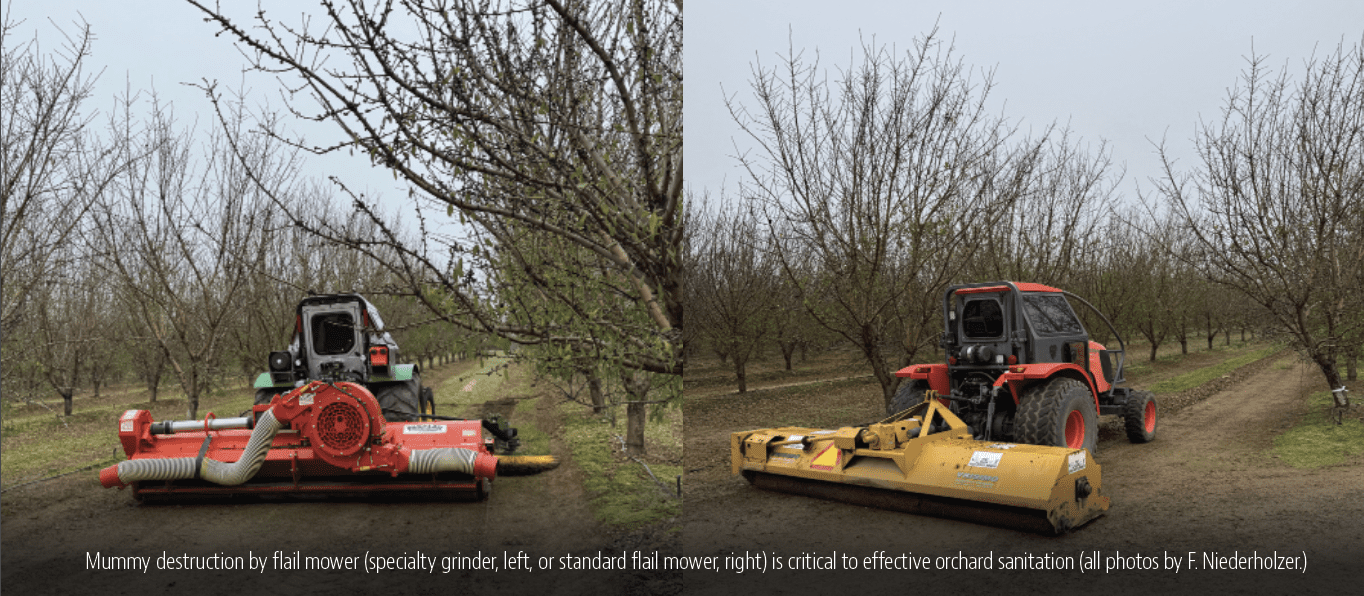
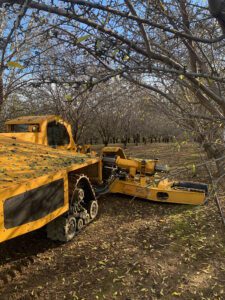
Orchard sanitation for navel orangeworm (NOW) control involves two equally important steps: 1) mechanically shaking trees to get the nuts onto the ground and 2) destroying the grounded nuts to kill the insects in them. This also eliminates shelter for the spring generation of NOW. For almonds, the deadlines are Feb. 1 for mummy removal from the trees and March 1 for grinding/mowing destruction. For walnuts, the sanitation competition deadline is mid-March. For pistachios, UC IPM Guidelines call for fall/winter mummy nut removal to the row middles and mowing or discing them to destroy them. Discing is only recommended to destroy old nuts in pistachios, not walnuts or almonds, due to difficulty in destroying pistachio nuts with a flail mower. Flail mowing is the proven and preferred mummy destruction practice for walnuts and almonds.
Sanitation targets for almonds in the Sacramento Valley are an average of two mummies per tree or less by Feb. 1, although depending on the year, that deadline can be stretched 7 to 10 days into February. If mummy shaking into early February, expect some bud loss, but crop yield should not be reduced (25% to 30% of all flowers become nuts in a good almond crop.) Please note: the “late sanitation” dates listed are not set in stone. An early bloom year should limit February shaking as buds are more developed (larger and heavier) sooner.
From the soapbox: Good orchard sanitation, where all the boxes are checked and threshold numbers met, is a critical practice in nut crop production. It does not guarantee a clean crop next year, but not hitting those numbers (two per tree by March 1) may mean a tougher year for rejects and income. It is critical to count mummies in the trees on Feb. 1 to confirm two or fewer mummies per tree and check that all mummies on the orchard floor are destroyed by March 1. If these final steps weren’t done or if counts show excess mummy numbers, the orchard isn’t sanitized. Work may have been done, but the job wasn’t completed.
If you needed more reasons to get mummy almonds out of the trees and destroyed, orchard sanitation is the one proven management practice, to date, for Carpophilus truncatus (C.t.) and helps reduce bacterial spot (Xanthomonas arboricola) pressure next spring as mummies are one of the overwintering sites in the orchard for that pathogen.
December is an excellent time to monitor scale insects. If not managed by sprays or beneficial insects, scale can kill branches and, in walnuts, increase Botryosphaeria pressure.
Monitoring scale populations on dormant wood during the winter is key to managing this potentially damaging group of pests. A dissecting microscope is the best tool for scale monitoring, in my opinion, as it frees your hands to move the spur or shoot wood under magnification and gives a steady image. It’s a great investment and lasts for years, and a basic model costs around $200. That works out to a few cents per acre over the life of the device plus the reduced costs (crop loss and/or unneeded sprays) resulting from more effective scale monitoring.
Dormant scale monitoring practices differ between almonds and walnuts. In almonds, the primary concern is San Jose scale, with soft scale (European fruit lecanium) a lesser issue. Check out the UC IPM almond San Jose scale page. For walnuts, there are multiple scale pests: Italian pear, San Jose and walnut scale plus soft scales (frosted scale and European fruit lecanium). In walnuts, the tissue to check is current shoot growth. A pruning tower may be needed to take samples. Note: While dormant monitoring for scale, keep an eye out for European red or brown almond mite eggs. Control is usually not necessary, and these mites help feed beneficial insects and mites early in the season, but looking for this occasional pest helps avoid rare problems. In pistachios, the focus is on soft scale.
To avoid loss of bearing wood, it’s important to monitor for scale, now more than ever. Use of broad-spectrum insecticides for worm and/or bug control can harm beneficial insects and so increase scale populations. Annual scale monitoring helps avoid buildup from this damaging group of pests.
Good spray coverage is critical for scale control. Prebloom (dormant or delayed dormant) insecticide sprays have the potential for excellent spray coverage. Consult with an experienced PCA regarding insecticide material, rates and timings for scale control.
A late fall/dormant weed survey helps evaluate the 2025 weed program and plan for the new year. Not all herbicides are effective on all weeds. See UC IPM guidelines for details and monitoring sheets.
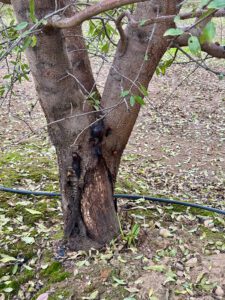
When surveying for weeds, it’s also a good idea to look for damaged trunks (shaker injury) from the past harvest if it hasn’t been done already. Shaker damage can harm the long-term economic potential of an orchard by opening the tree to fungal infection, particularly Ceratocystis canker. Limiting shaker damage is a key step to maximizing the productive life and profitable production of an orchard. Missing trees killed by injury/disease that started as shaker injury bleed value out of an orchard. The more damage, the more bleeding, and it costs too much to replace an orchard today to not pay attention to shaker injury and management. Notes and maps of shaker injury in an orchard taken now can help growers and PCAs focus on shaker management and limiting damage in future harvests.
Don’t rest on rodents as the orchards go dormant. While ground squirrels are generally hibernating behind walled-off tunnels, gophers and voles are active. Controlling these damaging pests before the populations build in the spring helps limit damage in the year ahead.
Using at least two control practices is a proven tool in gopher management. For example, use a poison bait probe/applicator to target gopher tunnels one week, rake out the mounds and follow up with traps in areas with new mound activity. Time training employees unfamiliar with using a probe to find gopher tunnels, bait applicators and gopher traps is time well spent.
Fertility Planning for 2025-26
December is a good time to review summer leaf analysis results, grade the 2025 fertilizer program and plan for 2026. With leaves off the trees, there is virtually no nutrient uptake aboveground or belowground. The only effective fertilizer input during the dormant season is potassium, as it can be held on clay and organic matter in the soil and in turn “banked” for use in the spring. Light (low cation exchange capacity) soils have limited capacity to hold cations (K, etc.), so lighter rates are advised to avoid leaching losses.
Increasingly, I’m hearing from CCAs that N and K are applied in-season once the overall crop load is established, since the crop is the largest user of these big-ticket nutrients, especially after the fourth or fifth leaf. Applying a full rate of K fertilizer (90 pounds K2O per 1,000 pounds kernel crop) in the fall is an effective practice but might be more K than is needed if weather unexpectedly reduces the crop. There are many ways to get K into the tree next spring, including surface application of coarse, field-grade fertilizers with lower cost than K solutions or solution-grade products. All materials work if they are injected or placed where irrigation water reaches the fertilizer. There may be value in evaluating K fertilizer options and deciding the timing of K inputs based on operational need (budget, labor availability, etc.). The goal is to avoid K deficiency (leaf K < 1.0%) going into harvest, as by then it is too late to avoid possible yield loss the next year.
Winter is a good time to check orchard leaf N levels with an eye to adjusting (or not) practices and rates in 2026. Too much nitrogen (leaf N > 2.5%) can encourage spider mites, rust, hull rot and more NOW damage. The increase in worm damage is due to delayed maturity on vigorous rootstocks such as peach/almond hybrids (Hansen, Titan, Nickels, Brights, etc.). The sweet spot target for July leaf N is 2.4% based on UC research.
Finally, if harvest hull boron levels indicate a need, including boron in a pink bud spray can increase cropload, based on UC research results. Even with harvest hull levels of 200 ppm B, a small amount of B (0.2 pounds actual B per acre) at pink bud is not discouraged by UC researchers. Avoid spraying B on almonds at full bloom, as this can reduce nut set.
Happy holidays to all and best wishes for a good 2026.
Resources
Articles and info (weekly ET, nutrition, meetings, pictures, etc.): sacvalleyorchards.com
Information on pests with photos: ipm.ucanr.edu/almonds and ucipm.ucanr.edu/walnuts
Using the pressure chamber for nuts and prunes: anrcatalog.ucanr.edu/Details.aspx?itemNo=8503#FullDescription
Advanced Stem Water Potential (SWP) Interpretation in Almond: https://www.sacvalleyorchards.com/manuals/stem-water-potential/advanced-swp-interpretation-in-almond/
Almond scale pests
• San Jose scale: ipm.ucanr.edu/agriculture/almond/san-jose-scale/
• European fruit lecanium: ipm.ucanr.edu/agriculture/almond/european-fruit-lecanium/
Walnut scale pests
• San Jose scale: ipm.ucanr.edu/agriculture/walnut/san-jose-scale/
• Italian pear scale: ipm.ucanr.edu/agriculture/walnut/italian-pear-scale/
• Walnut scale: ipm.ucanr.edu/agriculture/walnut/walnut-scale/
• Soft scale (Frosted scale & European fruit lecanium): ipm.ucanr.edu/agriculture/walnut/frosted-scale-and-european-fruit-lecanium/
• Telling scale apart in walnut: ipm.ucanr.edu/agriculture/walnut/distinguishing-scale/
Pistachio: ipm.ucanr.edu/agriculture/pistachio/soft-scales/
Fall weed survey: ipm.ucanr.edu/agriculture/almond/survey-weedspostharvest
Ceratocystis canker: ipm.ucanr.edu/agriculture/almond/ceratocystis-canker/
Please email fjniederholzer@ucanr.edu with questions or comments about this column.