
Listen to the audio version of this article. (Generated by A.I.)
Seeding cover crops in tree nut orchards presents a unique challenge, largely due to timing. By the time growers are ready to seed, the ground is often too saturated for equipment to enter the orchard, making traditional drilling difficult. Recent demonstration trials, however, highlight drone seeding as a promising new alternative.
Almond Demonstration
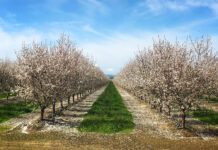
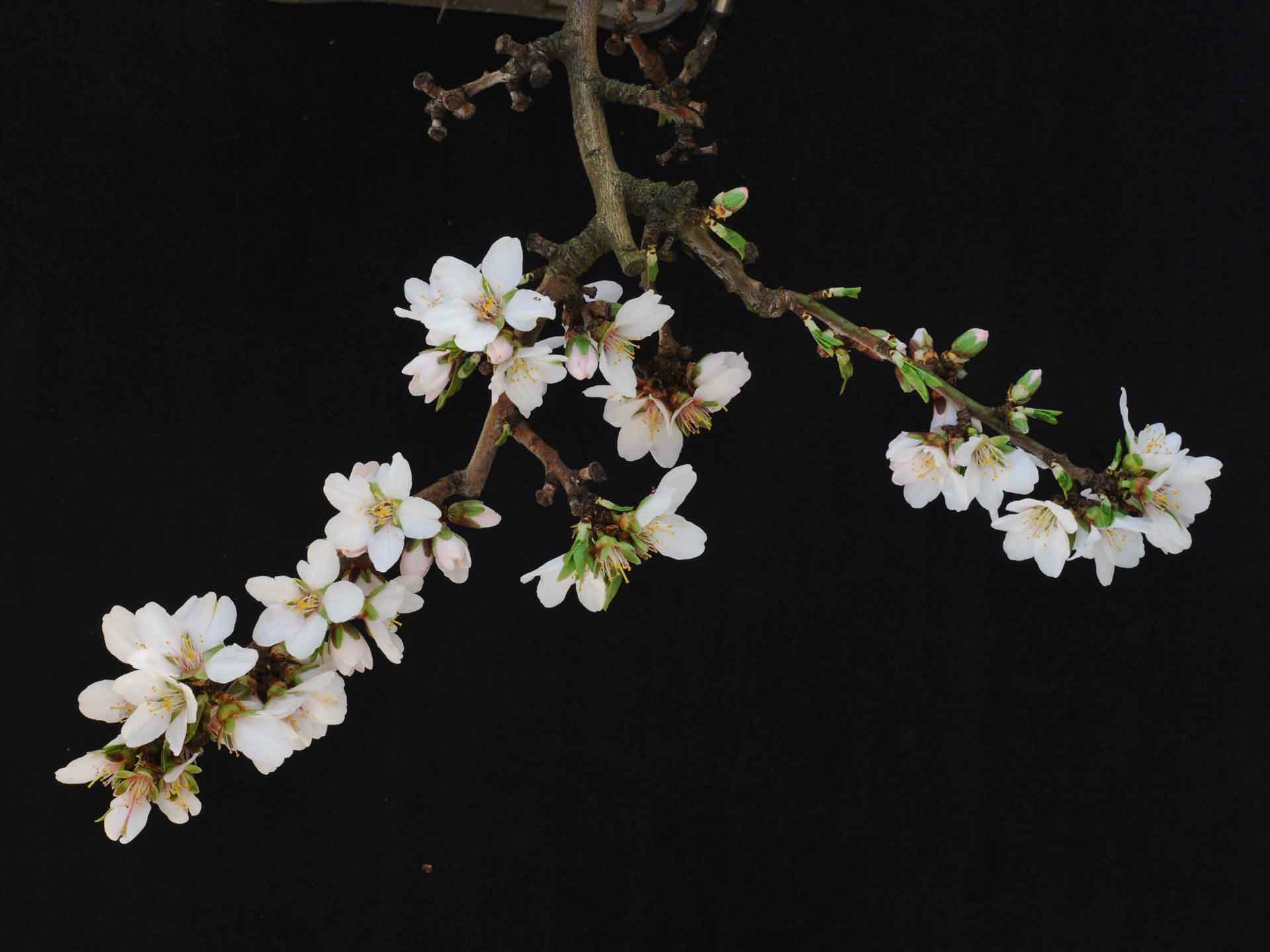
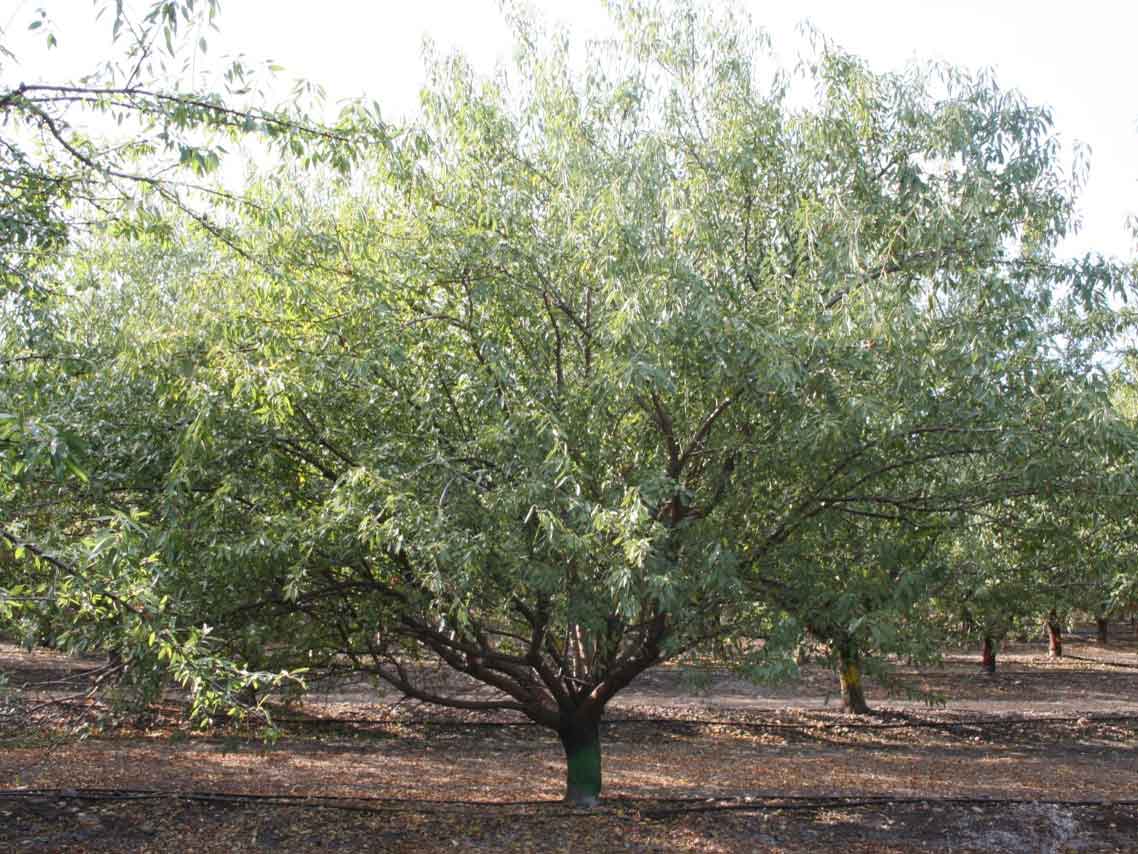
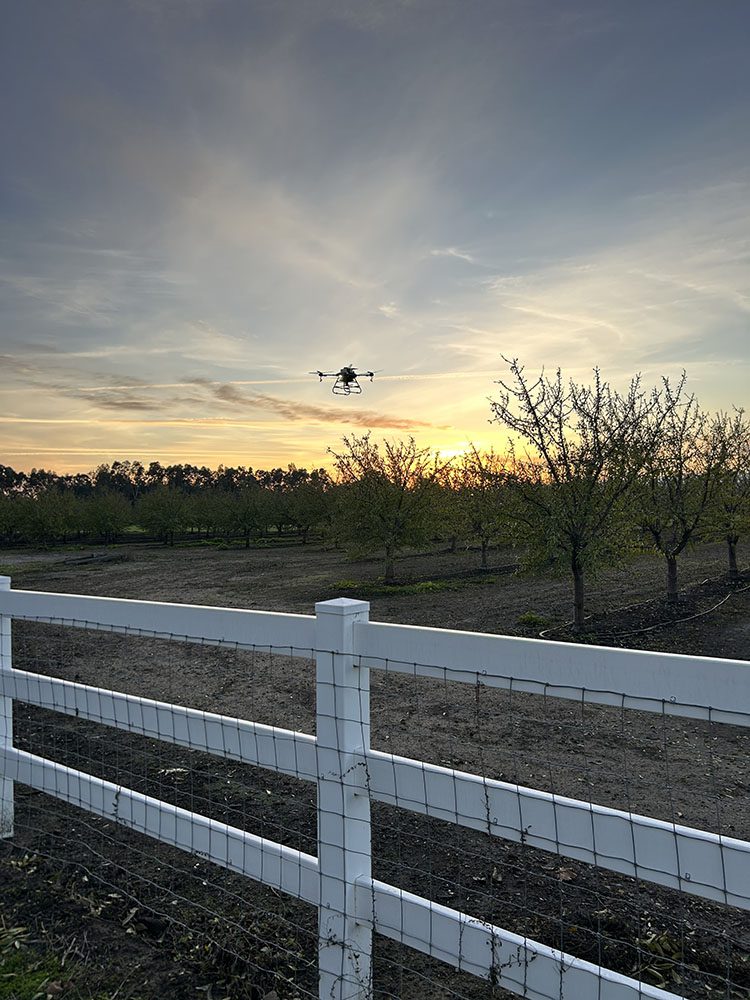
Kevin Hill, partner and operations manager for Parabug in Salinas, Calif., conducted a drone seeding demonstration in collaboration with Julia Michaels, vice president of The Native Seed Group (nativeseedgroup.com). The event took place in December 2024 on a 33-acre almond orchard in Dixon, Calif. The field was seeded at a rate of 10 pounds per acre in partnership with the Solano Resource Conservation District.
“An almond farmer received a grant to do pollinator planting in his orchard. As often happens, the best time to seed cover crops doesn’t always line up with the easiest time to seed them,” Michaels said, adding the soil was very wet, preventing the equipment from going into the orchard.
“For cover crops, that’s actually a really great time to plant, especially for the seeds that are planted more at the surface level,” she said.
“Some cover crops like peas really need to be rolled in, and it’s a little better if the soil isn’t as wet. But for some of the wildflower species that we’re trying to do for additional pollinator services, they actually love to be planted right at the surface onto wet soil,” Michaels said.
Benefits to Drone Seeding
Hill said the key advantage of drone seeding is its ability to operate when tractors can’t, whether the ground is too wet and muddy or there are concerns about compaction. “That’s probably the No. 1 use for drone seeding,” he said.
But there are other benefits. “With drones, we can achieve up to centimeter-grade accuracy,” Hill said, adding this was particularly important for the almond demonstration because they flew in between every single row, making accuracy very important.
Labor savings was another benefit. “All you really need is one person, a drone and a bunch of batteries,” he said.
Timing
November/December is the prime time for cover crop seeding when the ground is already wet and ideal for drone seeding, but not drill seeding, Hill said.
“There’s a pretty tight window on the optimal time to get the seed into the ground to give you the best chance of getting that cover crop. So having the ability of the drone, and obviously it’s not touching the ground except for when it lands and takes off, there’s no risk of getting equipment stuck,” Hill said.
Drones
The drones are very easy to use. “If you can use an iPhone, you can fly one of these drones,” Hill said.
“There’s a pretty tight window on the optimal time to get the seed into the ground to give you the best chance of getting that cover crop. So having the ability of the drone … there’s no risk of getting equipment stuck.” – Kevin Hill, Parabug
He noted that most agricultural drones are manufactured by DJI, a China-based company. However, he added that potential Federal Communications Commission (FCC) restrictions are being discussed, raising concerns about the long-term availability of DJI drones in the U.S. market.
“Another big concern that a grower would need to take into consideration if they were to do this themselves is getting the proper licensing. Basically, if you make any money off a drone in the U.S. as long as it weighs more than 0.55 pounds and under 55 pounds, you have to get what’s called a Part 107 through the Federal Aviation Administration (FAA). That’s just the standard drone license,” Hill said, adding there are plenty of study guides and online courses to basically guarantee passing it.
The drones that Hill uses are under the 55-pound weight requirement. “If you were going to do drone seeding on a really large scale, you’d probably want a larger drone,” Hill said, or several drones under 55 pounds.
Once you exceed 55 pounds, things get more complicated. An additional set of FAA licenses is required, which can be difficult to obtain. But staying under 55 pounds, the hopper only holds 16 pounds of seed, which means more reloading.
“In California, the Department of Pest Regulation (DPR) considers this a pest control-related business, so you would have to be licensed through DPR to get an apprentice pilot certificate, then eventually a journeyman pilot certificate,” Hill said. Bottom line, there are several hoops to jump through for this license.
The other option is to hire a custom operator, Hill said.
The Future
Michaels returned in March and April to assess the demonstration results. Various species had emerged, and overall ground cover was excellent. However, the site had been tilled beforehand, which brought Japanese knotweed to the surface. The invasive plant eventually took over, an outcome Michaels said likely would have occurred regardless.
“I think there’s a lot of potential, and not just orchards, but for restoration projects and areas that are difficult to seed,” she said.
“Right now, given where the technology is at, I wouldn’t say that drone seeding is faster, cheaper and better than traditional seeding methods, but it very well could be getting there quickly,” Michaels said, adding when conditions prevent using traditional methods, drones can get the job done.
There aren’t more demonstrations planned, but Michaels said she would love to team up with Hill again.
USDA/NRCS Demonstration
Margaret Smither-Kopperl is a manager with the USDA Natural Resources Conservation Service and has held drone seeding demonstrations at the Plant Materials Center (PMC). Parabug conducted a drone seeding demonstration at PMC in December 2023. Conditions were cold and wet, so wet in fact that a tractor couldn’t enter the field to plant or roll the seed. In this case, the drone proved to be the only viable option for getting the job done.
“We had a fantastic stand that came in with the grasses and the pollinator species,” Smither-Kopperl said.
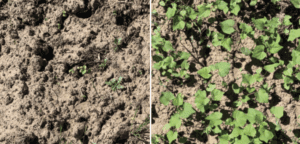
The following spring, Smither-Kopperl hosted a field day and invited Parabug to conduct another seeding demonstration. They planted buckwheat, a common cover crop, though typically a warm-season species. Recent rain had left the site wet, and they successfully seeded about an acre. The demonstration proved effective, she said.
The advantage to the drone is it’s quicker and can seed when traditional equipment can’t get on the ground, Smither-Kopperl said.
Cover Crop Demonstration for Habitat Corridors
Chris Storm is a viticulturist with Star and Storm Crop Solutions, and he was part of a cover crop demonstration. “We were planting headland as part of trying to increase beneficial insects and predators and combat the weeds. We were trying to create some wildlife strips and habitat corridors in hard to farm areas,” Storm said.
“The site was an area next to a county road that was parallel with the vineyard, and we wanted to farmscape that area with native plants,” Storm said.
The soil was broken by running a quick disc pass over it, then seeded, and finally rolled to cover the seed with soil because it would be a couple of months before it rained, Storm said. It was successful in that there were many flowers growing, and he estimates 60% of the seeds germinated, he added.
Storm feels drone seeding warrants further research to look at the economics and determine if it’s economically viable. “Do the economics work out that it can be applied by air and get the same amount of recruitment or slightly less, but for a significant cost savings vs the compaction that comes from drilling in cover crop seed?” he said.
“I’m a huge proponent of scientific studies where it’s not just a split block design, but a true replicated trial with controls, multiple replicates and statistics because that’s really the only way you can show a difference in the technique,” Storm said.
But knowing growers as he does, Storm expects they are just going to try it out like they always do, with or without research.
“Drone releases of beneficial insects and mites have been very effective, so this seems like the next step,” Storm said.