


Listen to the audio version of this article. (Generated by A.I.)
Governor Gavin Newsom’s recent announcement of an $80 million investment in rural economic development, including $28.6 million for agricultural technology innovation, is more than a budget line. For California’s specialty crop producers, especially the state’s world-leading tree nut industry, it marks a pivotal opportunity to shape technology that truly works for growers. Whether this investment succeeds will depend on how effectively it connects innovation to orchard reality.
California’s tree nut producers have long been at the forefront of adaptation. From managing labor shortages and water scarcity to meeting the pressures of global markets and climate volatility, producers have repeatedly turned constraint into opportunity. Yet the promise of “AgTech,” that is, AI-enabled, data-driven, and robotic solutions, too often remains stuck at the prototype stage. It is impressive in concept but disconnected from orchard realities and the rural economic challenges it aims to solve.
If guided wisely, this wave of public investment could bridge that gap and empower California’s producers to lead the next chapter of AgTech. This chapter must be rooted in practicality, regional resilience and long-term competitiveness.
A Strategic Moment for California Agriculture
The $80 million state investment in rural economic development is part of the California Jobs First Economic Blueprint, which targets growth across key sectors of the state’s economy, including aerospace, manufacturing, water and technology. The $28.6 million earmark for AgTech includes:
• $15.1 million to establish the California AgTech Alliance, led by UC Agriculture and Natural Resources, focused on workforce development, business attraction and innovation funding.
• $9.2 million to establish three smart farms through the Community Foundation of Merced County, with UC Merced advancing AgTech research and Merced College supporting early stage startups.
• $3 million to extend the AgTEC certificate program to three additional community college campuses in the state.
These investments are strategic, but their success hinges on execution and relevance. To turn potential into measurable impact, five priorities should guide implementation, and growers must be involved in each.
1. Build a skilled and inclusive AgTech workforce
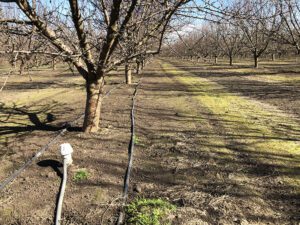
AgTech is only as effective as the people who operate it. California’s tree nut sector increasingly depends on technicians and data-savvy farmworkers who can install sensors, manage irrigation data and integrate automation into orchard systems.
Programs like AgTEC and the California AgTech Alliance hold promise, but they must expand beyond traditional academic settings to reach nontraditional education and vocational pathways. A statewide effort to align training with industry needs will be critical to building a lasting pipeline of skilled workers who can support the technologies reshaping orchard management.
2. Bridge the gap between research and real-world adoption
California is home to world-class agricultural research institutions, yet too many AgTech innovations never leave the research lab. Expanding smart farms in Merced County is a strong start, but transformative impact requires continuous feedback loops between researchers, growers, workers and industry partners.
Public-private partnerships, grower-led pilots and cooperative extension programs are essential. When growers help shape AgTech field trials, technologies become both practical and profitable.
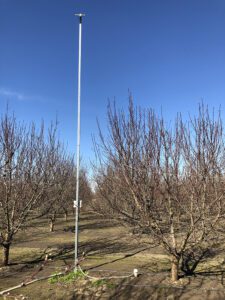
In almond production, for instance, UC Davis researchers working with Central Valley producers found that microtensiometer stem-water-potential sensors could track tree stress with an error margin of just 0.22 megapascals. This enables real-time irrigation control and measurable water savings. Field-validated innovations like this are what California must accelerate.
The Washington Tree Fruit Research Commission’s Smart Orchard Initiative also offers a compelling model. By integrating university scientists, startups and commercial growers in live orchard test beds, Washington has created a collaborative system that speeds technology adoption while improving sustainability and profitability. California should adapt and scale this type of grower-driven model.
3. Align innovation with sustainability and compliance goals
California’s tree nut industry sits at the intersection of environmental regulation and global competition. Technologies that help growers meet groundwater, air quality and soil health standards while improving margins represent the future of viable farming.
Precision irrigation, soil-moisture analytics and renewable energy systems should become standard orchard infrastructure. The California Almond Sustainability Program reports that microirrigation has reduced water use by roughly one-third per pound of almonds over the past two decades. Targeted AgTech innovations can build on this momentum and align productivity, compliance and profitability to create a win-win for growers, workers and local communities.
4. Invest in regional resilience and place-based solutions
California’s ag diversity is its strength, but it is also its challenge when it comes to AgTech innovation and adoption. For example, almond growers in the San Joaquin Valley face groundwater sustainability issues, salt buildup and soil compaction, while walnut growers in the Sacramento Valley and pistachio growers in Kern County face different pressures. In 2024, the state’s tree nut acreage included 1.38 million bearing acres of almonds (62%), 488,000 acres of pistachios (22%) and 370,000 acres of walnuts (16%). Each crop and region requires tailored, place-based solutions.
AgTech investment should support regional and commodity-specific innovation hubs that tailor solutions to each area’s realities. Local startups, cooperative extension networks and grower associations are ideally positioned to lead this place-based approach, ensuring that innovation remains grounded in the economic and ecological contexts where it must succeed.
5. Foster collaboration across the ag value chain
California’s tree nut sector remains a cornerstone of the state’s ag economy, driving roughly $9.4 billion in utilized production value in 2024, a 15% year-over-year increase. But behind that growth lie tightening margins, volatile markets and mounting environmental pressure.
Effective innovation is not about isolated breakthroughs; it depends on collaborative ecosystems. The AgTech Alliance must build and maintain networks that can connect software engineers with soil scientists, growers with developers, and processors with policymakers to ensure those most affected by technology help shape it from the start.
By aligning incentives across researchers, entrepreneurs and growers, California can move from fragmented experimentation to coordinated, scalable adoption to drive measurable improvements in labor efficiency, water savings, yield stability and regulatory compliance.
Measuring Success
The $28.6 million AgTech investment is more than an economic stimulus; it is a strategic inflection point. But dollars alone will not transform orchards. Success should be measured not by the number of sensors installed or startups funded, but by how many growers achieve real improvements in water efficiency, yield consistency, labor productivity and compliance costs.
This is where metrics matter. State and university partners must track adoption outcomes and quantify how public investment translates into on-farm performance and community benefit.
A Call to Lead
California agriculture has never waited for the future; it has built it. This recent investment by the state offers an opportunity to lead again if growers, researchers and innovators work together from the start. For researchers and AgTech entrepreneurs, it’s a chance to design with producers, not just for them. For growers, it’s a call to shape the tools that will define the next era of competitive, sustainable agriculture.
The future of agriculture will undoubtedly be shaped by technology, but the real question is whether California’s tree nut growers will take the lead in shaping that future themselves.
M. Anne Visser, Ph.D., is a professor of community and regional development at UC Davis, where she researches how automation, AI and innovation are reshaping agricultural work and rural economies. She co-directs UC’s Labor and Automation in California Agriculture program and partners with growers, entrepreneurs and policymakers to advance resilient and equitable ag systems and economies.