
Listen to the audio version of this article. (Generated by A.I.)
When the Locke family started farming, people were flocking to California looking for gold. As they celebrate the 175th anniversary of their farming operation, now called Locke Ranch Inc., the Lockes have a unique perspective on the history, rewards and challenges of farming in the San Joaquin Valley.
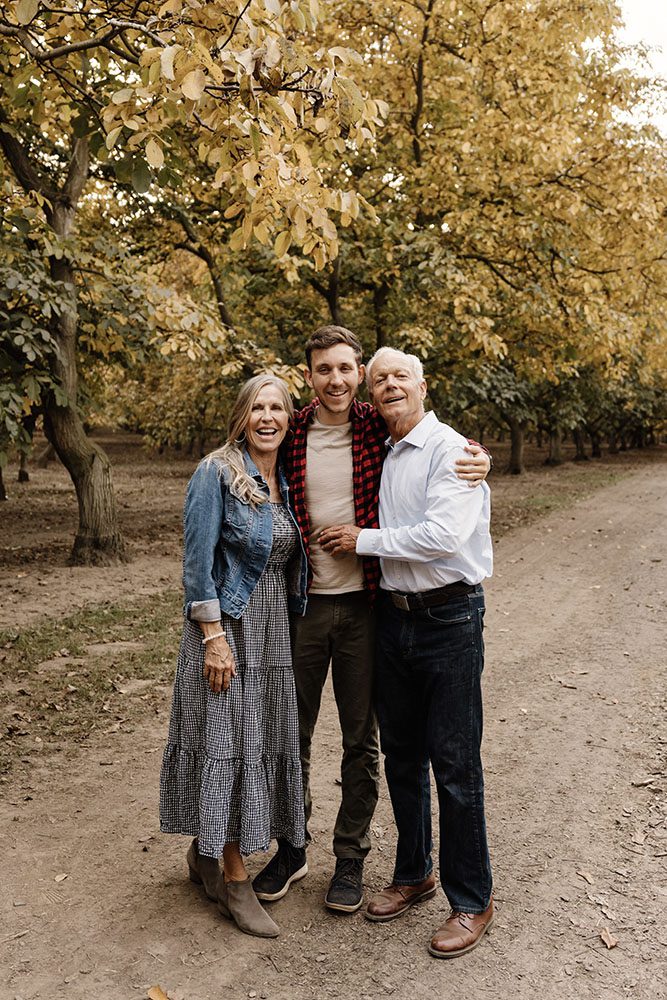
Elliot Locke recently joined Christy and Chris Locke to become the sixth generation of Lockes to work the land in the town of Lockeford that their ancestors founded.
While Chris has long been a proponent of regenerative practices like natural pest control and cover cropping, Elliot wants to put his background in mechanical engineering to good use as he looks for more efficient ways to farm the land where his great-great-great-grandparents sowed the first seeds.
West Coast Nut asked the Lockes to give us their perspective on the history of their family’s operation and their perspective on the current state of the tree nut industry.
Q. What is the history of your farming operation?
Christy: Chris’s great-great-grandfather, DJ Locke, was a physician who graduated from Harvard. He was hired as the physician for a stock company that traveled across the United States in a wagon train in 1849; they were coming here to mine gold during the California gold rush.
Christopher: The farm started with my great-great-grandfather in 1850. After gold panning proved not to be very lucrative, he decided that he liked the lay of the land here in Lockeford, established a medical practice, a farm and founded the town here on the Mokelumne River. He donated property for a school, and that was another building block for Lockeford. It’s still a pretty small town of about 3,000 people. We have some of the grant deeds with Abraham Lincoln’s signature on them.
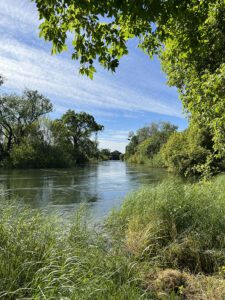
Elliot: DJ and his son, Nathaniel Howard, began an operation where they grew feed, raised stock that they would take to competitions and eventually transformed it into a dairy with Neil, Chris’s grandfather, my great-grandfather. Neil was really involved with terraforming a lot of the floodplain that we live and farm on. We’re next to the Mokelumne River, so the area is part of an ancient floodplain created from snowmelt from the Sierra Nevada mountains.
Christopher: One of the problems that held things up was flooding. It wasn’t until Comanche Dam was built on the Mokelumne River for flow control that we could diversify from row crops to perennials. After the cattle years, we had sugar beets, tomatoes, peas and asparagus. After that, we grew winegrapes and had a custom winegrape harvesting business. Finally, we decided to grow walnuts, and that’s pretty much what we’re doing right now.
Elliot: It’s been a lot of ups and downs over the years. I think Chris is painting a picture that showed a lot of change and a lot of transitioning generation to generation, and that remains true. And that was mostly due in part to all the challenges that each generation was faced with.
We talk about the flooding. I think that was one of the largest issues for our farm that really prevented us from growing crops like walnuts or winegrapes. But obviously with access to surface water like the Mokelumne, we do see immense value in that. But we are not naive to accept that it can also be a potential curse if you’re not careful with the water management.
Q. What is everyone’s personal journey into the family business?
Christopher: I went to college at the University of California, Davis. That was also the alma mater for my father. I graduated in 1973 then took a little time off to do a bicycle trip. I came back in 1976, and I’ve been working at the ranch ever since. We grew winegrapes and we had a mechanical harvesting business, and we’ve just been doing a number of things. With winegrapes, we weren’t getting the kind of quality we needed, so we stopped. We pulled out all the winegrapes and concentrated on walnuts, and walnuts thus far have been a really good crop for Locke Ranch.
Christy: I was not a farmer. My father was a grape grower in Napa. I’m from Napa Valley, and I also went to college. I have a doctorate in pharmacy, and I practiced hospital pharmacy for 30 years. I retired from that in 2014 and joined Chris farming, and now that’s what we do every day.
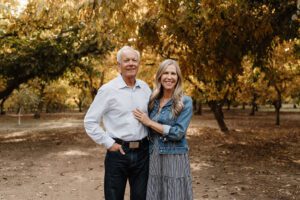
We’re 175 years in for the family, and this was Chris’s 49th year harvesting, so he has decided to take a step back. I have stepped forward a bit as far as helping to manage the business. We’re very grateful that this year Elliot has joined our family business.
Elliot: I also followed in the footsteps of my father and my grandfather and went to UC Davis. I studied mechanical engineering, and I absolutely fell in love with electric propulsion and electric systems, and I became extremely impassioned with developing electric vehicles. I ended up spending about three to four years working in the automotive industry, working as a hardware design engineer for Tesla.
Growing up, I had always worked on the farm, and it’s always been a special place in my heart. As the years went by, there was an opportunity for me to come back to be a big help, so I elected to make that change. Now I get the opportunity to help out and identify areas where we can make improvements and push the farm on to another hopefully 25 years to make the 200.
Christy: I’m actually the corporation president, and Elliot is the chief operating officer in charge of daily operations, all the mechanics, the crew, everything that happens on a daily basis. We have about 600 acres and a permanent crew that lives on our farm, so there are a lot of moving parts that require attention and management.
Q. How would you say farming practices have evolved over the time you’ve been farming?
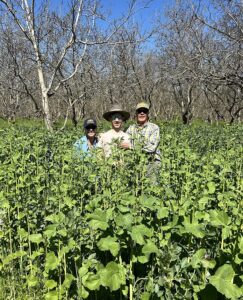
Christopher: They have changed dramatically since I started back in the day with my father. We have different irrigation systems we’ve been using and we’re moving away from the use of pesticides. We’re using other means for insect control and for taking care of our soil, making it good healthy soil with no-till and with cover crops.
We’ve been using cover crops since the early ’90s and we’ve gotten some great results in the soil. We’ve gone from sand, which was a result of all the flooding, to about 7% organic matter. You can grow anything with that kind of soil.
We’re using bats and owls for pest control and that’s also worked out really nicely. It’s all around you, you just need to open up and say, “OK, let’s make some changes and try something different.”
Q. When did you decide to make the switch to organic?
Elliot: Chris and Christy made their own initial pilot program for about 10% of our total operation, about 60 acres, about two years ago.
Coming in, looking at our operation, looking at the business aspect of where we stood, we are barely … keeping our heads above water, if you will. There have been challenges, obviously, in the industry, and from a first-principles perspective, we worked too hard to get very little to sometimes negative pay for the years of risk that we take on.
Looking at opportunities to get us into a better position, I think organic was one of the larger potentials that does carry additional risk but also has an upside. We’ve been carefully penciling the opportunity, and we feel we’re at a point where it makes sense.
We’ve already been doing 80% to 90% of what is necessary for organic operations. We just haven’t been able to capitalize on the current market value of that crop.
Q. What are the things that keep you up at night related to growing tree nuts?
Christopher: Weed control. Migrating away from herbicides has been eye-opening because all of a sudden you have 600 acres of weeds and it’s become an interesting management issue that Elliot’s developed a unique approach to.
Elliot: I would say water. I see that as one of the most valuable assets and commodities that will drive the future of agriculture in our state and in the Valley. I think we’re already seeing repercussions right now when you drive down I-5, and I think it’ll continue to be one of the leading issues for all farmers, including ourselves.
“We are so constricted by market conditions, by input costs, by government regulations and documentation requirements that we
have to change.”
– Elliot Locke, Locke Farms
Q. When did you start using bats and owls as natural pest control?
Christy: Chris joined a group called the BIOS in the late 1990s and it was a collection of innovative people steered by a UC advisor named Joe Grant. This collection of people farmed in ways that were unique to this area. They adopted practices that were not the standard of practice at the time, including things like cover cropping, using pheromone mating disruption for codling moth control, planting hedgerows and so forth.
Another piece of that also involved putting in bat houses. We probably have approximately 10 or so bat houses and we have 10 or 15 owl boxes as well. The bats eat insects and the owls eat rodents.
Q. Elliot, how does your background in electric vehicles transfer to what’s going on at the farm machinery wise?
Elliot: Farmers are industrious people and I think that rubbed off on me. Growing up seeing some of the foremen and Chris kind of ‘MacGyvering’ items, that left a lasting impression on me, and I think that pushed me to pursue engineering.
With automobiles and electric vehicles, [it’s really] just an advancement of technology in a specific sector of engineering or of consumer electronics, but farming, in my opinion, has been left in the dust.
I think we’re just starting to see change coming with a lot of startups and I think that’s what has me so excited, that there’s such a large opportunity to make basic improvements.
One example is a ground sprayer that we have. They’ve taken sensors and put them on an orchard sprayer that can now visualize the whole canopy using LiDAR, so it creates a dense pixel map that allows us to precisely spray material to reduce spray material costs and improve ground time. That results in a huge cost reduction for one of our most expensive inputs, which is spray materials. Things like that have me extremely bullish on other areas of our farm where we can apply that same logic and learn from other industries parallel to us.

Q. Christopher, does that sometimes blow your mind, though?
Christopher: Yeah. The stuff he’s coming up with is impressive. We’re out there with a rake and he’s thinking of an electric backhoe and sucker, and he’s doing all kinds of crazy things in the barn. It’s wonderful. With Elliot, I think we’re in month five, and he’s built or changed a lot of equipment.
Elliot: I think the focus is those low-hanging fruit. We’ve developed a custom breakaway system to mow the weeds in our tree rows for our organic blocks.
We’ve developed a dust reduction system for one of our harvesting rigs and a custom water spray condition based off the exact system, which eventually will help with harvest visibility and overall health. We also developed a mulching head for our waste matter off our huller/processor so we can kickstart a compost program.
Q. Talk about why all these changes are necessary.
Elliot: The thinking process is the sooner the better. The sooner we implement these improvements, the faster we’ll get the benefit of our labor. But that’s the world we live in.
We are so constricted by market conditions, by input costs, by government regulations and documentation requirements that we have to change. We are being forced to, and we really need to rethink some of the ways we do things and find opportunities to improve because there are some things we’re doing that, from a business perspective, are not sustainable. So we need to adapt.