


Listen to the audio version of this article. (Generated by A.I.)
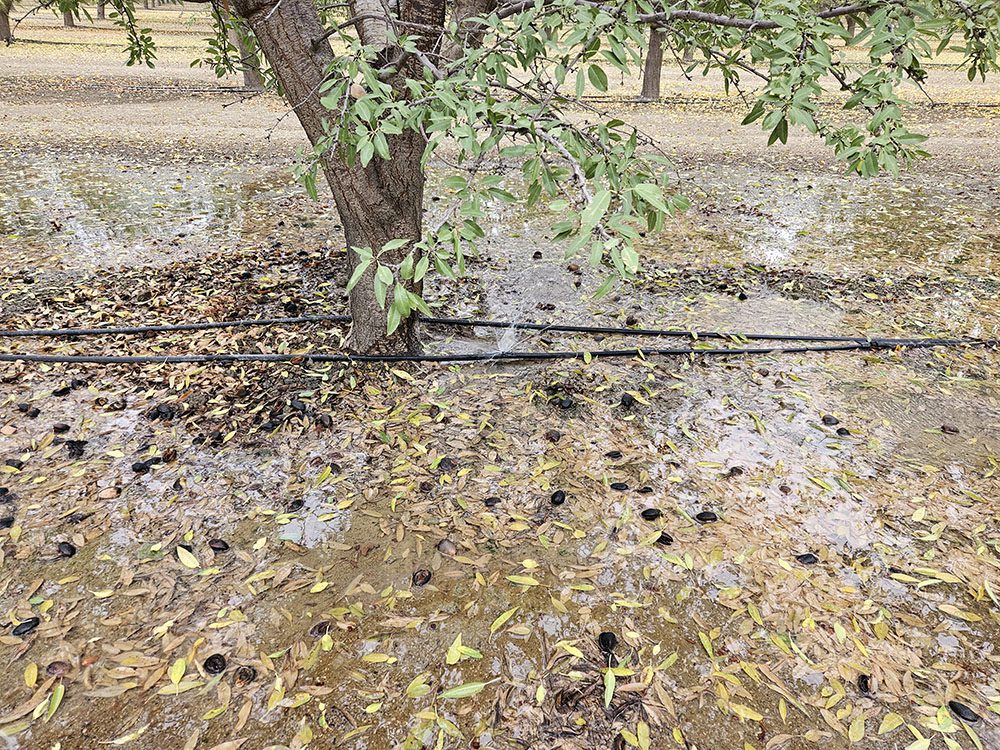
As if the ground squirrel invasion wasn’t bad enough. This past summer, roof rat numbers spiked in several San Joaquin Valley counties, causing damage to irrigation lines and trees and loss of yields to hungry roof rats.
The unprecedented invasion was caused by several factors, Roger Baldwin, UCCE human-wildlife conflict specialist, said.
“Lots of unmanaged orchards, an abundance of food and lack of control allowed populations to build,” Baldwin said. Growers who did try control were faced with restrictions on rodenticide use early in the season.
“They just reached critical mass this year,” Baldwin said.
Growers who faced losses in yields and damage have an opportunity for control during the dormant season.
Rats are active year-round, and rodenticides work best when there is less natural food for rats, Baldwin said. There is also less reproductive activity when food is scarce.
While rats tend to live up in tree canopies, particularly when foliage is present, the Almond Board of California (ABC) noted researchers have found that in tree nut orchards, rats will use burrows near trees.
Knowing where rats live and when they are active helps with planning control measures.
Baldwin said an integrated approach to rat control, with a strategy specifically targeting rat behavior in an orchard will have the most success in controlling populations. Neighbors implementing the same approach in their orchards will also help. He noted that part of a good IPM program is monitoring with the use of tracking tunnels and tracking cards to determine rodent species present in the orchard. Based on the information presented by tracking tools, Baldwin advised multiple overlapping strategies to reduce rat populations.
Targeted baiting programs using diphacinone-treated grain are attractive to rats as food sources decline in the winter. Baldwin noted that the rule for using this bait is that it be placed at least three feet from the ground with the bait station secured to a tree branch. Monitoring can give a grower an idea of the rat pressure in a grove and bait station numbers should reflect that. Baldwin said one station for every 165 feet should be sufficient. Bait stations need to be kept full of fresh bait for at least four weeks (longer when rat densities are high). Rats can become bait shy. Baldwin advised rotating non-treated bait to avoid resistance. Consumption of bait will drop when other food sources are available.
Tightening of Rodenticide Regulations
ABC notes that CDFA is working to update pesticide labels for rodent control materials and on approvals for use of zinc phosphide and diphacinone. Western Tree Nut Association and other agriculture groups have voiced opposition to the Department of Pesticide Regulation’s Sustainable Rodent Management Plan due to the proposed limitations on rodenticide use including the proposed time limitation of 35 consecutive days for application and 105 total days in a calendar year for application of a rodenticide.
Other control methods include snap traps in trapping tunnels. Post-baiting, these traps can help with long-term control, but they require maintenance to be effective. Another suggestion from ABC is broadcasting zinc phosphide bait or applying it in burrows. There are fumigation options that work best when soil is moist. Burrow fumigation with aluminum phosphide, gas cartridges or CO and CO2 injection devices are all control options. UC ANR notes that in addition to normal requirements for restricted-use pesticides, a Vertebrate Pest Fumigation Certificate is required. The diphacinone-treated bait must be purchased from the county agricultural commissioner’s office.
Biocontrol with barn owls is a rat control option. Barn owls hunt at night when rats are most active. During the winter, rats have less cover to hide from owls. However, Baldwin said barn owls are best used to keep low rodent populations from growing. Owls are unlikely to provide complete control or be effective with large populations.
Installation of nesting boxes to attract barn owls to an orchard is not a proven method for sustained rodent control by itself but part of an integrated system.
Biocontrol could also be in the form of rat terriers. Oregon-based Jordan Reed has a “mongrol hoard” of dogs that have been used to hunt down and kill rats in warehouses and feed mills. Reed said the dogs have also worked in orchard settings, locating and killing rats in organic systems. Reed said the dogs are adept at locating rat nesting sites, scattering the rodents and swiftly killing them.
This tactic does not work well with ground squirrels, he said, as they tend to burrow deeper into the ground.
Other orchard practices are eliminating shelter and nesting sites of rats. Large woodpiles and debris piles provide rat shelter.
Vigilance Necessary
After knocking rat populations down, Baldwin said, growers must be vigilant about rebounds due to their high reproduction rate. Rats can also move in from neighboring properties where no control measures are used.
Industry groups are working to provide support for growers facing serious rodent pressure. California Association of Pest Control Advisors and ABC are pooling funds to purchase and distribute abatement stations or owl boxes. Tulare FFA chapter is building owl boxes for purchase.
Identification of Species
There may also be more than one vertebrate species that is causing damage in your orchard. It is important to identify which are present as control methods may be different. The most effective management strategies will depend on species, population levels, primary damage and logistical constraints.
For example, barn owls may provide control of rats, gophers, voles and mice but ground squirrels are diurnal and won’t be controlled by the night-hunting owls. Burrow fumigation to control squirrels is best timed for emergence from winter hibernation. These pests feed on green vegetation but later in the summer turn to seeds.
UC IPM reports late winter to early spring is the best time to fumigate for gophers before they have a chance to reproduce. Gophers feed on roots and may also girdle trees below the ground.
According to Becky Wheeler Dykes, UCCE orchard systems and weed ecology advisor in Tehama and Colusa counties, trapping provides excellent gopher control and can also be a good strategy for squirrels. Burrow destruction, weed management and tree protectors can make your orchard inhospitable to rodents.

Cecilia Parsons | Associate Editor
Cecilia Parsons has lived in the Central Valley community of Ducor since 1976, covering agriculture for numerous agricultural publications over the years. She has found and nurtured many wonderful and helpful contacts in the ag community, including the UCCE advisors, allowing for news coverage that focuses on the basics of food production.
She is always on the search for new ag topics that can help growers and processors in the San Joaquin Valley improve their bottom line.
In her free time, Cecilia rides her horse, Holly in ranch versatility shows and raises registered Shetland sheep which she exhibits at county and state fairs during the summer.