

Listen to the audio version of this article. (Generated by A.I.)
Tools, technologies and strategies to improve irrigation efficiency and water sustainability were priorities at the American Pistachio Growers’ (APG) water education meeting held in Kern County.
“We’re working to bridge gaps in irrigation knowledge and application for improved water management in the future,” Joe Coelho, APG’s director of sustainability and member outreach, said. “First comes education so growers can do more with less water.”
New technologies for water management are available to growers and managers, Coelho added, but adoption can be slowed by lack of information. Increasing restrictions on groundwater pumping make “doing more with less” vital to sustaining production.
Striking a Balance
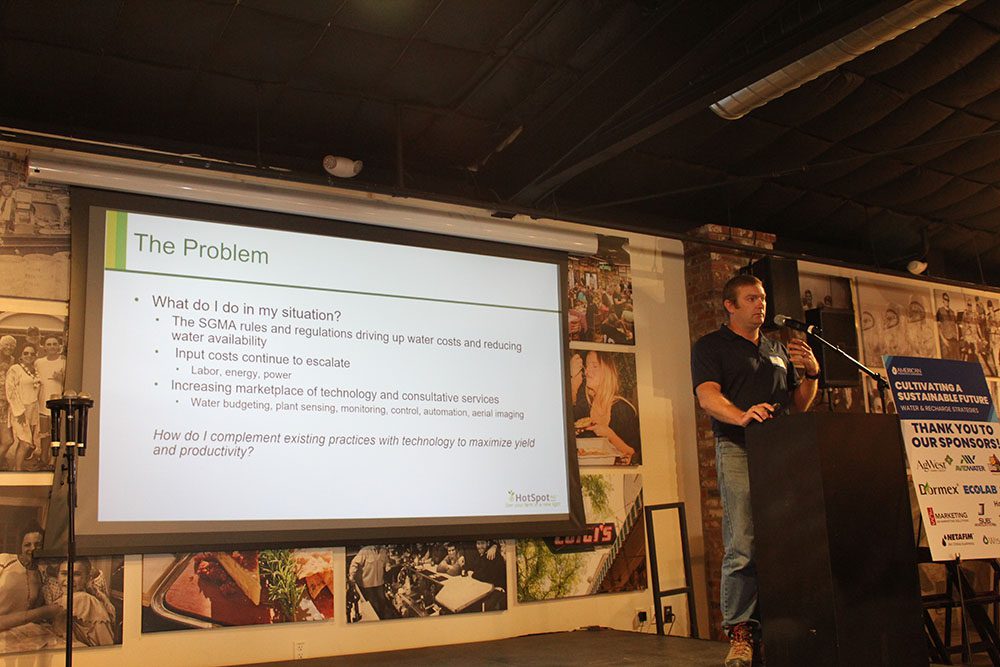
Advanced analytics is one of the new tools available to improve water use efficiency as Sustainable Groundwater Management Act (SGMA) rules and regulations drive up water costs and reduce availability. Jimmy Nichols of HotSpot Ag and Nichols Farms in Hanford said this tool strikes a balance between old and new irrigation approaches in the age of SGMA. It also complements existing irrigation scheduling practices.
Automation allows for more precise and timed water applications and saves labor costs.
Nichols said pistachio growers need to understand SGMA regulations and how to comply and put that in their water budget when developing an irrigation strategy. In-season execution of the plan includes verification of current field status, developing a plan and evaluating system performance.
Part of the strategy can include deficit irrigation during shell hardening. Research has shown irrigating at 50% of ETc during that growth period and irrigating at 100% of ETc during nut fill is effective for saving water without impacting yields. Nichols said that their farm incorporates a hybrid approach to reduce irrigation amounts, irrigating to 60% of ETc during shell hardening and 85% of ETc during nut fill.
Verification of system performance can be done with aerial imagery or the old way, with a shovel or soil auger.
Agronomist Cory Broad with AvidWater said correct volume and timing of irrigation water is what creates growth and crop yield opportunities. Trees are taking up nutrients via irrigation water, he said, making efficient delivery critical. Soils must also be efficient in water use, taking in water and holding it where it is available to trees.
Broad also pointed out that many inefficiencies can be found when irrigation systems lack routine maintenance.
“Postharvest is the best time to look for damage. Despite best efforts, many systems will have some damage after harvest,” Broad said.
Damage can include cuts, nicks and missing segments on emitter lines, damaged leads and barbed connections, micro sprinklers, damaged fittings on riser connections and damaged ball valves and air vents for flush-outs.
System Diagnostics
Broad said that performing a distribution uniformity (DU) test after harvest is a great practice for many reasons. Many irrigation systems will continue to operate for permanent crops, so no additional pumping hours are required. With the test, corrective action can be identified, implemented and checked again prior to next growing season. Larger issues can also be identified, and management plans can be created.
Broad noted that irrigation systems may have a good DU at installation, but degradation will occur over time. Dropping from 0.9 to 0.8 results in 13% more runtime when using DU as part of an irrigation scheduling practice. DU can impact fertilizer application efficiency.
The challenge of SGMA is driving closer attention to irrigation systems’ performance. Broad said reduced water allocations and groundwater pumping restrictions make it critical to make sure irrigation systems are in optimal working conditions. Checking pressure at the filter station and field can reveal leaks, plugging or closed valves at the filter station. In the field, low PSI can indicate filter plugging, low flow or a pump issue. High PSI can indicate valves closed or field plugging.
Filter stations need attention. Media can lose its “edge,” Broad said, and should be changed if necessary. Field plugging can be caused by inorganic or organic materials.
Panel Discussion
A panel that included Nichols, Broad and farm managers Kevin Brooks and Jason Gianelli discussed irrigation management strategies they use for efficient water use. Site-specific evapotranspiration readings, Brooks said, are his preference. Remote monitoring is useful, but he said it is important to “fact check” with stem water potential readings to save water.
Nichols said irrigation strategies have evolved and there is a need to get a better sense of the amount of water applied. Development of crop coefficients in pistachios has shown benefits in water savings.
There is a wide range of irrigation management tools used by growers, Broad said. Pistachio growers are more advanced in their irrigation strategies, likely due to trees planted in more water-challenged areas. Gianelli said it is important to understand that data can vary depending on the soil. Verification should always be made with the “low tech tools,” such as a shovel or soil probe. Attention should also be on water infiltration rates in orchards. Improving infiltration, he added, also helps with managing diseases and pests.
The Path Forward with SGMA
Speaker Paul Gosselin, deputy director of Sustainable Groundwater Management at the Department of Water Resources, advised growers to become involved in their local groundwater sustainability agencies.
“You have the knowledge and perspective important to navigate your subbasin.”
Basin groundwater sustainability plans (GSPs) will need to take steps to avoid subsidence, and recharge may be a management practice. Gosselin noted outreach programs that are available to navigate SGMA.
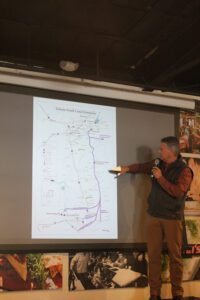
Speaker Geoff Vanden Heuvel with San Joaquin Valley Water Blueprint outlined goals of this coalition made up of community leaders, businesses, water agencies and local governments.
“We are developing a plan to address environmental, community and agricultural water needs in the valley to keep the economy strong by facilitating sustainable groundwater basins and minimizing adverse impacts of SGMA,” Vanden Heuvel said.
The California Water Institute at Fresno State and the Water Blueprint are working to address water supply and management challenges in the region. Vanden Heuvel said they have been developing and integrating subregional water management initiatives into a comprehensive water plan. This effort involves data mining from GSPs to create summaries for each subbasin.
The Unified Valley Water Plan projects that 900,000 acre-feet per year of additional surface supplies from the Sierra watershed could be achieved. Vanden Heuvel noted that regulatory flexibility and infrastructure are necessary to store the water. The plan is to pursue groundwater storage opportunities with urban partners with surface water rights they cannot fully utilize in wet years.
The best-case outcome for the valley, Vanden Heuvel said, based on Blueprint Economic Impact Analysis, is that all necessary local water projects and repair of essential infrastructure be funded, Delta regulations be modernized and new Delta facilities to protect fish and new interregional conveyance be built. The valley needs state and federal funding to advance local projects already identified in GSPs. In the absence of elected officials assisting with those projects, land fallowing will result.
There are low-impact solutions for water abundance in the valley, nurseryman and former Congressman John Duarte said. One simple solution he offered would be to dredge the Delta. As part of a panel discussion, Duarte also noted how delays in water recharge permits affect the impact of this practice.

Cecilia Parsons | Associate Editor
Cecilia Parsons has lived in the Central Valley community of Ducor since 1976, covering agriculture for numerous agricultural publications over the years. She has found and nurtured many wonderful and helpful contacts in the ag community, including the UCCE advisors, allowing for news coverage that focuses on the basics of food production.
She is always on the search for new ag topics that can help growers and processors in the San Joaquin Valley improve their bottom line.
In her free time, Cecilia rides her horse, Holly in ranch versatility shows and raises registered Shetland sheep which she exhibits at county and state fairs during the summer.