


Listen to the audio version of this article. (Generated by A.I.)
It’s January, you have a barn full of tractors, sprayers, trucks, tillers, mowers and ATVs with flat tires. Looking at them, you have an itchy sensation that spring may be closer than you figured.
It’s time to get up and assess the basic equipment that keeps your tractors rolling through the orchards: your tires.
‘The wrong tire for your operation could cost you money in extra fuel, wear and tear on your machinery and reduced production as you stop to dig yourself out or repair your tires or drivetrain.’
General Maintenance
Step 1
Inflation, says Mark Oslie of Ag West Supply. Get out your tire gauge and inflate all your tires to the suggested level. Oslie has sold and serviced agricultural tires in Oregon for more than 30 years.
Just like your ego, your tires need input to stay healthy. Keep your tires aired up, even when in storage, and they’ll last longer. Why?
“You don’t do it, and it will cost you money,” Oslie said. He suggested putting a sticker on the steering wheel listing the date of the vehicle’s last inflation.
Inflation problems keep Ag West and other agricultural tire suppliers in business, but they also cost orchard owners extra money for fuel and can create safety problems, according to the U.S. Department of Transportation and the U.S. Department of Energy. When tires are underinflated, resistance to the ground increases, making your engine work harder and burn more fuel, costing you an additional 3% in fuel or more. But that’s not all; underinflation can impact vehicle safety and tire longevity, resulting in poor handling or blowouts. By the same token, overinflation can cause tires to wear unevenly.
Step 2
Rotate your tires regularly. That little sticker on the steering wheel? Include rotations on the schedule to make sure your tires are wearing evenly.
Step 3
While you’re inflating and rotating those tires, inspect them for cracks, wear and other damage. Remove dirt and chemicals that can deteriorate tires over time. You are storing your tires out of the weather, especially the sun, right? UV rays can be tire killers.
New Tire Time
You’ve maintained your tires (or not), but they don’t last forever. Your vehicles most likely will outlast the tires that came with them. Or perhaps you’ve moved your equipment into a new setting, flat to hilly or dry to muddy, or both. For your own list of reasons, you decide to go shopping for tires. Where to start?
Before you trot down to your ag tire distributor, jot down some information that will make you look organized.
• Tire size: The manufacturer makes initial research easy by printing the tire’s size and type right on the sidewall. Your tire’s wheel diameter and wheel size are usually listed like this: 18.4-30, in inches, or 460/85R30, metric. The first numbers are the tire’s width in inches or millimeters, and the second numbers are the rim’s diameter. Write it all down. You must match your rim diameter to the wheel, but the actual tire size is variable. Read on.
• Next, get out your crystal ball and try to predict the conditions of the land you’ll be running those tires on. Muddy, soft, grassy, flat, hilly, dry, hard, marshy? All of the above? Note it. These can impact the tire size and type you might consider.
• Weighty matters: Each tire type has a capacity for carrying weight. Jot down the heaviest load you can imagine lying on that tire.
List in hand, it’s time to take up some of your ag tire dealer’s precious time. When you get there, you might want to ask them a few pointed questions. Here are a few I asked Oslie, as well as Chris Neidert, agricultural tire expert at Yokohama/Trelleborg, a tire manufacturing company.
Bias or radial?
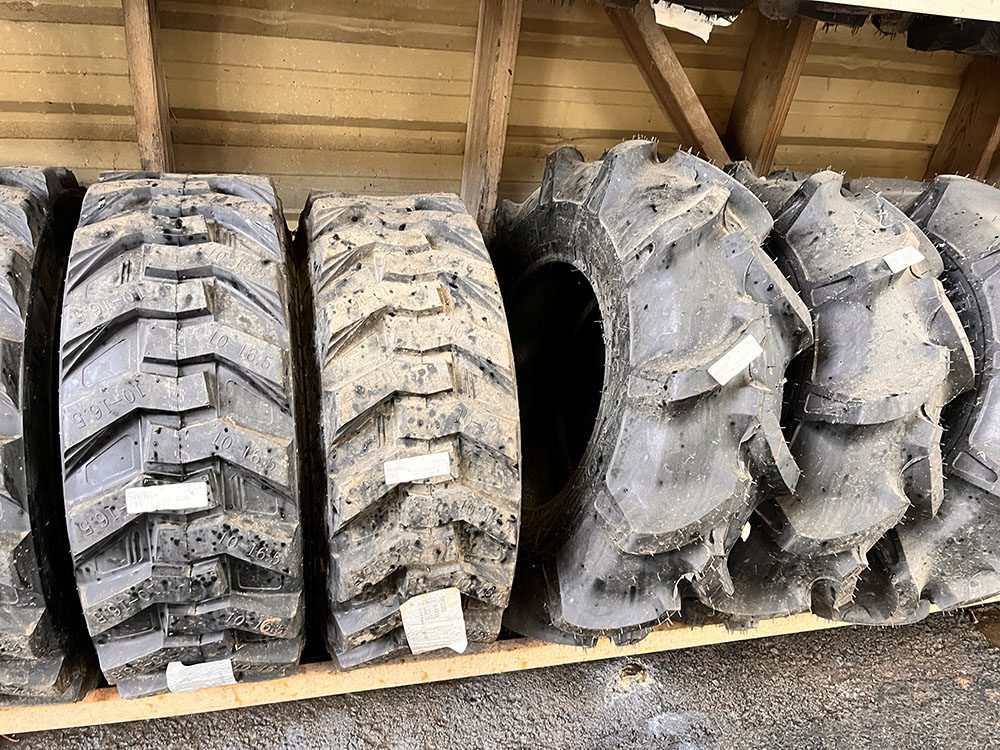
Bias tires use layers of fabric (plies) in a design that increases durability but are less flexible than radials. Radial tires also use plies in a different design that includes built-in steel belts, which Oslie suggests provide a smoother ride, traction and, as a result, better fuel efficiency. Most of the orchard tires he sells are radial.
What kind of radials work best for my orchard?
The wrong tire for your operation could cost you money in extra fuel, wear and tear on your machinery and reduced production as you stop to dig yourself out or repair your tires or drivetrain. If you see an “R” in the tire’s size marking on the sidewall, it is a radial. R1W radials, for example, have deep treads designed for traction in bare soil or mud. If your land is especially wet or soft, flotation tires may be your choice to reduce soil disturbance. But if your orchard rows are planted to grass or other cover crops on flat terrain, turf-type tires (R3) may provide wider but shallower treads that won’t damage cover crops. Industrial tires (R4) may be your choice for mixed surfaces or when you are preparing a new orchard or expanding one. Again, this is a question your agricultural tire dealer can answer for you and your specific situation. Don’t be shy!
What are some of the new innovations in orchard tires?
For example, in the past decade, high-flexion radial tires have proved they can carry more weight without increasing tire pressure, prolonging the life of the tire. Many agricultural companies, Michelin, for example, began selling flexion tires that offer up to 40% more flexibility and a larger footprint, according to company claims. The same goes for Trelleborg, the agricultural and industrial tire company recently acquired by Yokohama Rubber Co. Trelleborg now sells tires that can roll on low inflation, spreading weight across a larger track, reducing soil compaction without damaging sidewalls. Some tires are imprinted with QR codes that make maintenance tips available with a click of your phone camera. Trelleborg’s Chris Neidert points to innovations such as the Central Tire Inflation Systems that allow the operator to change the air pressure of the tires on the go, to adjust to varying conditions in the orchard. Tires are now available for the Western orchards’ smaller tractors, all with the same ability to reduce soil compaction.
Decision Time
You’ve made your list, chatted up your ag tire dealer and pawned your Lay-Z-Boy to pay for new tires. Now, it’s time to drag your feet before you buy by scrolling on the web. One useful hint: If you go to a tire website and find they don’t have an agricultural tire section, move on. You want a company that cares about your work. Here are a few sites I liked both for information and amusement:
• www.trelleborg-tires.com/en-us
• www.bauerbuilt.com/bauer-built-blog/understanding-the-3-types-of-tractor-tires
• www.treadwright.com/blogs/treadwright-blog/the-history-of-tires
• www.imiproducts.com/blog/guide-to-agriculture-tire-maintenance
• www.ceatspecialty.com/blog/technology/the-future-of-agriculture-tires-trends-and-innovations
• www.business.michelinman.com/ag-tires
Funny but True
Tired yet? Pun intended.
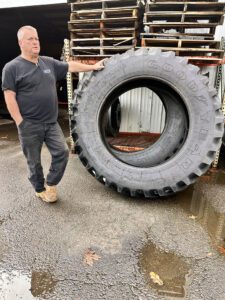
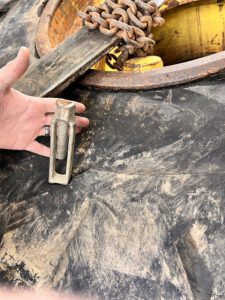
Sometimes, a freak puncture will break up the already-exciting world of tire sales. Take, for example, the cable guide, a foot-long, heavy-duty peg with an eye to guide cable probably used for logging, that wound up stuck in the loader tire. It was a gigantic 8-foot-wide tire you’d think could never be punctured, but there it was, with a cable guide eye sticking out of its sidewall, winking evilly, the rest lodged deep in its carcass. “How did that get in there?” I asked Oslie. He has no idea. The logger who brought it in doesn’t say. But Oslie chains up the tire that takes up the whole back of a truck, hooks it to a forklift, and the tire is deftly transported to Ag West’s covered bay. Today, it’s repaired, and we assume rolling back through the trees.
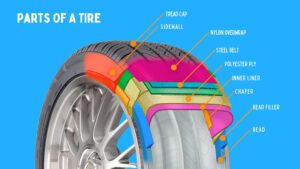
Talk About Tire Parts
Shivansh Sabhadiya, a mechanical engineer, describes the parts of most tires in his blog, “The Engineering Choice,” at www.theengineeringchoice.com.
The main parts of most tires are as follows:
• Tire Casing or Carcass: Everything inside the tire, including the plies and belts. Plies, typically cords of polyester, nylon, rayon or other materials coated with rubber, are layered and sealed in place. The steel-belted plies are generally close to the treads and make up the body of the tire.
• Bead: A coated steel cable that keeps the tire attached
to the rim.
• Steel Belts: Improve mileage, impact resistance
and traction.
• Plies: Layered in various patterns depending on the
tire’s style and tread, providing strength and resistance
to road damage.
• Inner Liner: Since most modern tires no longer have inner tubes, this component, along with beads and bead fillers, holds air inside the tire walls.
• Tread: The part that contacts the surface.
May include sipes (small cuts that improve traction)
and grooves to shed water.
• Shoulder and Sidewall: The shoulder wraps into the sidewall, which contains size and style information and is designed to resist damage.