Listen to the audio version of this article. (Generated by A.I.)
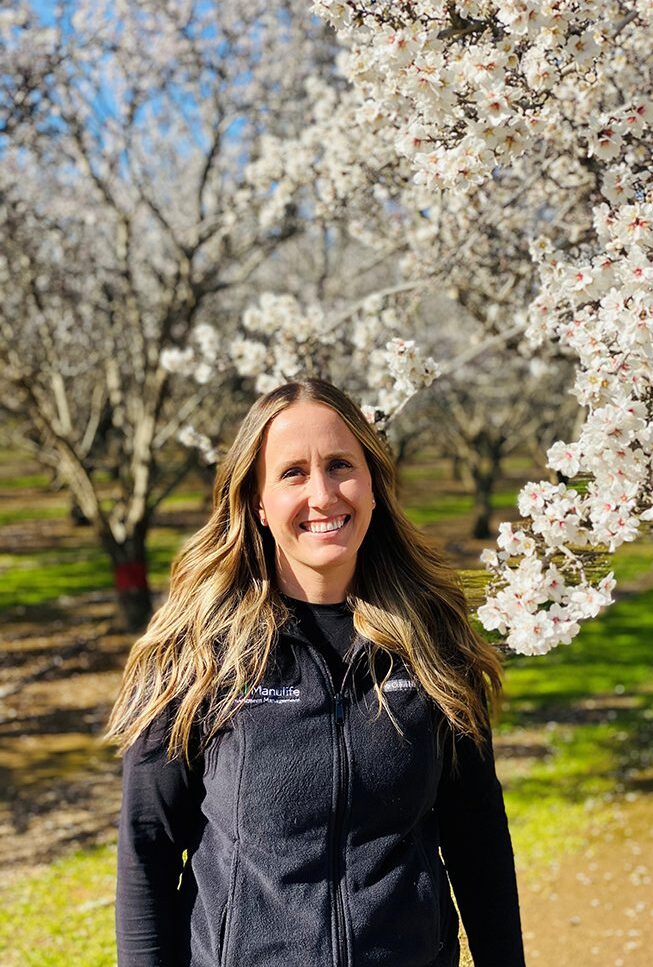
Megan Stetser, vice president of crop marketing for Manulife Investment Management Farmland Management Services, oversees 42,000 acres of nut-growing farmland, but she never set out to be in agriculture.
“I didn’t grow up in agriculture at all,” Stetser says. It was only after not getting into the business school at Cal Poly, San Luis Obispo, that her dad suggested she try ag business instead.
“I got in, and I absolutely loved it. Cal Poly’s motto is ‘Learn by Doing,’ so everything was super hands-on,” she says. “We got to be out in the field, milking cows, picking carrots. It was a really cool experience.”
In her current position, Stetser offers a broad perspective on the nut industry as Farmland Management Services grows almonds, pistachios and walnuts. Despite the company’s scale, Stetser holds many of the same concerns around water, labor and sustainability as many smaller farmers.
We asked her to share with our readers her thoughts on the current state of the nut industry:
Tell me a little bit about your background.
After I graduated, I knew I wanted to do something in agriculture with my degree, but I graduated in 2010, and that was during the recession, so there weren’t a lot of jobs.
I worked for AmeriCorps, which is the land-based Peace Corps, and then I moved around. Then in 2018, I found a job with Farmland randomly online. It was a ranch manager position. I applied for it, and the HR person thought I was fantastic, but she was like, “I don’t think you want to be a ranch manager. Let’s find something that works for you.”
‘We go above and beyond with testing to make sure that everything we’re putting out in the environment is good.’
So, I started out as an operations support manager. That function is essentially the operations support team that does all of the support for the farms, paperwork, chemical reporting, production, invoice processing. That’s where I started, and now I manage that whole team.
And then this year in March, I got promoted to be the vice president of crop marketing. Crop marketing is kind of a funny word. It’s more like being in charge of production. I don’t do marketing of the crop, but I’m in charge of contracting all of the crops in California. We grow walnuts, pistachios, almonds and citrus, and that’s just in California.
How does the perspective of a large corporate growing operation differ from that of a family farmer?
Manulife is an investment company based out of Canada, so all of our clients are typically pension funds. For example, Dallas Police and Fire take a portion of their retirement funds and invest it into farmland that we manage.
People often think of us as a corporate farmer, but I don’t. I definitely think of us as a large family farm because we’re very passionate about the clients that we’re servicing. We care about people’s retirement, we want people to make money, we care about the environment, and we care about the communities we live in.
I think what makes us different is that we’re a big farming company, but we’re still very localized and really centered on the people we service. We always have our clients top of mind.
With that many acres, how does new technology like automated tractors impact your operation?
I would say because we’re a large farmer, we definitely get bombarded by companies that want to share technology. And in the past, I think we’ve been at the forefront of really helping companies design that technology.
We partner with John Deere, we’ve partnered with Fieldin, we’ve partnered with Ceres Imaging. We’re always looking for ways we can contribute to agriculture, how we can use our scale and acres to test out automation. We’re doing some trials right now.
I think it’s hard because we get bombarded. Everybody wants to do a trial with us, which is great, but you have to pick and choose where you want to focus. I would say labor and water are huge issues for us, so we’ve really focused on equipment automation and irrigation automation, those kinds of projects that can really make an impact.
Talk about the labor and water situation.
We utilize farm labor contractors. I believe we have three in the state of California that we utilize. So that’s kind of hard for us, having a contract company that can agree to our safety policies and procedures because that’s one of our top priorities and then has the scale that we need. We need people from Bakersfield to Anderson.
I think one of our biggest challenges is finding a contractor that can meet our needs and, of course, finding people. We need qualified people, and it’s hard to train people.
And like I said with safety, we want to make sure everybody’s trained, they know how to use the equipment, how to clean the equipment. At the end of the day, we want to make sure everybody’s going home.
What are the biggest changes that you’ve seen in the industry?
I would say water has been the biggest thing. When I first started in 2018, SGMA (Sustainable Groundwater Management Act) was just kind of coming on board, and I was going to every water meeting I possibly could.
Being in Northern California, SGMA really hasn’t hit up here like it has in the southern San Joaquin. So, I think just water, how we get through SGMA and how it’s impacting farming in general, that’s the biggest change I’ve seen.
How are you responding to SGMA?
I would say we’ve actually been at the forefront of this. Obviously, we’ve tried to be at every water meeting, every GSA meeting that we can. We have a water team that’s dedicated to understanding how SGMA is going to impact our properties and then doing some forward planning.
You talked about how you’re interested in sustainability and protecting the environment. What practices are you focusing on?
Manulife has a sustainability team. We’re tracking our fuel usage, how we can be more efficient, how we can buy clean tractors, just understanding how our business practices are impacting the environment and what we can do to change that. So, we track everything.
We actually just had an audit with the CDFA, and the lady was very impressed by how much data we’ve collected. We test all of our wells, we sample all the water, and we go above and beyond with testing to make sure that everything we’re putting out in the environment is good.
When you look at the nut industry, what makes you hopeful?
I think the tough times make you stronger. The past three years have been very difficult for everybody. We haven’t made any money either, so our clients haven’t made any money.
It’s really about making sure the client understands the long-term vision. This is a 20- or 30-year property. You’re going to have ups and downs. We spend a lot of time explaining that.
But I would say we’re pretty involved in the industry. We try to participate with APG. I’m on Almond Leadership, I completed that program and now I’m a mentor. It’s really about staying involved and trying to understand what’s happening, so we can share that with our clients and also stay focused on the future of the industry. We want to be a part of it.
What needs to happen for prices to go back up?
It’s more industry-specific. Pistachios are very interesting. It’s dominated by a few large processors that set the price. I appreciate how they share information with me when I have questions. I would also say that the Almond Board does a wonderful job working with growers and handlers, keeping them informed of issues impacting the industry.
Prices are coming up, so I think it’s pretty positive going forward. I think we’re doing the right things. It’s just how is everybody going to survive if prices don’t stay up?
Is there any hope for walnut farmers?
Walnuts are tough. They have pretty steady prices right now. I honestly don’t know how the family farms for walnuts have survived. I really don’t. You have to think outside the box now, especially for walnuts.
What are the biggest assets of the California nut industry?
I think you can really only grow walnuts, almonds and pistachios here the way we do. This is a prime growing region, and we produce a really quality and consistent product. I don’t think you can get that all over the world.
And California, I love this state, unfortunately, we’re very good at regulations. However, I think to a certain degree, it actually helps our product because we can deliver such a clean product year in and year out. We have the data to back it up, and I think that helps us at the end of the day.
Talk a little bit about being a woman in the nut industry. What has that journey been like, and what advice would you give other women?
We have a leadership team, and I’m one of two women on a team of 10, so it’s knowing you have to have a voice and not being afraid to speak up. I will say, though, 90% of the men I’ve worked with in this industry only want to help me succeed. Very rarely have I felt somebody look down on me because I was a woman.
And I think that says a lot about how the industry has matured. They want more women to be involved. We’re actively seeking women to fill roles, it’s just hard to find.
We work closely with the Women in Agribusiness Summit. We sponsor students to get involved and show them there are other jobs in the industry than just being out in the field.
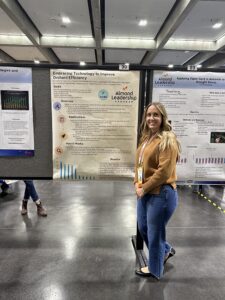
I also think it is important to get involved in the industry. I am an alumna of the Almond Leadership Program and continue to serve as a mentor today. Staying involved and understanding what is impacting your industry is critical.
What would you say to family farmers who have a bad impression about corporate-owned farms?
I would say, get to know us. Yes, we’re an institutional investor, but like I said before, we have actual clients that we care about, and we want them to succeed.
Just like every farmer, they want to pass it down to their next generation. We want this farm to sustain and continue to bring money into this portfolio, so I think we all have the same vision.
And all the employees are local to the community. They might work for an institutional investor, but they’re still your neighbor.
What kinds of innovations do you see making a difference in the future?
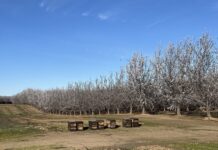
More rootstocks that require less water. Any variety that requires less water, and fewer bees, I think that’s going to be huge. We had a huge issue with bees this year. Water is always an issue. We luckily haven’t had a drought for a couple of years.
I think anything that can reduce those resources is key for the industry. Technology is going to be huge, but I just don’t think automation is there yet. There’s still a lot of improvement needed.
So, automation needs to advance and be really user-friendly. A lot of our employees are Spanish speakers, and they work off an iPad or their phone, so it needs to be easy to use. I just don’t think we’re there yet. I haven’t seen any technology succeed to its fullest yet.
Do you see a role for AI?
Yes! We have so much data, we don’t even know what to do with it. Using AI to interpret the data, analyze it and make recommendations, that’s definitely in the near future.
Even Manulife was asking, “How can we utilize AI more?” They were asking our opinion because I don’t think we even use it enough.
What are three things that keep you up at night about the nut industry?
Prices. Right now, yields, it was a very interesting year for yields, especially on Sonoras, and price.
I think there’s economic uncertainty. The political environment in California is very interesting. It changes often. I never know if the governor likes agriculture sometimes, so I think politics in general make it uneasy.
Can you touch on tariffs a little bit and how they play into decision-making these days?
When that first started happening, every-day people were asking, “What do the tariffs mean?” And I think what’s cool about my position is we have really good industry relationships.
We can call people at Wonderful, we can call people at the Almond Board, and really understand how the tariffs impact us and what workarounds the industry is working on.