


Listen to the audio version of this article. (Generated by A.I.)
By Cecilia Parsons, Associate Editor
Maximizing a single shake in walnut harvest is one reason to use the growth regulator Ethephon.
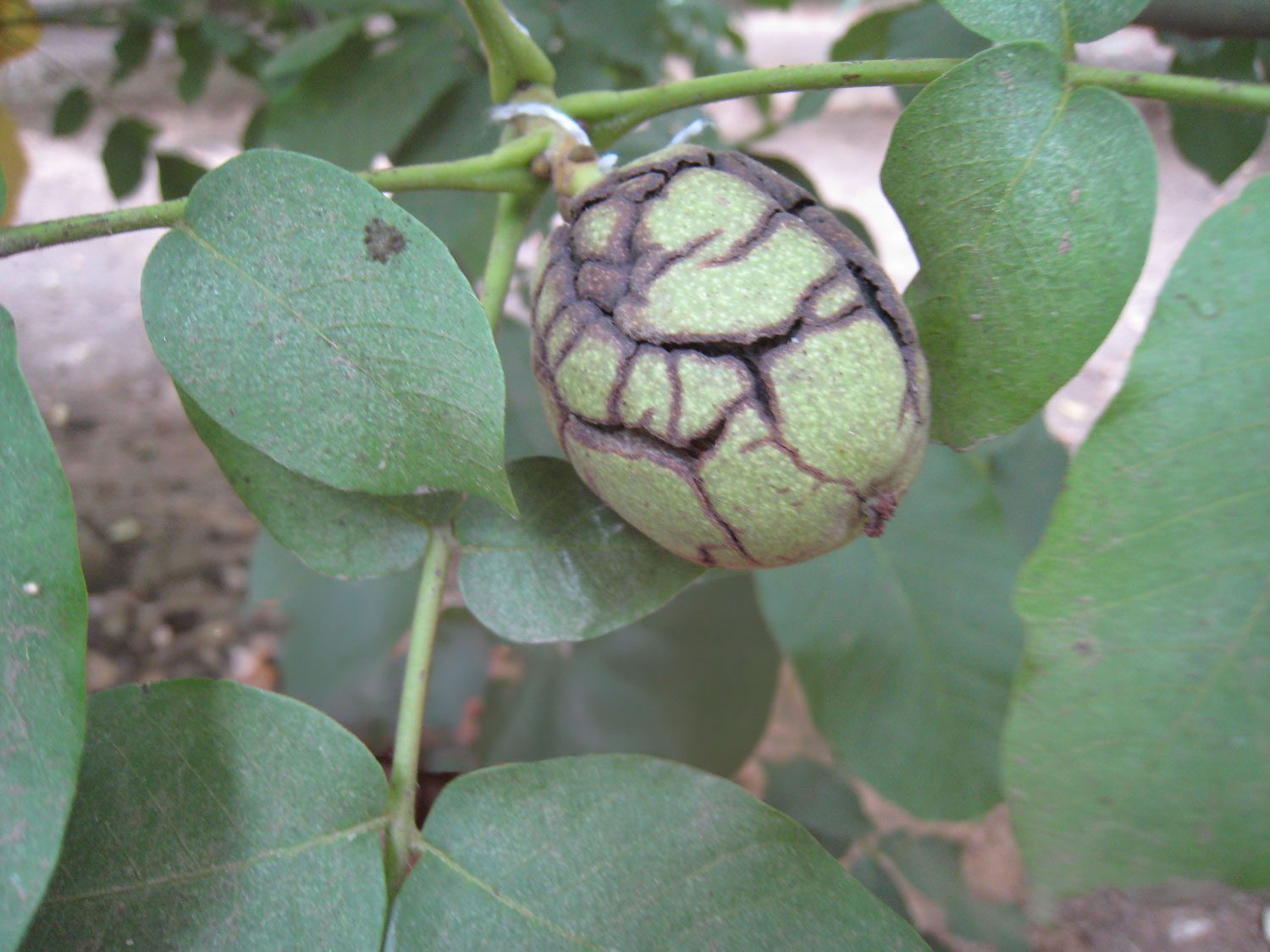
UCCE farm advisor Clarissa Reyes, speaking at the annual Tri-County Walnut Day, explained that Ethephon speeds up hull maturity so nuts can be removed more easily at a time when kernel quality is high. Walnut hull maturity is signaled when cracking appears and the hull begins to separate from the shell.
Ethephon is applied when kernels have reached maturity. This is determined by sampling nuts to check for packing tissue brown. Applications are made at 100% packing tissue brown.
Reyes noted that Ethephon is labeled for use at between 3 and 5 pints per acre. It is important that the nuts are hit during the spray application because the material is not translocated through the leaves. Ethephon is most effective when applied at temperatures between 60 and 90 degrees Fahrenheit and with higher humidity conditions. At higher and drier conditions, evaporation reduces efficacy. Ethephon should not be sprayed on stressed trees as it will cause defoliation that may impact crop yields the following year.
Reyes also cautioned that delayed harvest after Ethephon application can result in reduced kernel quality.
“It is good if a grower has their own harvest equipment as it can be hard to coordinate harvest with a commercial harvester,” Reyes said.
Sampling for Packing Tissue Brown
Checking packing tissue brown (PTB) is an important part of the process. Reyes said prior UCCE experiments suggest PTB begins at the top of the canopy and travels downward.
To check for PTB, she advised to first collect a total of 10 nuts from the bottom, middle and top of the canopy. After splitting them in half and removing the kernel from one half, rate the empty shell for percentage covered by brown. In trials conducted last year in Solano and Chandler orchards, she said in the early phases of PTB, there is more separation between canopy layers. At later phases of PTB, the layers are similar to one another.
To sample an orchard to determine timing for an Ethephon application, Reyes advised walking diagonally or in a zigzag pattern across the orchard about 35 days prior to your typical harvest date and picking a minimum of 100 nuts. After cutting them in half, group them into a yes — or 100% PTB — or no — less than 100% PTB — then determine percentage from yes nuts. PTB is reached when all packing tissue is brown and the kernel is pulling away from the tissue.
Early findings from 2023 field trials
Reyes noted that prior UCCE experiments with Ethephon applications and rates were performed on older walnut varieties. Last fall, the pilot experiment was done in Solano and Chandler varieties in Yuba County to see responses to Ethephon application and how much it advanced harvest. Trees were 13 to 14 years old on Conejo loam soil. Three rates were used: zero for control, 300 ppm and 900 ppm, the maximum rate on the label. Ten groups of three nuts were bagged per tree on 10 trees. Following the Ethephon treatments, the hull split progression was checked about every other day. The progression was: 0 — smooth hull; 1 — 1 to 2 thin lines before cracking; 2 — beginning of cracking; 3 — pronounced cracking; 4 — hulls started to separate; and 5 — hulls split, nut hanging by threads.
Reyes noted that these initial experiments in the newer walnut varieties show the earliest times of harvest at certain concentrations in one year only.
In the Solano variety, 80% of walnuts reached hull split stage 4 after 13 days with the 900 ppm rate. With the 300 ppm rate, stage 4 was reached in 19 days. Predicted harvest date with the control groups was 24 days.
Chandler trees were more initially stressed than Solano. Phytotoxicity in the control group was 1%, 2.5% at the 300 ppm rate and 10% at 900 ppm.
In Chandler, 80% of walnuts reached hull split stage 4 after 14 days with 300 and 900 ppm treatment and after 18 days with no treatment. Reyes noted that there was rain after the Ethephon application.
Reyes said the next steps with Ethephon are to determine the best time to apply after PTB for maximum nut removal, rate optimization and use on the Wolfskill variety.