

Listen to the audio version of this article. (Generated by A.I.)
Hello, 2026! As of early January, chilling is accumulating at a similar pace to the last few years, nut prices are generally improved, and Shasta and Oroville reservoir levels are above average. Given the last few years in the nut business in the Sacramento Valley, this is a pretty good start to the season.
Crystal ball check: What could 2026 hold for nut yield? Here are some points to ponder, although no one can know for sure how the crop year will go for almonds, walnuts and/or pistachios. Relatively mild weather in 2025 and improved pricing for almonds and walnuts could (should?) mean better 2026 yield potential in many orchards. Once nut set is complete, planning can be adjusted up or down, but this might be a year to start with higher crop expectations than the last couple of years. Pistachios should be in an “off” year, so fertilizer programs in individual orchards may be reduced to reflect a light nutrient need with a lighter crop. What could all this informed speculation mean to nut prices? Predicting the future is tricky, but, in my opinion, it’s a good idea to track expert forecasts. There’s a link to the five-year almond prospectus from a major ag lender in the notes at the end of the column. It is an interesting read.
Currently, chilling accumulations around the Sacramento Valley are about the same as 2024: good, but less than recent years with great winter chill (2022 and 2023). Clear, warmer-than-normal days may slow chilling accumulations as the new year progresses, so growers and PCAs working with walnut and pistachio may want to keep a close eye on chilling levels through February and consider the work of Dr. Katherine Jarvis-Shean, UCCE orchard advisor in Sacramento, Yolo and Solano counties, on rest-breaking agents such as Dormex.
Check out the UC Davis Chilling Calculator (web address in the notes at the end of the column) to see current chilling data and compare to the past five years. The UCD Chilling Calculator supports different chilling measurements: Dynamic Model, Utah Model and hours under 45 F. The Dynamic Model is the most accurate model available according to research, particularly in winters with irregular weather patterns.
‘Since good bee activity equals the best nut set possible, growers should do all in their power to keep hives and bees healthy and active.’
Irrigation: For almond growers, where irrigation water is available, prep irrigation systems in case of frost. Also plan to measure irrigation distribution uniformity (DU). Links to critical temperatures for almond bloom and mobile irrigation labs are in the notes.
Frost: If frost is forecast and irrigation water is available for frost protection, start sprinkler irrigation when wet-bulb temperature reaches the critical temperature for bloom stage and shut it off only after the wet-bulb temperature climbs back above the critical temperature. Turning on the sprinklers when wet-bulb temperature is below the critical temp can result in cooling, not heating, the orchard, at least initially, and potentially cause crop damage.
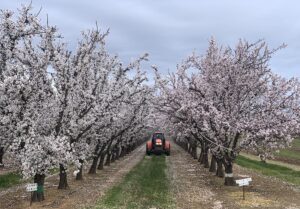
Some general frost control basics include the following. Firm, bare and moist soil ensures the best chance of passive frost protection by absorbing heat from the sun during the day and releasing it at night. Clean spray strips and close-mowed (less than 2 inches tall) vegetation in the row middles is the recommended state of the orchard floor ahead of forecast rain. Good moisture is only needed in the top foot of soil to deliver passive frost protection via heat release at night. If frost conditions last, it may be necessary to rewet the topsoil. Running drip irrigation ahead of a frost event to darken the soil and hold daytime heat (assuming the sun is shining) for release at night may provide some slight increase in orchard air temperature. A link to critical temperatures and frost control practices is in the notes. Note: Frost-damaged buds or flowers are infection sites for bacterial blast, so frost management is especially important for limiting blast infections and protecting the crop. Crop loss due to frost or bac blast can be at greater risk in orchards planted to a single (self-fertile) variety because of similar bloom stage throughout the planting.
Bees
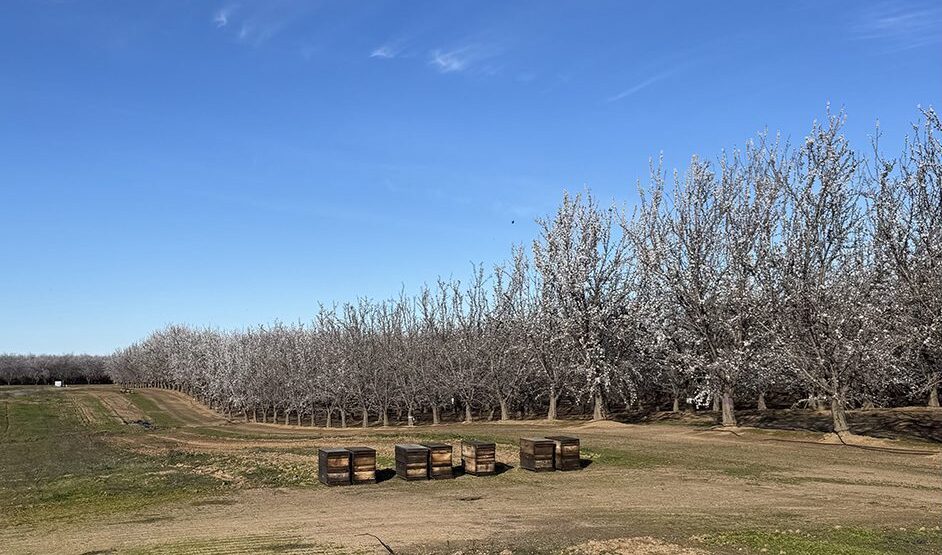
Profitable almond growing requires good bee activity in the orchard during bloom. Current hive stocking recommendations are at least two strong hives (at least eight frames of bees per hive) for self-infertile orchards and half to one strong hive per acre in self-fertile orchards. As self-fertile plantings continue to increase, talking with your beekeeper about hive placement to ensure best pollination of your acres, especially in cold or wet bloom weather, might be worth considering.
Since good bee activity equals the best nut set possible, growers should do all in their power to keep hives and bees healthy and active. Good communication with beekeepers is part of hitting this goal and setting a good crop. Key beekeeper communication topics include fungicide selection and timing, along with clean water for bees, especially in dry bloom weather.
For general good bee health practice, avoiding any insecticides in bloom sprays (except B.t. if recommended) protects bees and hive health. Some insecticides are labeled for bloom use but can be deadly to bee brood when contaminated pollen is collected and brought to the hive. Weather permitting, starting fungicide spraying in the mid-afternoon and into the night helps keep fungicides out of bee hives and the brood. See more info in the notes.
Pests
Insects: Intact mummy nuts are the only winter home for navel orangeworm (NOW) in a nut orchard. While the time for getting mummies out of the trees is past, the cleanup of downed mummies is the key insect pest practice in February. All mummies on the orchard floor should be swept and destroyed with a flail mower before March 1. This makes sure that navel orangeworm, and other pests in the grounded mummies, are killed and can’t hatch and infest any remaining mummies in the orchard. The more mummies left in the trees, the more critical this practice. Use a slow tractor speed and check behind the mower after each pass to ensure all nuts are broken up or shredded. When in doubt, do it again. Careful mummy destruction is critical to finish the job in any nut crop. Don’t waste the $250 per acre spent on dropping and sweeping mummies with an incomplete $50 mowing job.
Scale control in walnuts is an important part of Bot management. February is a good time to assess the scale population in an orchard and decide if treatment is needed ahead of bloom. Prebloom control delivers the best coverage and results. See details on scale management in walnuts in the notes.
Diseases
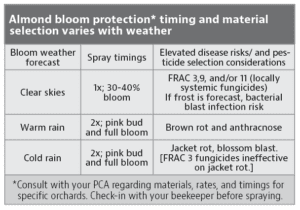
Working with your PCA, plan almond bloom fungicides to match bloom weather conditions. The following information is from the work of Dr. Jim Adaskaveg, UC Riverside. Blossom brown rot is always a focus, but other disease concerns vary with rainfall and temperatures.
The UC guide to fungicide efficacy and timing is available, free from the ucipm.anr.edu site listed in the notes and includes almonds, pistachios and walnuts. Looking ahead, work out a game plan with your PCA for red leaf blotch management. Critical timings are petal fall through five weeks after petal fall.
Pruning wounds: Treat almond or walnut pruning wounds, especially large cuts, with Topsin-M (thiophanate methyl) to limit any fungal infection of the wound. If cuts are not treated, it is Russian roulette with tree health.
Weeds: Talk with your PCA about preemergent herbicide treatments if not applied by this point. In almonds, avoid these treatments when hives are in the orchard and if flowers are present in the target strips. For all nut crops, preemergent herbicides offer extended control of problem weeds when properly matched to weed species and carefully applied. Blow leaves and other organic matter from the weed strip ahead of spraying to allow the full herbicide dose to reach the soil surface. Good weed control in young orchards is especially important to limit vole activity in tree rows and chewing damage on trunks.
Rodents: Keep after gophers and squirrels. Gophers can kill trees by girdling the crown, and squirrels eat profit in the form of nuts. Gopher control in late winter is a good practice because the breeding season has not started. Combinations of trapping, baiting or fumigation are more effective than relying on a single practice. Ensure personnel using or supervising fumigation are properly certified or licensed. Do not let gopher populations build in orchards.
Ground squirrel control using fumigants (for trained and licensed personnel) is highly effective in February when used properly and the soil is moist, with no cracks that can allow gas to escape from tunnels. Check to make sure ground squirrels are active before using fumigants. Given the temperatures in January, they should be out of hibernation in many orchards.
Nutrition: Walnuts and pistachios are dormant in February, so nutrition topics are limited to almonds.
Boron at pink can help improve nut set. Boron spraying at full bloom can harm nut set, so fall spraying is my preferred foliar boron application. Timing a pink bud spray to benefit nut set in a block with mixed varieties (Nonpareil and pollinizer) is not easy. Talk with your CCA about effective rates. Too high a boron spray rate can reduce nut set in almond.
No other nutrient applications are needed in February, but now is a good time to plan nitrogen (N) and potassium (K) applications for the season. First N and K feedings should start in early March. Spoon feeding, meaning frequent smaller applications, delivers more efficient and effective nutrition to your trees. Work with your CCA to decide the target annual N and K rates and a program for the year. The most critical first fertilization is N at a rate equal to 20 percent of the annual crop budget. That application feeds spur growth, which means future flower sites, as well as current nut growth. Include N needed to support vegetative growth in the early season N budget along with expected crop N needs.
See the Almond Board of California’s nitrogen BMP publication for annual N rates for vegetative growth, adjusted for orchard age. If the weather is dry and warm through bloom, that could mean a good crop set, fast leaf-out and a need to get plant-available N into the root zone earlier than in wet years. In a heavy nut set year, the first N fertilization should include extra N to match the larger crop plus enough N to feed shoot and spur growth.
It’s too early to tell how the season will shape up, but here’s hoping for full reservoirs and a good crop for all growers in 2026.
NOTES:
cpc.ncep.noaa.gov
https://fruitsandnuts.ucdavis.edu/chill-calculator
https://cdec.water.ca.gov/resapp/RescondMain
wcngg.com/2025/01/07/can-we-help-walnuts-get-through-low-chill-winters
Mobile irrigation labs in the Sacramento Valley:
tehamacountyrcd.org/mobile-irrigation-lab
sutterrcd.specialdistrict.org/mobile-irrigation-lab-367e01c
yolorcd.org/what-we-do/bilingual-mobile-irrigation-lab
www.sacvalleyorchards.com/almonds/horticulture/frost-protection-2
www.almonds.com/almond-industry/orchard-management/honey-bee-best-management-practices.
www.ipm.ucanr.edu/agriculture/ (fungicide info; scroll to the page bottom for the link to the free pub.)
sacvalleyorchards.com/almonds/red-leaf-blotch-finds-its-way-to-the-sacramento-valley-2025
www.ipm.ucanr.edu/agriculture/almond/Weed-Photo-Gallery-with-common-and-scientific-names
ipm.ucanr.edu/agriculture/walnut/dormant monitoring
www.ipm.ucanr.edu/agriculture/pistachio/dormancy-to-delayed-dormancy
www.groundsquirrelbmp.com/biology.html
www.almonds.com/almond-industry/orchard-management/soil-quality-and-nutrients/nutrient-management