
Listen to the audio version of this article. (Generated by A.I.)
A component identified as critical to the advancement of the tree nut industry in California is being delivered by California State University, Fresno. The component is highly competent and innovative employees who can operate complex processing machinery and have a true interest in the tree nut industry.
Mike Kelley, CEO and general manager of Kerman-based Central California Almond Growers Association (CCAGA), the largest huller and sheller in the state, said more positions in tree nut processing facilities are now being filled with knowledgeable and qualified persons who have received hands-on training and experience in Fresno State’s unique nut processing laboratory, the Western Agricultural Processors Association Tree Nut Laboratory.
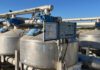
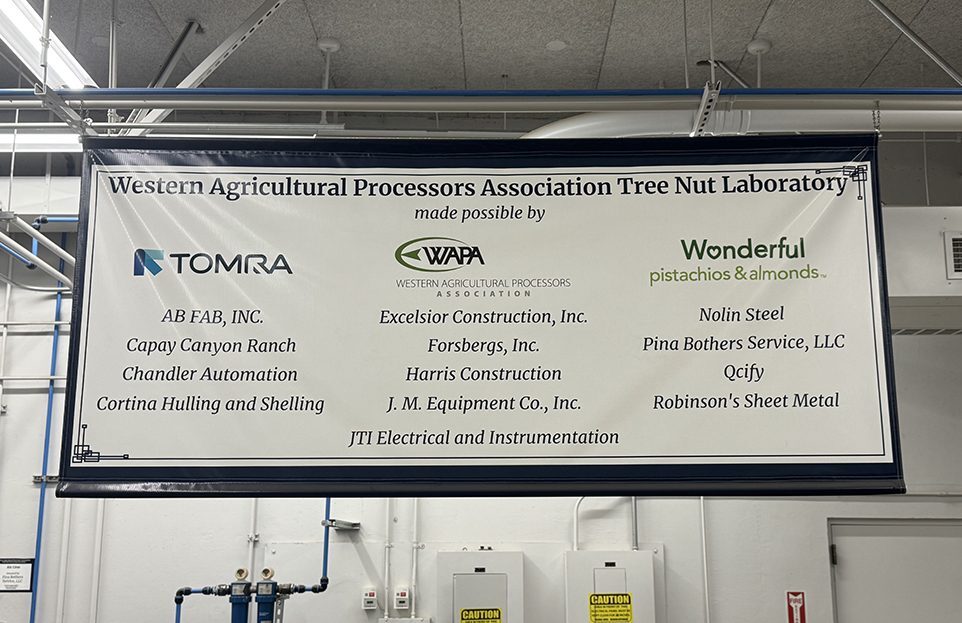
The lab at the Jordan College of Agricultural Sciences and Technology, installed just over five years ago, consists of multiple nut processing machines generously donated by Central Valley tree nut industry partners. The nut processing class is part of Fresno State’s Ag Systems Management program and is offered during fall and spring semesters. Since first being offered in 2020, the course has steadily gained in student enrollment. The lab is in the Industrial Technology building on campus.
Dr. Arun Nambiar, head of the Industrial Technology program, said class participation has increased in the last two years, with 45 to 50 students now enrolling for the fall and spring semesters.
Students enrolled in this agriculture systems course learn to operate and maintain machinery used in commercial tree nut processing. They also participate in multiple field trips each semester to see operations in commercial processing facilities.
“We could not do this without our industry partners,” Nambiar said. “They provide real-world expertise.”
Planning for the lab began when Western Agricultural Processors Association (now Western Tree Nut Association, or WTNA) board member Dan Pronsolino approached Roger Isom, WTNA president, about developing the class at Fresno State.
Nambiar credits Athanasios “Alex” Alexandrou, a professor of mechanized agriculture, with putting the program on track. WTNA was also heavily involved in securing industry donations and the planning and execution of the program.
Saw a Need
With the introduction of more complex machinery to improve product, the tree nut industry saw a need for more highly trained employees.
“We saw there might be a lag in education and the need to get positions filled with competent people,” Kelley said.
These are not seasonal processing jobs; they are full-time positions for people with engineering skills who can not only keep the machinery running but can find new ways to improve processing efficiency.
Two of those people came to the CCAGA plant and developed an innovative way to protect stockpiles from heat damage. These former Fresno State students applied drones to observe stockpiles and hull piles using a program to detect heat levels. Kelley said the drones are used weekly to detect any changes in temperature.
Aniruddha Barahate and Kaumith Illereruma, the former Fresno State engineering students, graduated prior to the completion of the nut processing lab but have been involved in its operation since they began working at CCAGA. They also participated in the citrus processing lab at Fresno State. Kelley said their innovative drone program is just one example of how processing facilities can improve operation with the addition of new employees with a working knowledge of food processing. New employees at the plant who come with a certificate of completion from the FSU processing program are familiar with the workings of the equipment.
“They hit the ground running,” said Barahate. He said training new employees in a fully operational plant is difficult and time-consuming considering the noise generated by the machinery. Students who have completed the course arrive knowing how to communicate and are already knowledgeable about many of the operational needs at the plant.
Christopher Court is a current graduate student at Fresno State who has completed the processing course. He explained how it works.
Industry professionals teach the course, which includes operation and maintenance of six pieces of processing equipment. Court explained that the machines are operated as separate stations to allow students to focus on each step. Most of the nuts run through the machinery are almonds, but pistachios have also been processed in the lab. Nambiar said local growers donate 5-gallon buckets of hulled almonds for use in the class.
Industry-donated equipment includes an AB FAB aspirator, which removes foreign material, sticks, rocks and other debris from the nuts. Other machines include a bin tipper, conveyors, Nolin gyratory sizer, Forsberg TKV-25 gravity deck, a QCIFY automated quality grading machine and a TOMRA Nimbus 649 color sorter, which is the most technologically advanced machine in the lab. The sorter can be programmed to kick out any nuts that do not meet specific criteria.
“The programming of the machine is the most interesting part of its operation,” Court said.
Nambiar said the course can open new avenues for students. Court is one example. His graduate studies involve cold plasma, a nonthermal pasteurization process that reduces energy use in processing and helps ensure food safety.
“This course opens new venues and helps with a better understanding of industry,” Court said.
Chris McGlothlin, assistant vice president of technical services at WTNA, said the organization is proud of the growth of the tree nut processing course and lab.
“The overwhelming response from industry partners to help supply the school with vital equipment and provide guest lecturing opportunities is a true testament to the resourcefulness of the tree nut industry. We hope that the program continues to provide experience and confidence in students who will continue their journey within the industry,” McGlothlin said.
He noted that WTNA is working directly with Fresno State staff on the development of a Tree Nut Certificate program that would be offered to current industry employees. This program would aim to improve employee skill sets and provide them with exposure to equipment and necessary training that is important to the tree nut industry.

Cecilia Parsons | Associate Editor
Cecilia Parsons has lived in the Central Valley community of Ducor since 1976, covering agriculture for numerous agricultural publications over the years. She has found and nurtured many wonderful and helpful contacts in the ag community, including the UCCE advisors, allowing for news coverage that focuses on the basics of food production.
She is always on the search for new ag topics that can help growers and processors in the San Joaquin Valley improve their bottom line.
In her free time, Cecilia rides her horse, Holly in ranch versatility shows and raises registered Shetland sheep which she exhibits at county and state fairs during the summer.