

Listen to the audio version of this article. (Generated by A.I.)
Oregon State University’s Hazelnut Breeding and Genetics Program has released a cultivar with a new source of resistance to Eastern Filbert Blight (EFB).
The cultivar, Lagerstedt, is the program’s first release with a source of EFB resistance outside of the Gasaway gene, which was used to provide relief from the fungal disease in multiple cultivars that today dominate hazelnut acreage in the Willamette Valley. The Gasaway gene is no longer effective against a new strain of EFB now prominent in the valley, a strain OSU researchers are referring to as Race 1.
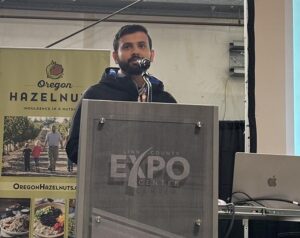
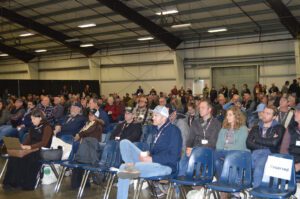
Speaking at the Nut Growers Society’s Winter Meeting, Jan. 7 in Albany, Ore., Gaurab Bhattarai, assistant professor and head of the OSU Hazelnut Breeding Program, said Lagerstedt has an international pedigree that includes parentage from Italy, Turkey and Spain.
“It brings the quality of those cultivars that were important from these different countries,” Bhattarai said.
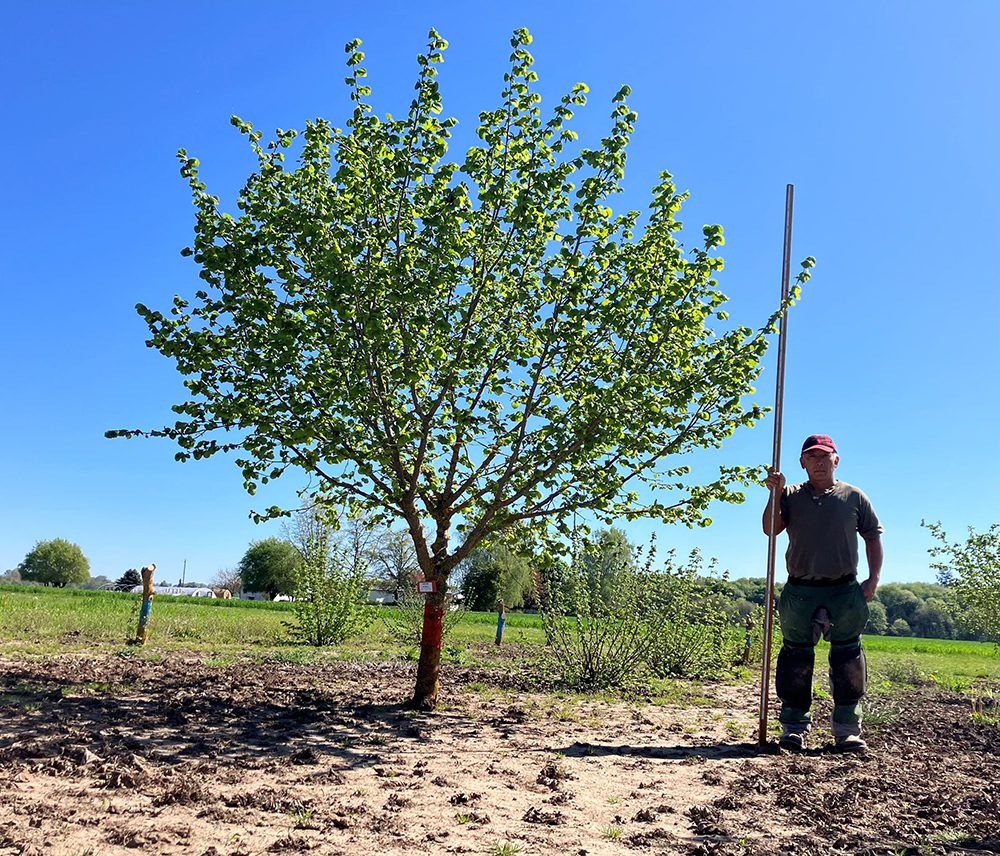
The 29th hazelnut cultivar released by OSU, Lagerstedt gets its resistance from a gene in the Spanish cultivar Ratoli.
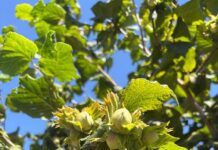
Lagerstedt’s upright growth habit is similar to Jefferson, Bhattarai said. Its nuts are slightly smaller than the popular hazelnut cultivar Jefferson, with a nut weight of 3.34 grams versus Jefferson’s 3.48 grams, but its percentage kernel is slightly higher than Jefferson. Its kernel weight is 1.63 grams, versus Jefferson’s 1.56 grams, giving it a percentage kernel of 49%, versus 44 to 45% for Jefferson, 47% for Wepster and 46% for Yamhill.
Named in honor of former OSU professor and USDA research horticulturist Harry B. Lagerstedt, the cultivar is best suited for the blanched and kernel markets, Bhattarai said.
“The kernel size is 16 to 17 millimeters, so it probably won’t fit into the chocolate perfectly,” Bhattarai said, “but it can be used for other confectionary purposes.”
In sensory tests at the OSU Food Innovation Laboratory, Lagerstedt was rated as very good with high-quality kernels, he said.
It brings the quality of those cultivars that were important from these different countries.
— Gaurab Bhattarai on the new OSU hazelnut cultivar
The cultivar matures slightly earlier than Jefferson, he said, and in a multi-year trial, its yield efficiency was not significantly different than Jefferson, Wepster and Yamhill. (Yield efficiency is the total yield over the trial period adjusted for differences in tree sizes.)
Recommended pollinizers for Lagerstedt are McDonald, Wepster, York and Yamhill. Pollen from PollyO and Jefferson is incompatible with the cultivar, Bhattarai said.
The cultivar should be available by this spring. North American Plants expects to have enough plants for spring orders, he said, and Microplant Nurseries has completed rooting trials and is looking for orders for stage 3 tissue cultures.
Lagerstedt is among several varieties now in the OSU breeding program with new sources of resistance to EFB. It uses a gene from linkage group 7, or LG7, to confer resistance. The Gasaway gene, by comparison, used a gene from LG6 to confer resistance.
Promising selections nearing release include one that uses a gene from LG2. Sourced from seeds from the Russian village Holmskji, it has a nut weight of 2.59 grams, a percentage kernel of 46.8% and a blanch rating of 3.3.
The program is also using EFB-resistant sources from two new locations where resistance maps, LG1 and LG4, and is advancing some lines with quantitative resistance, or multiple-gene resistance.
EFB Now Widespread
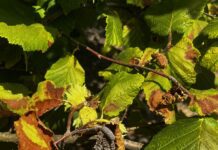
According to OSU plant pathologist Jay Pscheidt, the Race 1 EFB strain that has overcome resistance formerly conferred by the Gasaway gene is now widespread in the Willamette Valley, and growers need to be scouting for it, cutting out infected tissue and treating for it.
“The fungus is already all over the place and your resistant cultivars may not be resistant anymore,” Pscheidt said. “Please be out scouting for cankers. If you find them, prune them. And putting on protectant fungicides is important.”
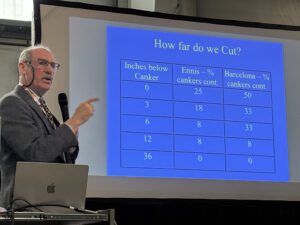
When pruning, Pscheidt said growers should cut below the canker.
“If you cut right at the base of the canker, many of them will continue to move down into the branch,” he said. “We recommend cutting one to three feet below that cankered area.”
In some cases, he said, growers will want to replace heavily infected trees.
Pscheidt added that growers today have multiple fungicides available for controlling EFB.
The (EFB) fungus is already all over the place and your resistant cultivars may not be resistant anymore. Please be out scouting for cankers. If you find them, prune them. And putting on protectant fungicides is important.
— Jay Pscheidt
“When I started in this business in 1988, there were zero fungicides that were registered for Eastern Filbert Blight. We now have over 60. They come from six or more chemical classes. You have a lot of tools in your toolbox to get after this disease.”
He said that multiple application methods are effective against EFB, including ground and air applications.
“Drones will probably work as well, as the data comes in for those,” he said.
Researchers also are looking at the feasibility of drenching tree roots
with the FMC fungicide Topguard for EFB control.
“This is a new way of applying the fungicide that we’ve been working with,” Pscheidt said. “Topguard is a Group 3 material. It is the most systemic of the different fungicides that we have. We’ve proven that it works in the greenhouse and we’ve moved to the field to see if it will work there as well.”
In the trials, researchers poured fungicide mixtures onto the ground in a tree’s root zone. To date, research results are promising, he said.
“It is looking really good. It doesn’t matter whether you put it on four times on the top of the plant as a foliar spray, or drenching a plant four times or just applying one drench at budbreak, we are getting excellent control with this particular material.”
The key for any treatment program, he said, is to start at budbreak. “That is when infection starts in the springtime.”