


Listen to the audio version of this article. (Generated by A.I.)
Having mealybugs at harvest is a problem. Making your crop unsalable through attempts to control mealybugs is devastating.
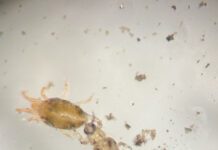
Presenters at the annual UC Statewide Pistachio Day focused on effective control of Gill’s mealybug, including late season when options are very limited due to maximum residue levels for exports.
“Control attempts can ruin sales,” David Haviland, UCCE entomology and pest management advisor in Kern County, cautioned.
He explained three root problems with mealybug control. First, overwintering and first-generation populations are very low. The second generation is not conspicuous until nymphs are large and move out to feed and produce honeydew. This can prompt late-season panic.
Second, the European Union is shifting away from risk mitigation to risk prevention with maximum residue levels (MRLs), and default tolerances are becoming more prevalent.
The third problem is flaws in the U.S. registration process for pesticides. Haviland noted that while pistachios are part of the nut crop group, they are not almonds, walnuts or pecans.
Haviland’s research into optimizing chemical control for Gill’s mealybug notes that feeding in pistachios results in smaller kernels, a lower percentage of split nuts, reduced yield and problems with harvestability.
Gill’s mealybug emerges from overwintering in May, and a first generation is produced from late May to late July. The second generation appears from late July to September and October. Late insecticide applications are the cause of residue issues.
Haviland’s California Pistachio Research Board-funded trial in 2025 showed the difficulty in finding effective control of Gill’s mealybug. The trial was conducted in a Golden Hills commercial pistachio orchard in Corcoran.
Standard products containing spirotetramat, including Movento, spirotetramat and Senstar, provided 87% to 93% reduction in mealybug densities, and acetamiprid, sold as Assail, provided 96% reduction. The experimental product Sequoia provided similar reductions. Haviland noted in his presentation that he hopes this product will become available.
He reported that the trial reiterated the difficulty in developing a late-season control strategy. Effective control in late May remains limited to products containing acetamiprid, sold as Assail, or Movento until Sequoia can be re-registered for use in pistachios.
Alternative products, including Sivanto, Sefina, Aza-Direct or Fujimite, can be used but provide only suppression and may need to be paired with an early- or late-season treatment. Early-season options remain limited to Centaur, with moderate efficacy. This is because most products are systemic and are not effective until the trees leaf out.
Haviland said microbial or biological products do not provide significant control, with Fujimite and lime sulfur providing about 30% reduction in mealybugs.
Haviland’s recommended timings and products for Gill’s mealybug control are Centaur from March to April and Movento or Assail from May to June. Other products that can be used are Sivanto, Sefina, Venerate or Aza-Direct. By July and August, possibly lime sulfur. These timings can prevent MRL issues for export. Additionally, Admire, sold as imidacloprid, can cause MRL issues. Buprofezin, sold as Centaur, should be applied only in March, and acetamiprid only in May. Haviland said processors, based on their data, have concluded that Assail should not be used after June.
“We are looking for other options,” he added.
Basic Biology
Raman Bansal, USDA-ARS research entomologist in Parlier, presented basic mealybug biology, explaining why control is difficult and new studies that may reduce insecticide resistance.
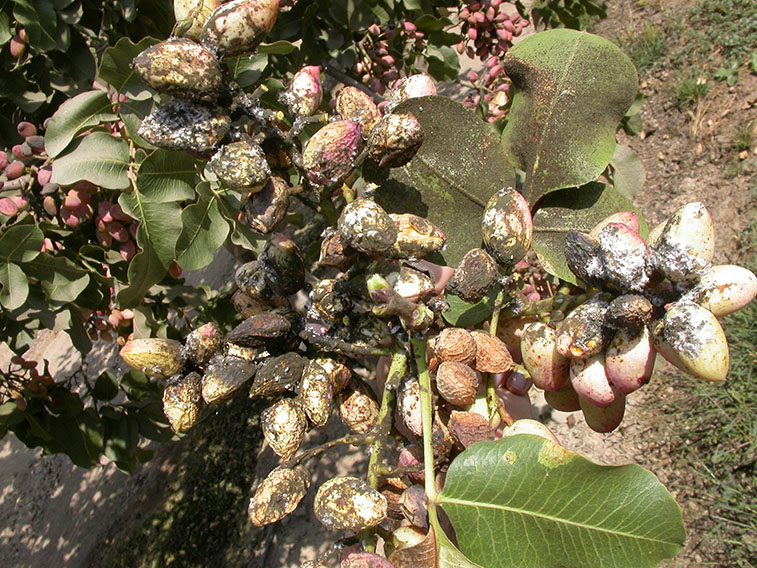
Infestations are most noticeable close to harvest when honeydew and sooty mold appear on nut clusters, but control at that time carries a risk of crop rejection due to residues. Control is most effective earlier in the season, making monitoring essential to time treatment.
All stages of the life cycle have different susceptibility to control materials, Bansal noted.
Adult female mealybugs give birth to live offspring, averaging 30 to 50 per female. Three generations are produced annually. Mealybugs overwinter as nymphs but emerge in low numbers. Nymphs move into trees to feed on buds in March and April. By May to early June, they produce the first generation of crawlers. These crawlers move to developing nuts and rachis to feed and become adults in late July. These adults produce the second generation of crawlers, which also feed on nuts. When nut development ends in September, adults move to tree branches and produce the third generation of crawlers. This final generation overwinters.
Bansal said standard insecticides have become less effective against Gill’s mealybug populations in the past six to seven years, making control options more limited. His research has centered on preserving the effectiveness of chemical control.
Acetamiprid, a systemic insecticide, is effective against all stages of mealybug, but resistance threatens to diminish its viability in the future, Bansal said.
“Effective rotation requires understanding the resistance mechanism, not just chemical diversity.” – Raman Bansal
Resistance Issues
Insecticide resistance issues with Gill’s mealybugs include target-site resistance, metabolic resistance, penetration resistance and sequestration resistance. Bansal suggests rotating the resistance mechanism rather than the mode-of-action chemistry for control, noting that acetamiprid and spirotetramat resistance appears to involve metabolic detoxification, not target-site modification. Effective rotation requires understanding the resistance mechanism, not just chemical diversity.
Insecticide resistance management involves several avenues to reduce resistant mealybug populations.
One is persistence of resistance. Insecticide resistance is a heritable trait that may carry a fitness cost for the insect. Bansal said resistant populations can progressively revert to susceptibility if insecticide treatments are stopped. His trials showed resistance persistence following insecticide withdrawal after four generations, resulting in a decrease in resistance ratio.
There are also novel nonchemical controls being studied, including promising synthetic chemicals, entomopathogenic fungi and gene silencing.
Monitoring and detection, dosage management, and mixtures and mosaic strategies are included as parts of resistance management.
In a research report to the California Pistachio Research Board, Bansal outlined trials to determine cross-resistance of standard insecticides used to control mealybug and to determine persistence of acetamiprid resistance in Gill’s mealybug.
Bansal said both cross-resistance and persistence of resistance are important for managing resistance and preserving acetamiprid for mealybug control.

Cecilia Parsons | Associate Editor
Cecilia Parsons has lived in the Central Valley community of Ducor since 1976, covering agriculture for numerous agricultural publications over the years. She has found and nurtured many wonderful and helpful contacts in the ag community, including the UCCE advisors, allowing for news coverage that focuses on the basics of food production.
She is always on the search for new ag topics that can help growers and processors in the San Joaquin Valley improve their bottom line.
In her free time, Cecilia rides her horse, Holly in ranch versatility shows and raises registered Shetland sheep which she exhibits at county and state fairs during the summer.