

Listen to the audio version of this article. (Generated by A.I.)
Thinking back, Oregon State University Extension Orchard Crop Specialist Nik Wiman believes he has been seeing symptoms of bud rot in the university’s hazelnut research orchards for the past 10 years. Until just this past year, however, the disease has gone under the radar.
This past year, after it was identified by Mana Ohkura in the OSU Plant Disease Clinic, Wiman said he has been seeing bud rot, or hazelnut anthracnose, in orchards throughout the Willamette Valley.
“Since we’ve picked up what the symptoms are, I’ve seen it in most orchards that I’ve been in this past summer and fall,” Wiman said. “It’s been diagnosed from Oregon and Washington. It has already been known to be present in commercial hazelnuts in Europe. And it’s been in Oregon for a long time, we think, just unrecognized, undiagnosed or misdiagnosed is another way that it has kind of flown under the radar.”
A fungal disease, bud rot attacks the buds, catkins, leaves and husks of hazelnut trees. Its main economic impact is that it infects and kills floral buds in the spring.
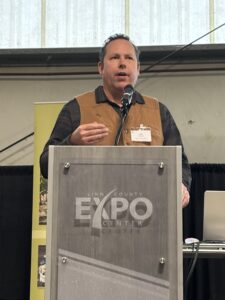
“And so, that is a direct impact on yield,” Wiman said during a presentation at the Nut Growers Society Winter Meeting, Jan. 7, in Albany, Ore.
A secondary effect is its capacity to affect shoot and leaf development.
“When the female pistillate bud dies in the spring, you are also losing a shoot and the leaves that would normally accompany that shoot,” he said. “So, it changes the structure of the tree, and you’re going to end up with dead wood in odd places on the branch where there is nothing growing. So, that is a secondary effect that can affect the overall health of the tree.”
Symptoms and Confusion With Other Issues
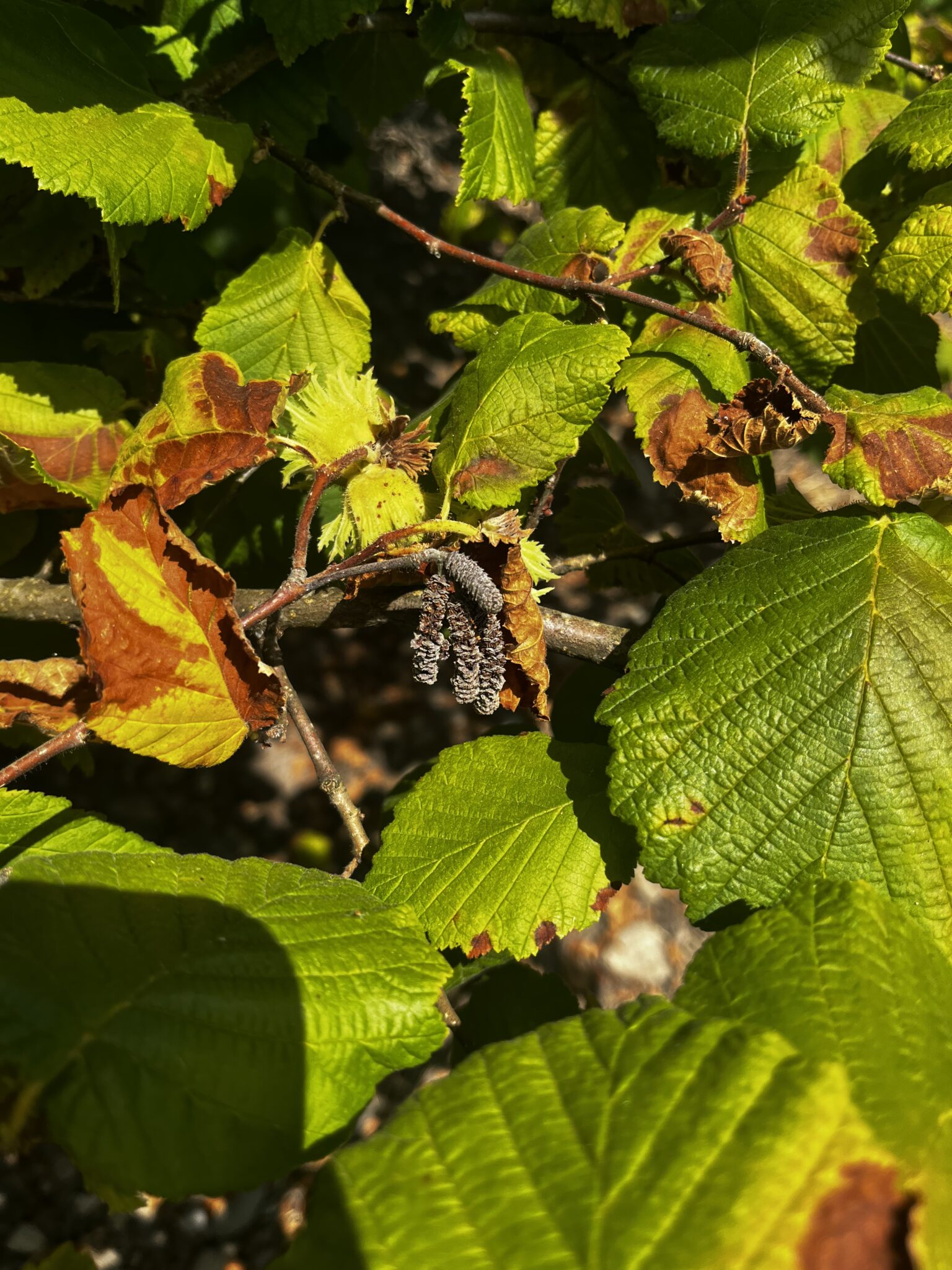
Symptoms of the disease include a brown necrosis that forms on buds infected with bud rot. Dead catkins also are strongly associated with the disease, he said.
“We think that the disease stays rather limited to the buds themselves,” he said. “We haven’t really seen it take off into the wood.”
An additional concern with the disease is that infected buds will release new spores and potentially infect new tissue, Wiman said. “And so there is a direct economic impact but also loss of photosynthetic potential. So, there is an overall health impact on the tree.”
Over time, bud rot symptoms can appear similar to drought stress, given that a tree can develop dead twiggy tissue on the periphery of the canopy, Wiman said. Until this past year, in fact, he thought drought stress was what he was observing in trees infected with bud rot. He added that bud rot symptoms “are extremely common,” particularly on the McDonald and Jefferson cultivars.
The disease’s symptoms also appear similar to bacterial blight, or common blight, another disease that can cause bud death. “So, it is easy to conflate bacterial blight with the bud rot disease,” Wiman said.
Research Findings and Industry Response
Bud rot came to the forefront of the industry’s attention this past year through a research project funded by the Oregon Hazelnut Commission that was looking at bud development in the spring.
In the study, Wiman noted that during bud swell, trees that looked healthy in January suddenly were exhibiting browning on catkins and buds were not swelling very well. “And then we got into March and we noticed that a lot of the female flowers were turning brown and dying,” he said. “And that is when we got really concerned.”
Wiman and his faculty research assistant, Heather Andrews, began working with the OSU plant clinic to diagnose the problem. The lab found that the bud rot DNA matched a disease caused by a pathogen, Cryptosporiopsis tarraconensis, that had never been found in North America, and at one point, federal plant authorities were preparing to slap a quarantine on orchards infected with the disease.
“We tried to explain to them that no, it’s already everywhere,” Wiman said. “But what turned out to save us is that its DNA sequence also matched another disease, hazelnut anthracnose, that had been diagnosed long ago. It was already known from North America.”
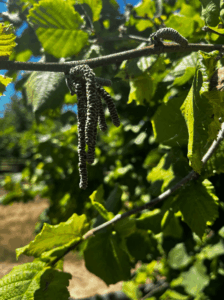
In addition to the dead buds, Wiman and Andrews found undistended catkins infected with the anthracnose fungus, shriveled anthers that were reddish color and in June started to see other symptoms.
“We think that the disease stays rather limited to the buds themselves. We haven’t really seen it take off into
the wood.” Nik Wiman
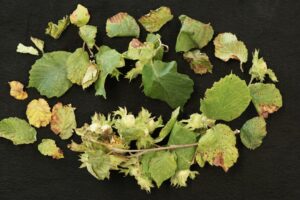
“In a lot of cases, we are seeing spots and other lesions and burn margins starting to form on leaves, especially leaves that are close to these undistended, persistent catkins,” Wiman said. “And this developed into sort of a secondary part of the disease cycle.”
As the lesions developed, Wiman said leaves turned brown and started dropping from trees.
“So, during the secondary infection period, you can lose a set of leaves,” he said. “Then it started to move into the husks of the nut clusters. And as those leaves that were infected start to drop off the tree, then the canopy gets even thinner.”
He added that he and Andrews were noticing infected catkins still hanging in trees into August.
“And then I started to realize as we got toward harvest that some of these infected husks are having a hard time forming excision layers that are needed for the nuts to fall from the husks naturally,” he said.
He added that he has been hearing from growers recently about nuts getting stuck in tree canopies, a development that could be linked at least in part to bud rot.
Disease Management
Wiman believes that with proper management, growers should be able to obtain good control of the disease. Past research dating back to the 1960s in England showed that fall copper sprays for bacterial blight had no effect on the fungus, but the researcher was able to show a good rate of success with a fall fungicide treatment.
The researcher was able to show that spring applications also had some effect, but that nothing worked as well as a postharvest application.
Wiman noted that he applied a fungicide this past fall and will be analyzing its effectiveness over the upcoming growing season. “We will have some results to report next spring,” he said.
“I do think that this will probably be fairly easy to manage,” he said.
He added that the jury is out as to whether it will pay to treat the secondary infection period. “I don’t have an answer to that,” he said. “Maybe if there are a lot of those undistended catkins in the orchard, but there is no field research on spray efficacy.”
For organic growers, Wiman advised pruning out dead wood and catkins, especially those persistent dead catkins that are serving as a source of inoculum for further infection.
He added that poor airflow is a contributing factor. “I think increasing airflow through canopy management could be helpful in some cases.”