 TM
TM
From policy discussions in Brussels to U.S. grocery store shelves, an expanding list of forces is shaping the future of California walnuts. Trade policy uncertainty, changing retail dynamics and emerging consumer spending patterns are reshaping the industry’s competitive environment.
Today, the considerations that shape walnut demand reach far beyond orchard management, covering everything from international trade policy to the more data-driven strategies retailers are applying to move products.
Those pressures were a key aspect of a market outlook panel at the California Walnut Conference in Turlock, where speakers addressed the economic and policy forces impacting the crop’s future. Knowing and adapting to those pressures will be key to long-term grower profitability, they said.
California Walnut Board and Commission President and CEO Robert Verloop introduced the session by stressing the need to innovate and develop new consumer uses instead of relying solely on traditional consumption patterns. Fresh California premium quality walnuts are always the key to driving retail volume, encouraging larger display space that grab consumer attention and generate impulse buys. Additionally, given today’s consumer interest in plant-based foods, he cited a concept for a walnut-based ranch dressing that was sampled at the event (and extremely popular with the growers) as an example of early product innovation the industry is exploring.
“In the past when we did something like this, the emphasis was how do our processors take this product and take it to market,” Verloop said. “No offense to the processor sitting here. You’re not walnut ranch guys.”
Moving food innovation ideas like that into commercial channels, helps demonstrate the health benefits and versatility of walnuts and how they can become more relevant for today’s younger consumer, he said, and will require collaboration with category specialists who understand formulation, packaging and distribution within specific product segments. The broader goal, he added, is to reposition walnuts beyond their long-standing association with baking and into more everyday meal occasions, foodservice applications and new product formats.
Trade Environment in the EU Is Still Fluid
European Union trade policy remains vital to California exports. Anna Boulova, secretary general of Frucom, a European trade association representing nut importers and other specialty food sectors, said the political environment has shifted over the past several years.
“It’s important to understand how the political climate in Europe is shifting and how that can influence trade policy,” Boulova said.
Farmer protests across Europe have shaped policy discussions and put a greater focus on protecting EU agricultural producers, she said. That shift has resulted in closer scrutiny of trade relationships and production standards applied to imports into the EU.
A 25% tariff on certain goods, including walnuts, has been authorized under EU legislation but remains suspended, she added. She also outlined a proposed tariff-rate quota framework that would allow up to 500,000 metric tons of various nuts to enter duty-free on a first-come, first-served basis, pending EU parliamentary approval.
At the same time, the EU is accelerating trade negotiations with other producing regions, with potential agreements that could affect the competitive position of U.S. walnuts in the key export market, she said.
“The complexity of today’s marketplace is so much different than it was even 20 years ago.“
− Robert Verloop
Retail Fragmentation and Consumer Divergence
On the domestic market front, economist Arjun Chakravarti of Cogknition Analytics described a U.S. consumer economy that’s growing increasingly fragmented across regions and income groups.
“Half of the country is sort of in a recession right now,” Chakravarti said. “The other half’s kind of treading water.”
He noted that higher-income households account for a disproportionate share of total spending, while lower-income consumers remain more sensitive to food and housing costs.
He said that gap makes retail strategy and promotional planning more challenging.
In response, retailers are doubling down on data analytics and targeted marketing tools. Retail media networks, extended promotional calendars and highly segmented shopper messaging are becoming the norm. In an environment like that, products need to justify shelf space not only through margin but through consistent turns on shelf, he explained.
Understanding the Retail Price Spread
During the discussion, Verloop posed a question frequently raised by growers: how does a $1 per pound walnut in the orchard translate into $8, $10 or even $12 per pound at retail.
Mapping out the snowballing costs across the supply chain, Chakravarti said kernel yield is the first factor that influences the effective cost basis, noting that once shell weight is removed, the per-pound value changes significantly. From there, he cited the shelling, sorting, quality assurance, food safety scanning, packaging and transportation costs that must take place before the product even reaches retail shelves.
Retailers must also account for shrink, spoilage, theft and inventory carrying costs. Products that move slowly tie up shelf space and capital in stores, which increases the pressure on both margins and turnover.
For commodity categories, the implication is that generating repeat purchase occasions and increasing retail turns can be just as important as negotiating price, Chakravarti said.

Marketing as Infrastructure
Pam Graviet, vice president of integrated marketing for the California Walnut Board & Commission, described the breadth of marketing programs supporting walnut demand both domestically and internationally.
The commission currently operates marketing initiatives in more than 20 countries, supported by a combination of industry dollars and USDA grant programs, she said. The long-running Market Access Program (MAP) provides annual funding for international market development, while newer short-term programs are designed to accelerate sales in targeted regions.
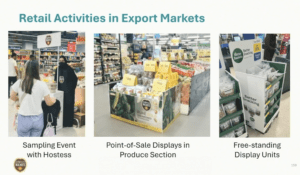
Graviet said retail activation remains central to demand growth. Sampling events, freestanding displays, digital in-store messaging and targeted seasonal promotions are all designed to increase consumer awareness and drive repeat purchases.
“Our walnuts taste better,” Graviet said. “When we get it in their mouth, they’re like, ‘Oh my gosh, I never tasted walnuts this good.’”
She also pointed to younger consumers as an important driver of future growth.
With U.S. Millennials and Gen Z now representing a larger population group than baby boomers, they are increasingly influenced by digital channels and health and wellness-focused messaging, she explained. Nutrition research remains a foundational element of marketing strategy, especially as walnuts are positioned as a healthy and plant-based food option.
On a broader scale, Verloop said the structure of the walnut industry has evolved significantly, shifting from a predominantly in-shell market to a kernel-dominant one while retail planning timelines and promotional requirements have grown increasingly complex.
“The complexity of today’s marketplace is so much different than it was even 20 years ago,” Verloop said.