 TM
TM
April brings a clearer sense of the 2026 almond crop set and the beginnings of the walnut crop year. With reservoir volumes in good shape, plenty of winter rains, and the relatively mild weather last year when buds began developing for this year, Sacramento Valley orchards should be starting off the year in good shape. A good start is a good start.
Almonds
As I write this in early March, it’s too early to tell just how the crop will shape up. There were at least some warm days during bloom with good bee activity and bloom overlap, so a decent crop in many orchards might be a good bet. A key to growing a good crop this year is Goldilocks irrigation and nutrition: just right. That can be harder to do than to write about, but setting out the target is a first step.
Irrigation
Spring irrigation is often a balancing act between too little and too much root zone water. Early season orchard water stress limits nut set and vegetative (spur and shoot) growth, which limits future flowering and possibly yield. Excess spring irrigation often results in saturated soils, which limit root function (water and nutrient uptake).
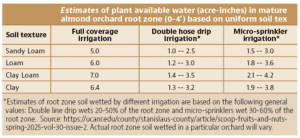
How best to hit the sweet spot of just-right spring irrigation? Soil moisture and ET based values are the current recommended practices. I have included a table with general amounts of soil moisture held in the root zone (4 feet deep) under different irrigation systems and soil textures. These values are a starting point to gauge the maximum amount of water to apply in each irrigation set when using the ET approach. Applying less than the maximum amount of water the soil will hold under an irrigation system literally gives roots some breathing room. It is a process to be worked out for each orchard, but well worth the effort.
Soil moisture readings can be used to schedule irrigation and track how irrigation based on ET calculations is maintaining soil water availability. Continuous measurement devices (data loggers for soil moisture, etc.) can help fill in gaps in orchard moisture conditions between irrigations and provide a sense of when high or low soil moisture exists in an orchard.
I have not mentioned the pressure chamber for scheduling almond irrigation in the spring. That’s because not using the pressure chamber to schedule spring irrigation is a new recommendation based on recent UC research. Those results revealed that standard weekly pressure chamber measurements can miss rapid decreases in spring water status of almond trees, potentially resulting in increased water stress leading to reduced yield or nut size.
Spring is a very busy time in almond orchards and water use is less than in the summer. Still, time focused on irrigation will pay off in good nut growth and orchard health heading into summer heat. Spring irrigation is like city driving. The best approach for both is keeping up with the flow of traffic (maintain irrigation) but not tailgating (irrigating too close to saturation) and watching for brake lights ahead (changes in the weather) that can signal the need to stop. You’ll get across town, or to harvest, in good shape.
Final Note on Water
In-line water meters (for example Neptune T10) are great tools for checking irrigation output, how much water you are really delivering over time. They are inexpensive (under $200), plumb right into the drip line and are easily readable in the field as part of orchard monitoring. ET predicts what is needed by the orchard, and flow meters record what is applied. David Doll, The Almond Doctor, recently posted how he and his irrigation crews meet monthly to review ET targets and water application based on flow meter data to dial in orchard irrigation.
Nutrition
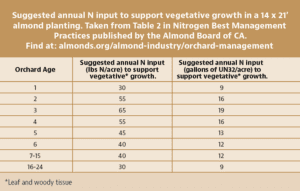
Good nut set means strong nitrogen (N) and potassium (K) demand to grow the crop and maintain spur growth and health for future crops. Feeding both a good crop this year and spur growth for next year’s buds means solid nitrogen programs in April. 80% of almond nuts grow on spurs. Spur growth tends to slow by May in mature, well-cropped orchards. Don’t miss spring N for spur growth and continued bearing surface next year.
Potassium is important for current crop use and spur health for next year. An almond crop uses more potassium than any other mineral nutrient, 90 to 100 lbs K₂O per 1,000 lbs of kernel crop. In-season fertigation of potassium fertilizers is an effective way to maintain adequate to excellent orchard K levels throughout the season. Potassium demand is steady through crop development, so K fertilizers do not need to be front loaded like nitrogen inputs but applied at the same rate from March to July. Monthly leaf analysis and monitoring for potassium deficiency symptoms in the orchard are tools to maintain adequate orchard potassium.
Now is a good time to apply boron if 2025 harvest hull sample boron levels were low (<100 ppm) or deficient (<80 ppm). Talk with your PCA regarding soil or foliar boron fertilization in season to increase hull boron next harvest. Recent heavy rainfall winters have leached boron from many orchard soils in the Sacramento Valley and made boron fertilization a regular activity to maintain target levels and improve crop yield.
Pests
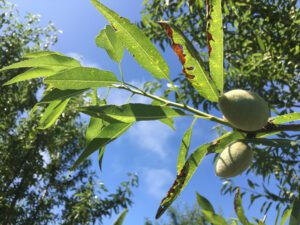
Red leaf blotch, a new foliar disease of almond in California, is a game changer for disease management. The current recommendation is two to three fungicide sprays from petal fall through April. Spore release occurs when leaf litter is wetted by rain or sprinkler irrigation water. Especially in sprinkler-irrigated orchards, growers should consider treating ahead of irrigation this month. An outbreak of red leaf blotch will be far more damaging than the cost of treatment.
Warmer weather brings increased concerns for early pressure from true bugs. In the San Joaquin Valley, both leaffooted and stink bugs are significant pests of almond. However, leaffooted plant bugs are the primary concern for Sacramento Valley growers.
Monitoring includes walking orchard edges, looking for feeding damage, adult bugs, or eggs. Independence, Aldrich, Monterey, Fritz, and Butte varieties are more susceptible to damage and are good rows to monitor. The key timing for monitoring is March through April.
If leaffooted plant bugs are found, growers must make a difficult decision. The most effective control comes from pyrethroid insecticides, but these materials can also kill beneficial insects that control mites and scale.
Spider mites are another pest of concern in warm springs. Monitoring should begin in late March or April and continue every two weeks, increasing to weekly monitoring by mid-May. Miticide resistance is real and rotating products is critical to maintain effective control.
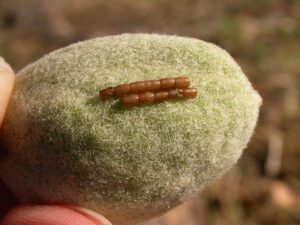
Navel orangeworm remains a major pest in California almonds. As of March 1, NOW damage cost Sacramento Valley growers an estimated $40.2 million in lost crop in 2025, assuming NOW damage represents 75% of total rejects and a grower price of $2.25 per pound.
Season-long mating disruption dispensers should be installed before biofix. In orchards with high mummy counts, a spring spray can help reduce NOW populations. Where mummy counts are low, growers may consider adding another hull split spray instead.
Walnuts
Irrigation: Unlike almonds, the start of walnut irrigation can be delayed until stem water potential measured with the pressure chamber reaches two to three bars below baseline. This approach can save time and water without reducing yield.
Blight: Two blight sprays during walnut bloom remain the foundation of UC recommendations for controlling this bacterial disease.
Mites: Monitoring should begin earlier than usual this year due to warm spring conditions.
Nutrition: Nitrogen and potassium fertilizer programs could begin slightly earlier this year. Current nitrogen recommendations are for 25% of the annual nitrogen budget to be applied each month from May through August, with total nitrogen based on orchard history and crop load using a rate of 30 to 40 lbs N per ton of inshell crop.
More information is available at the Sacramento Valley orchard website:
sacvalleyorchards.com