 TM
TM
The Carriere family has a long history in California agriculture. Bill Carriere is the fourth generation to head up the family farm. It’s just a little bit bigger than the 17 acres his great-grandfather started with, and the technology is a little more advanced than the rice harvester his grandfather built out of scrap metal.
Today, Carriere Family Farms is a diversified operation where the fifth generation of Carrieres is beginning to join the family business. We asked Bill Carriere to share some of his family’s history and his perspective on the current state of the walnut industry:
Tell us a little bit about the history of your operation.
My great-grandfather immigrated here to Northern California and was working for a large ranch here as a laborer. He married the oldest daughter of that farm family, which was a smart move, the equivalent of buying land in Silicon Valley a long time ago. Eventually, he bought a little place, actually where my house is today.
We’re right next to the Sacramento River, so there were a lot of oak tree forests around. He chose a place along the river because of the good soil.
My grandfather ended up buying a little ranch a quarter mile away and also farmed row crops. My grandfather bought 200 acres of ground between Willows and Glenn, which is away from the river, where it’s more of a rice-growing area rather than deep alluvial soils where now we grow trees. We still farm that 200 acres of rice today.
He had three kids. My Aunt Mildred was born deaf, and they waited quite a while, 20 years, before having another child, who would be my father.
Mildred eventually went off to the deaf school in Oakland and met someone down there. He was a local dairy farmer and was also deaf. As was tradition then, she got married and went to live with his family, and they had a dairy. Then my father and my uncle were born.
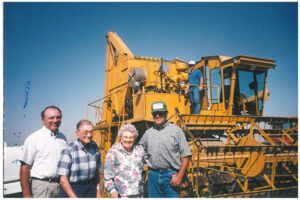
My father went off to college, did a short stint in the Army, came back and started farming with my grandfather. He bought another little ranch right down the road, and it had walnuts on it, big, old historic trees, in 1964.
My parents were married in 1963, and I was born in 1964. I’ve lived all my life on the ranch.
My uncle did the same thing, went off to college, did a little stint in the Army, came back, and they formed Carriere Brothers Partnership. My uncle ran the rice and did the office and bookwork, and my father was a good mechanic and metal worker, so he ran the walnuts and worked in the shop.
“They really ingrained the culture of sharing and mutual respect with the family, which we try to keep going today.“
How did the partnership work?
One of the things I would attribute to their success was that they shared everything equally, almost to a fault. When I came home from college, I’d say, “Hey, Uncle spent a bunch of money buying jeans in town and put it on the company.” My father would say, “Yeah, no problem.” I’d say, “Well, you should go buy some jeans.” He’d say, “Did you see my expense? I went golfing in Reno last week at a meeting.” It all worked out in the end.
Even farther than that, when my father went out to the rice field to help my uncle, he would literally say, “Hand me a shovel. Where do you want me to dig?” My uncle was the boss. And when they were in the walnut orchard, my uncle would say, “Hand me a shovel. Where do you want me to dig?” They really ingrained the culture of sharing and mutual respect with the family, which we try to keep going today.
They slowly bought ranches as opportunities arose. We expanded along the river with more walnuts because the soil is deep and good for walnuts.
Then my generation came along. A couple of us came back to the ranch to work. We have a policy that you have to work outside the company for a couple of years before coming back. I was the last person who got away with not doing that.
How did the partnership with the Borges Group come about?
I was applying for jobs out of college and came home right before I graduated. There were some Spanish people sitting at my parents’ kitchen table. They introduced me to the Pont family, owners of Borges Mediterranean Group in Spain. They were looking to invest in California.
We partnered with them for over 36 years, buying orchards here, managing them, shipping product to Spain, and building the business together. Three years ago, they divested of their holdings here, and we purchased them and enveloped everything under Carriere Family Farms.
Why did you start processing walnuts?
Borges helped us get into processing. They encouraged us to fill the gap between farming and the commercial side. In 2000, we bought equipment to process in-shell walnuts. That first year we sent 100% of our product to them. I think it was only 11 loads, but it was a good start.
In 2005, we realized that when you sort in-shell walnuts, you have broken and stained ones that are still good inside. We approached Borges about expanding into shelling, but they were in a period of austerity and didn’t want to invest. So we had a family meeting and decided to do it ourselves. We put in our own sheller, and eventually that outgrew the in-shell side.
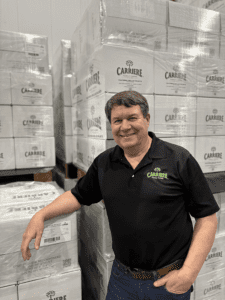
How did others in your family join the company?
I mentioned my aunt went off and lived with her husband and family. They had six kids.
Most of them were working in the area, some in ag.
When we partnered with Borges, suddenly we had more acres, and we needed more help. That’s when my father and my uncle offered jobs to my cousins. They became an integral part of our operation as well.
At one time, we had nine family members working in the business in various capacities: water expertise, pest control expertise, sales, marketing and construction.
I ended up being the business end. My UC Davis major was economics and business, so I eventually moved from working in the field every day to slowly working in the office full time.
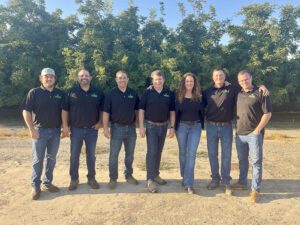
When we were partnered with Borges, we were sending reports by fax to them monthly. It was important to help my uncle, who did everything on paper. We bought computers and adopted other technology. The next generation kind of took over from there.
My father passed away in 1998, but my uncle is still around. He comes in almost every day to make sure we’re not messing things up and gives us sage advice. We still have eight family members working on the farm. I’m fourth generation, and now the fifth generation is also working on the farm.
How have production practices changed over time?
My grandfather, because he was the mechanic, actually built a rice harvester basically by putting a piece of metal on the table and starting to weld parts to it.
One of the first things we did in walnuts was build a walnut huller and dryer. We still have two of those facilities that we run. Building and fixing that on your own saves you tons of money, so it was important to keep that going.
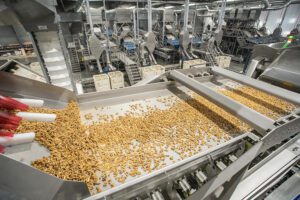
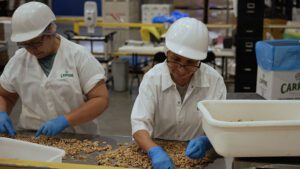
On the processing side, we don’t have any hand sorters at all anymore, and that’s relatively recent. Four years ago, we built a new walnut shelling facility, and we designed it so it didn’t have any hand sorting. It’s all electronic with lasers and cameras, and it’s doing a faster, more efficient job.
We had a lot of employees who were nervous about our new building. They saw there wasn’t going to be any sorting. We said, “Okay, nobody’s going to lose their job. Your job is just going to change. You’re going to go from a hand sorter to either an equipment operator, and we’re going to help you get trained, or you can be on the sanitation team,” because we do a lot of cleaning between shifts and between products. We were proud to receive “Plant of the Year” in 2025 for our food safety program.
We pride ourselves on not laying off a bunch of people because we’re a family business, and there are several families that have worked for us for generations.
“We were proud to receive ‘Plant of the Year’ in 2025 for our food safety program.“
How are you involved in the industry?
One of my cousins is a director for the Farm Bureau. One is going through the California Ag Leadership Program.
I’m on the Walnut Board and Walnut Commission, actually on the International Nut Council Executive Committee as well, trying to better the industry as a whole. We’re quite transparent about what we do and not as secretive as a lot of other companies. I don’t know if that’s good or bad, but it’s just the way we operate.
How have you weathered the low walnut prices and what do you see happening with walnuts in the future?
Part of our culture is that my grandfather rarely borrowed money. Leverage is good in certain situations, obviously, but he was very much, “You don’t buy it until you can afford it.” We’ve carried that into our culture today. You can’t get away with paying cash for everything anymore, but we keep that principle in mind.
We like to say we’re a little bit diversified. We have some rice. We grow almonds as well. That diversity has been really helpful. And of course, vertically integrating into processing has really helped.
One of the issues was, in my opinion, in 2014-17, prices got too high for walnuts. There was a shortage. Demand was great. And everybody planted, not just here in California but in Chile and in China.
China has several varieties now that compete with our Chandler variety, and Chandlers are off patent, so Chile can grow Chandlers. There are Chandlers grown in Spain, France, Chile, probably other places, competing with us.
When prices got too high, everybody planted. Walnuts take five to seven years to come into full production, and now all these trees are in full production. We have an oversupply.
This year, we’re looking at a crop of about 808,000 tons. I don’t think there’s demand out there to keep prices where they need to be to make the farm profitable. We’re hoping prices stay at least above break even for us.
I hate to say it, but we’re probably going to have 800,000 tons for the next two to three years.
Some growers have lost hope, and some orchards have come out. We’ve reduced acres in California, probably almost 60,000 acres over the last three years, but it’s been the almost abandoned orchards or low producing orchards that come out.
Some of these younger orchards are still coming into production. So we took out 3,000-pound-per-acre orchards, and the orchards coming into production are producing 6,000 pounds. It’s fewer acres but still the same number of walnuts.
So my vision is: in three years, things will come back. Hopefully in two, prices will still be above the cost of production.
Most growers need 80 cents to break even, or 75 anyway. I’m predicting this crop is right around 70. Seventy cents is a tough number to make work on a farm in California with labor.
What’s the best thing about walnuts?
I always say this, and I truly believe it: walnuts aren’t tobacco or alcohol. They’re healthy. They’re good for you. They’re vegetarian. They’re vegan, for that matter.
We continue to be aggressive, and we’re constantly pushing the health aspects. Gen Z is very aware of their health. They’re seeing all of us baby boomers in the hospital, or sick, or whatever, because we did all the bad things. They’re not drinking as much. They’re not doing a lot of things like that. I think they appreciate good food, and I think that bodes well for us.