
Listen to the audio version of this article. (Generated by A.I.)
The U.S. Biochar Initiative, an organization focused on developing end-use markets for biochar, states biochar applications on soil can increase water-holding capacity, microbial activity, soil organic carbon and nutrient uptake.
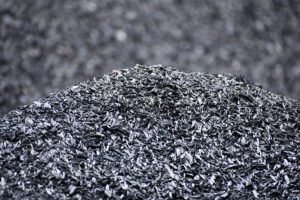
Biochar is not charcoal, fertilizer or compost; it is a pyrolysis product. Pyrolysis is a process that heats organic material like wood or crop waste in a low-oxygen or oxygen-free environment where it undergoes thermal decomposition, transforming it into a stable, porous, carbon-rich solid. This high-heat process prevents complete combustion, instead producing biochar alongside flammable gases and liquids that can be captured for energy. The process is halted by applying water to the burning material to prevent it from turning to ash. It is then crushed to increase the surface area.
American Farmland Trust reports that application of biochar as a soil amendment is a long-term integration process. Soil transformation is expected to be slow. Observed results from trials show, over time, reduced soil compaction and greenhouse gas fluxes, higher nitrogen retention among the berms during the dormant season and improved plant productivity. Continuing biochar studies will focus on gas fluxes and nitrogen availability, as well as soil analysis for bulk density, total carbon and nitrogen, pH, EC and texture.
Paul Lum, California senior agriculture specialist with American Farmland Trust, said ongoing biochar trials are scaling up and aimed at determining predictable responses in soil health and productivity with different application rates.
1. Soil Health Improvement Depends on Existing Soil Conditions
Biochar’s ability to improve soil health depends on several factors, including soil type, soil condition, source of biochar feedstock, application rates and timing.
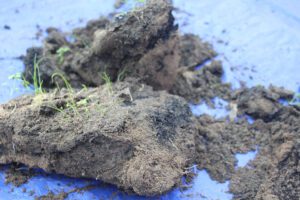
Soil structure, water retention and microbial activity that enhances nutrient uptake can be improved with biochar applications, trials have shown. Biochar has been found to have the most significant benefit to soil health in marginal soils with low fertility, coarse texture and high acidity. Sanjai Parikh, a UC Davis soil chemistry researcher who conducted biochar evaluation for the CDFA Fertilizer Research and Education Program, said research suggests that biochar has a promising role in remediating or conditioning challenging soils, but applications on fertile soils appear to have fewer agronomic benefits.
Lum said the focus of the current AFT trials is to measure the differences in soil health, comparing plots that do not have biochar with plots where biochar was applied. Common soil health measurements include soil organic matter percentage, water-holding capacity, porosity and nutrient availability. Lum said they are also comparing different application rates and feedstocks used to make biochar.
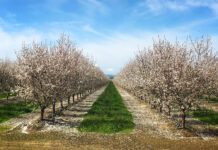
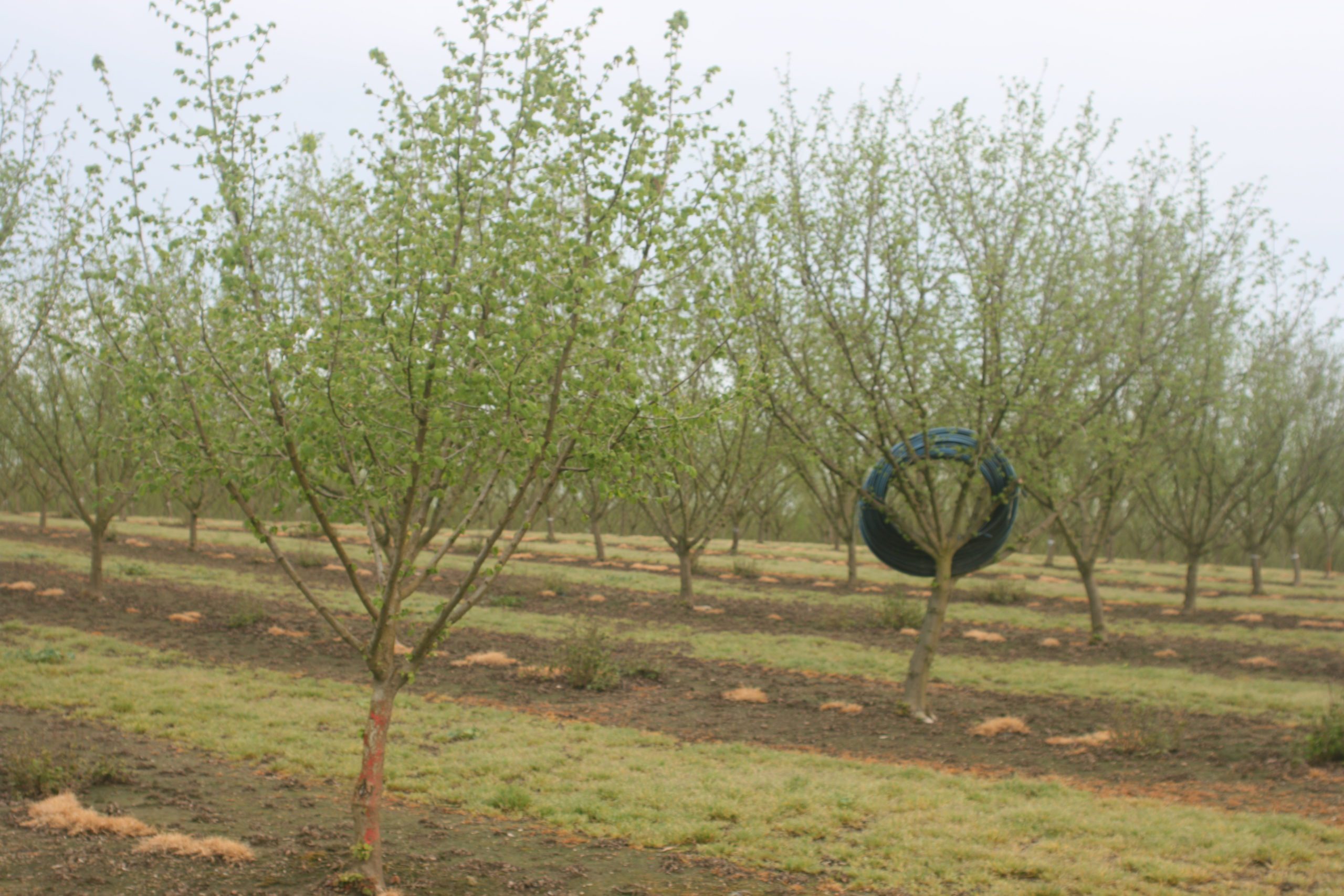
Rebecca Ryals, a UC Merced agroecologist, has been conducting a biochar trial in a Madera almond orchard to collect data on soil health indicators. Speaking at an October field day at the trial site, Ryals noted that soil health benefits, including water infiltration, are beginning to appear in the test plots. The small test plots were also showing higher yields compared to the control plots.
2. Feedstocks for Biochar Production Matter
Feedstocks for biochar production can include wood waste, including prunings and orchard removals, almond and walnut shells, poultry litter and manure. Parikh noted in his study that there is tremendous variability in the characteristics of biochars made from different feedstocks. Lum said feedstocks used to make biochar will determine its value in improving soil. Biochar made from woody feedstock or almond shells has a lower nutrient content than biochars derived from manures. Corigin Solutions, a Merced biochar facility, uses both shells and woody biomass. Pacific Biochar in Sonoma County uses waste timber. Sitos Group, on the Central California coast, is developing a project in partnership with Treehouse California Almonds to produce biochar with almond shells.
3. Research Recommendations
Use of biochar and cost of applications are current challenges, according to Lum. Use of almond shells as a feedstock benefits the almond industry, directing this byproduct to a value product. However, Lum said biochar production with shells does not meet current demand. A progress report on a Sustainable Agriculture Research and Education project conducted by Evelyn Perez-Agredano, a graduate student at UC Merced, recommends a combination application of biochar and compost.
This new recommendation was confirmed by Jessica Bronner of Sitos Group. She said that in the past nine years, use of biochar as a soil amendment has been refined. Growers who want to add biochar to their ground preplant or where there is an existing crop are advised to first take soil samples. With that information, a custom blend of biochar and compost can be made to meet soil needs. Bronner said while there is no upper limit on biochar applications, a 3-ton-per-acre biochar application is the minimum. A blend of 25% biochar to 75% compost for a total of 10 tons per acre is considered to be the most useful for meeting most soil health needs.
“This is considered a one-and-done type application,” Bronner said, since biochar does not move or decompose in the soil. The biochar acts as a habitat for soil microbes while the compost adds organic matter.
4. Biochar Application and Availability
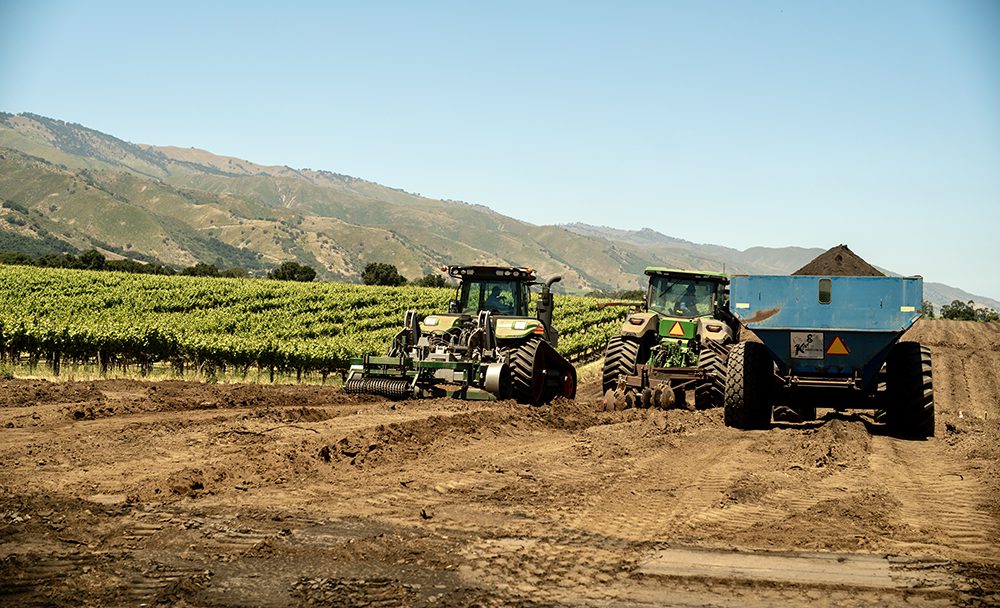
Biochar application methods in permanent crops are still evolving. The blend can be shanked into the soil at depths from 6 to 30 inches. Bronner said deeper applications are being tried to encourage deeper root structures.
Mayo Ryan at Sitos said injection methods are not there yet. Sitos has developed a system in vineyards that uses a ripper to open a trench where biochar is applied and covered with soil.
Ryals and others at the Madera field trial noted that use of a compost spreader was not an efficient method of biochar application in an orchard, particularly one with dry leaf litter. The biochar can pose a combustion risk if applied alone at high rates. Safety and handling training is advised.
Sourcing high-quality biochar and applying where it will be most effective are current challenges to increased biochar use. Bronner said current availability of biochar is limited on the West Coast as of now.
The Sitos/Treehouse Almonds project is expected to be online in early 2026 with the capacity to produce 8,000 tons of biochar a year.
Mike Woelk, CEO of Corigin Solutions, said he is sold out of biochar for the next four to five months.
5. Biochar Funding
Dr. Tera Lewandowski, director of agricultural research at the U.S. Biochar Initiative, said the Natural Resources Conservation Service Practice Standard 336 supports the use of biochar and compost to improve soil health and sequester carbon. This is part of the Environmental Quality Incentives Program.
Practice 336 provides cost-share support for applying biochar and/or compost to agricultural land. Eligible materials must meet quality standards, including documented feedstock, pH and nutrient profile. Lewandowski recommends working with local NRCS and technical service providers to develop an application plan. That may include a site visit with a conservation planner, applying and reviewing application plans for technical feasibility and environmental benefits.

Cecilia Parsons | Associate Editor
Cecilia Parsons has lived in the Central Valley community of Ducor since 1976, covering agriculture for numerous agricultural publications over the years. She has found and nurtured many wonderful and helpful contacts in the ag community, including the UCCE advisors, allowing for news coverage that focuses on the basics of food production.
She is always on the search for new ag topics that can help growers and processors in the San Joaquin Valley improve their bottom line.
In her free time, Cecilia rides her horse, Holly in ranch versatility shows and raises registered Shetland sheep which she exhibits at county and state fairs during the summer.