


Listen to the audio version of this article. (Generated by A.I.)
If I plant a winter cover crop, will it use water my trees need?
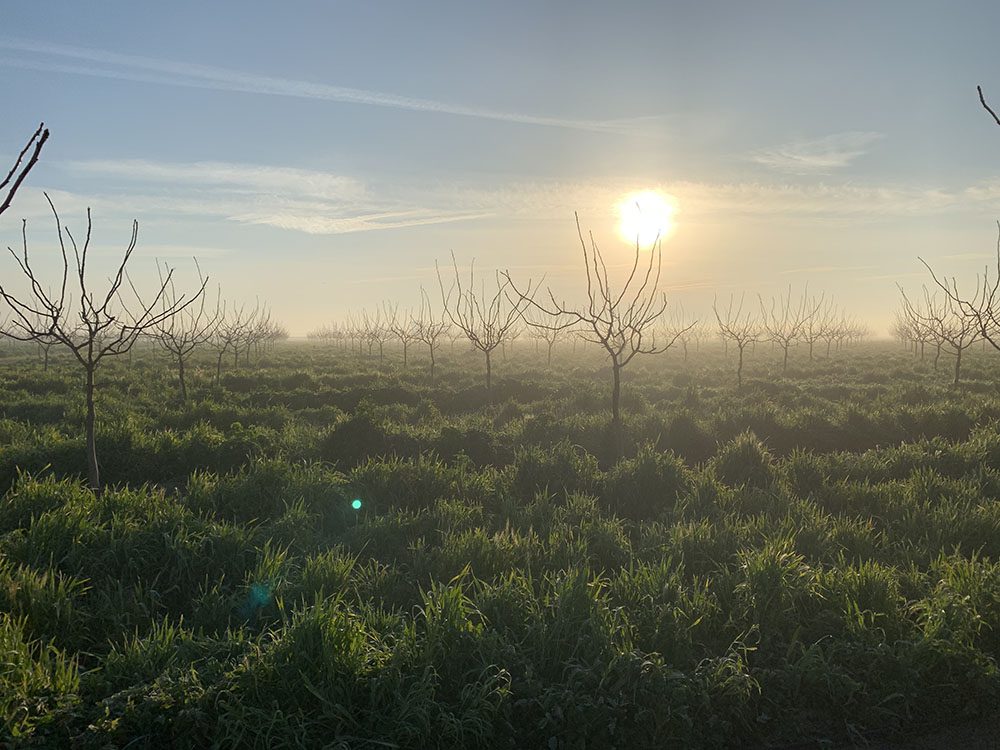
It is a question more growers are asking as interest in soil health practices increases and water uncertainty continues across California. Many growers still wonder what the trade-offs might be, especially in years when every inch of water matters. To move beyond assumptions and gather real field measurements, our team established a multiyear comparison study at Bullseye Farms in the Sacramento Valley to help answer this question. Growers want straightforward answers, but until recently, there were very few field studies directly measuring these trade-offs in commercial pistachio orchards. With pistachio acreage expanding across the Central Valley, these questions are becoming increasingly important for long-term orchard planning.
Inside the Study at Bullseye Farms
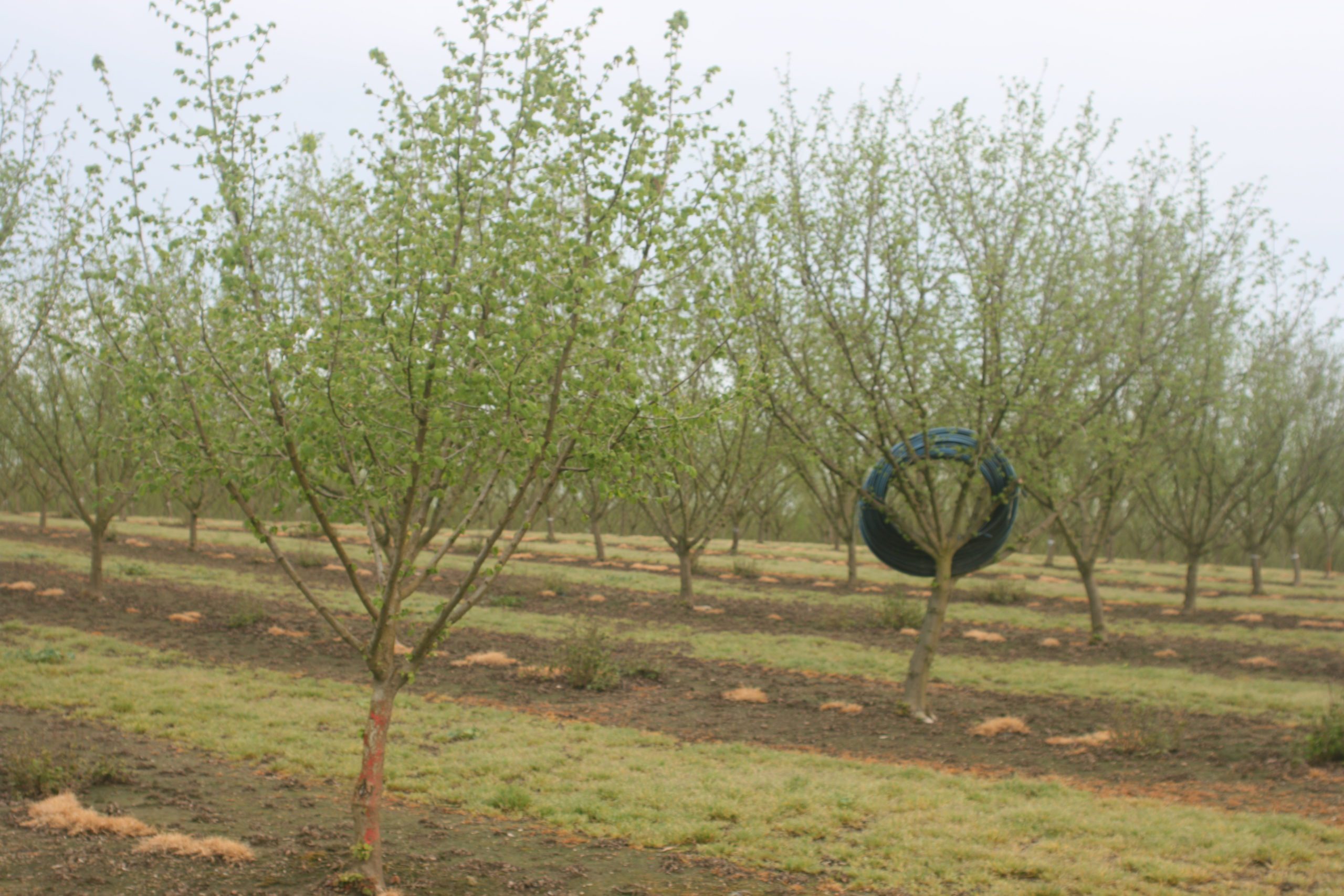
Our team, including Bullseye Farms, the USDA-ARS Sustainable Agricultural Water Systems Unit, and the University of California, Davis Agricultural Water Center, is studying water use and soil moisture dynamics in two adjacent pistachio orchards, one managed with a winter cover crop (CC) and one maintained without (NC). Both blocks were planted with Golden Hills in the same year, use the same double-drip irrigation system, and sit on similar silt loam soils.
The CC orchard has been growing cover crops since 2019, using a general mix of beans, peas, vetch, grains and brassicas typically planted in early November. Because the orchards are identical in age, variety and irrigation, the only major difference between the two systems is the presence of the cover crop itself, which offers a clean comparison of how cover crops influence soil moisture and evapotranspiration (ET).
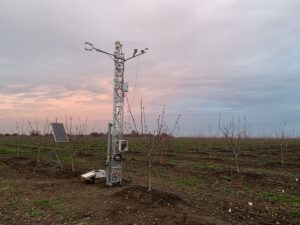
Research installation at the 152-acre orchard began in early 2023. Separate eddy covariance towers were installed in each orchard to directly measure ET. In addition, 36 12-foot neutron probe access tubes were installed at four randomly selected locations in each orchard—72 total—allowing us to monitor soil moisture from the surface down to 10 feet. Installation was completed by September 2023.
This level of instrumentation makes these orchards among the most closely monitored pistachio orchards in California. It allows us to see not just whether cover crops use water, but how they change the timing, depth and distribution of water in the soil profile. Biweekly soil moisture measurements have continued since installation, and we now have two full seasons of data showing how cover crops influence orchard water dynamics.
What We’ve Seen in Soil Moisture and ET
After two seasons of monitoring, a clear and consistent pattern has emerged: cover crops shift both where and when water is stored and used in the soil profile.
In the upper five feet, the CC orchard generally showed lower moisture during the winter and early spring due to active water use by the cover crop.
Deeper in the profile, around five to seven feet, the CC orchard consistently stored more moisture than the NC orchard. This deeper storage is consistent with other studies showing that cover crops can improve infiltration and move water deeper into the soil. For a deep-rooted perennial like pistachio, this water may become important later in the irrigation season, especially in mature orchards where roots extend well below the shallow layers that dry out quickly.
An interesting finding is that the timing of early winter rainfall did not change this pattern. The 2024–25 season received its first rainfall about a month earlier than the 2023–24 season, yet the contrast between shallow drying and deeper storage remained the same. This suggests that the infiltration benefits from the cover crop are not highly sensitive to when the first winter rainfall arrives.
Evapotranspiration (ET) patterns help explain the bigger picture. Over the full November through October monitoring period in 2023–24, total ET differed by only about 1 inch between the two orchards.
The key difference was when that water was used. The CC orchard had higher ET from November through April, driven by winter cover crop growth. Surprisingly, the NC orchard had marginally higher ET from July through October, possibly due to the protective mulch layer left in the CC orchard after termination reducing soil evaporation.
The orchard had its first harvests in 2024 and 2025. Over both seasons, there has not been a significant difference in yield between the two orchards. While it is still early in the orchard’s lifespan, initial signs suggest that the presence of a winter cover crop did not negatively impact yield in these young trees.
These results reinforce an important idea: cover crops do not substantially increase total water use. Instead, they change when the orchard uses water.
If timing is the real difference, the next question becomes how growers can use management decisions—especially termination timing—to shape these patterns.
Management Implications: Termination Timing Is Key
Our data show that the largest ET increase from winter cover crops occurs in late March through April, when growth peaks and temperatures rise. For growers looking to conserve soil moisture heading into the irrigation season, earlier termination may reduce this spring ET spike.
However, earlier termination comes with trade-offs. Ending the cover crop too soon can reduce soil health benefits, limit weed suppression and decrease protective residue on the soil surface. Growers need to balance these trade-offs differently depending on their individual management goals.
Both monitored seasons so far have been wetter than average. Under these conditions, the deeper infiltration observed in the CC orchard may benefit pistachio trees even if early season ET is slightly higher. Under dry winter conditions, however, the dynamics could shift.
A question commonly raised by growers, and one we are watching closely, is how winter cover crops influence soil moisture in years when rainfall is limited and every inch matters.
Soil type, orchard age, rooting depth, irrigation capacity, orchard floor management and the specific cover crop mix all influence how water moves through the orchard. But one early takeaway is becoming clear:
Cover crops may not use water that trees need, but they do change when and where water is stored and used in the orchard.
If your goal is to maximize soil health benefits, a later termination may make sense. If your priority is conserving water ahead of early season irrigation, an earlier termination could be more appropriate.
As we continue collecting additional seasons of data, our goal is to develop practical guidelines that help growers align cover crop benefits with their orchard water needs across the Central Valley.
Survey Call to Action
Because orchard conditions and management decisions vary widely across the state, we are conducting a survey to better understand grower and advisor perspectives on winter cover cropping in pistachios. The survey is open to anyone involved in the pistachio industry—growers, farm managers, PCAs, CCAs, consultants and technical advisors.
Your input is critical. The decisions you make in your orchard, and the factors that drive those decisions, provide context that field data alone cannot capture. Your experiences—whether positive, negative or mixed—help us understand how cover crops perform across different soils, climates and management systems.
‘Cover crops may not use water that trees need, but they do change when and where water is stored and used in the orchard.’
Responses will inform future research priorities, modeling efforts to evaluate water budgets, analysis of possible yield or stress impacts, and development of effective tools that reflect real-world production systems.
The survey is voluntary, anonymous and takes about 15 to 20 minutes. Simply scan the QR code to participate.
Whether you are enthusiastic about cover crops, skeptical of their water use or still deciding if they fit your operation, your experience is invaluable. The more perspectives we gather, the better we can understand how cover crops influence water management decisions and support growers in making informed choices in an increasingly uncertain water future.
We encourage you to share your perspective while the survey is open through the end of April.