

Listen to the audio version of this article. (Generated by A.I.)
Staying ahead of pest and disease threats will require new technologies as well as grower vigilance and action.
At The Almond Conference, UC researcher Houston Wilson, UC Davis researcher Florent Trouillas and UC Riverside researcher Jim Adaskaveg took aim at pest and disease challenges facing the almond industry.
Wilson outlined updates on the ecology, monitoring and management of Carpophilus beetle, an invasive species that has plagued Australian almond growers for years. This pest was first found in California almond orchards in 2023. The first confirmed finds were in Madera and Kings counties. Recent surveys found the beetle established throughout the San Joaquin Valley and Sacramento Valley. Globally distributed, the spread of Carpophilus truncatus is on the razor’s edge between an outbreak and a pest invasion, according to scientific reports.
In almonds, the adult beetles overwinter in remnant mummy nuts. In the spring, they become active on mummy nuts and infest new crop nuts at hull split. Adult beetles can chew through the shell, then deposit eggs. The larvae tunnel into the developing nuts. Both adults and larvae feed on kernels, leaving fine powder and frass. This pest pupates in the soil, in the top 1 to 5 centimeters. Multiple generations are produced in a year. Development thresholds are a minimum of 43 to 50 degrees Fahrenheit and a maximum of 107 to 114 degrees. Time from egg to adult is about 28 days at 86 degrees.
“Crop sanitation is the key to control this beetle. Even if it means multiple passes, do it.”
− Houston Wilson, UC researcher, on Carpophilus beetle management
Identification is a challenge
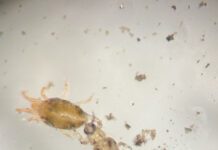
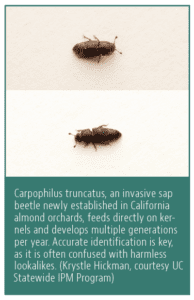
Not all little black beetles in almond orchards are Carpophilus truncatus. The driedfruit beetle and confused sap beetle can be found in orchards and mistaken for Carpophilus truncatus, which is the only species that feeds directly on the kernel. Other black beetle species feed only on decaying material. This almond and pistachio pest is 2.8 to 3.4 millimeters in body length as an adult. It has other characteristics that can only be seen with high-powered lenses.
The feeding damage is easier to identify but can also be confused with ant or navel orangeworm feeding. Wilson advised cracking open nuts and looking for feeding damage.
Both the Almond Board and Pistachio Research Board are funding research into management of the Carpophilus beetle. Control measures are limited, Wilson said. Chemical control success has been highly variable due to coverage issues. Results from 2025 found no significant impact from any chemical control materials. Biological control is also limited.
Work continues on refining a trap and lure combination in Australia. Wilson said pheromone compounds have been identified and synthesized. So far, he said, the compounds are attracting a lot of beetles.
Crop sanitation is the key to control this beetle. Putting the mummies on the ground and shredding them completely is advised, even if it means multiple passes. Wilson said adult beetles will survive on mummies even if they are buried in the soil.
Diseases
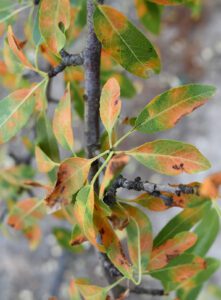
Fungal and bacterial diseases continue to impact California almond production, but Adaskaveg noted that climatic conditions generally limit severe outbreaks. Practices that modify the orchard environment, monitoring for pathogens and forecasts that allow for adjustment of management all contribute to keeping disease levels low.
Adaskaveg noted that Phytophthora diseases are caused by either cool- or warm-temperature species. Surface irrigation water can be contaminated with the pathogen.
Preventive measures include planting on berms, use of resistant rootstocks and soil applications of fungicides. Foliar applications of potassium phosphite can be used to prevent aerial phytophthora in susceptible cultivars.
Adaskaveg noted that surface water sources can be contaminated with the pathogen. Sanitation treatments for irrigation water were found effective. These include low concentrations of PAA, with rates of less than 5 ppm inactivating zoospores. NaOCl and chlorine dioxide at 5 ppm were effective in two-minute exposures to different irrigation water sources. However, NaOCl is a salt and may be harmful to plants. Chlorine dioxide is applied as a liquid and volatilizes off. A new formulation of chlorine dioxide is nearly odorless and much less corrosive than chlorine.
Other Disease Updates
A Section 18 for Kasumin was again submitted for 2026, Adaskaveg said, and full registration is still pending. This treatment has been highly effective against bacterial blast.
New fungicides are performing well against Alternaria leaf spot and hull rot in trials over the past three years.
Fungicides include Cevya, Elisys, Maravis Prime, Miravis Duo, Regev and Scala DFO. Applications of fungicides are timed with hull split NOW treatment, which are compatible as tank mixtures.
Adaskaveg said disease management also depends on orchard location, design, age and disease risk. Use of disease forecasts can help with prevention efforts.
The Regional Almond Disease Risk Prediction System is a system to increase awareness of the risk for disease and improve management, including timing of fungicide and bactericide treatments for the almond production regions of the state.
Red Leaf Blotch
A new and serious disease in almond production, red leaf blotch, is here to stay, Trouillas told growers at The Almond Conference. He expects it will become the main focus in almond disease management strategies, integrating it into management of rust, scab and shothole.
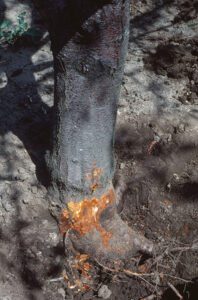
Red leaf blotch first appeared in 2024 in Merced County. This fungal disease only affects leaves, but in orchards with no fungicide treatment and a history of RLB, all leaves on all trees can become infected, causing early defoliation. This has high energy costs for trees and may prompt new leaf push. Infected leaves on the ground will serve as inoculum for the next growing season.
Trouillas explained that this disease has only one primary infection cycle. Symptoms begin to appear in the spring after a 35- to 40-day incubation period. During the summer, pycnidia forms on the leaves. The pathogen overwinters on leaf litter, and a new cycle of infection begins in the spring.
Current Research
A spore trapping study is looking at the seasonal spore dispersal dynamic to determine when spore inoculum is present in almond orchards. Using microscope slides covered with Vaseline, spores are trapped and counted. Counts are superimposed with weather data to show likely infection timing. Trouillas said that research is continuing to determine the optimal number of fungicide applications, but he notes that at least two to three applications will be required between petal fall and five weeks post-petal fall for effective management. Once symptoms appear, fungicides are not effective.
He advises using fungicides smartly, alternating active ingredients to avoid resistance. Mixing fungicides in FRAC groups 3+7, 3+11, 7+11, 7+12 and FRAC 3 triazoles are most effective.

Cecilia Parsons | Associate Editor
Cecilia Parsons has lived in the Central Valley community of Ducor since 1976, covering agriculture for numerous agricultural publications over the years. She has found and nurtured many wonderful and helpful contacts in the ag community, including the UCCE advisors, allowing for news coverage that focuses on the basics of food production.
She is always on the search for new ag topics that can help growers and processors in the San Joaquin Valley improve their bottom line.
In her free time, Cecilia rides her horse, Holly in ranch versatility shows and raises registered Shetland sheep which she exhibits at county and state fairs during the summer.