


Listen to the audio version of this article. (Generated by A.I.)
Chilean growers are expected to harvest more than 200,000 metric tons of hazelnuts annually by 2030, far outpacing Oregon’s expected production and firmly establishing the country as the second-largest hazelnut producer, behind only Turkey.
As recently as this past year, Chile ranked third in world hazelnut production, coming in behind Turkey and Oregon, which produced a record crop of around 112,000 metric tons in 2025.
The projections, highlighted in a presentation from Jorge Mohr Fuchslocher of Nefuen Trading Chile SpA at the Nut Growers Society Winter Meeting in Albany, Ore., Jan. 7, take into account a dramatic growth in the Chilean hazelnut industry over the past six years.
“In 2020, the total nut industry in Chile (including walnuts, almonds and hazelnuts) was not even a 600 million U.S. dollar industry,” Mohr said. “Today it is double that.” He noted that hazelnuts account for more than 45% of the Chilean nut exports, a percentage that is growing annually.
Concurrently, hectares planted to hazelnuts in Chile have nearly doubled over the past six years and are expected to exceed 60,000 in 2026, or slightly more than 148,000 acres.
Mohr added the projections for 2030 are not taking into account any increases in planted acreage in 2027 or 2028.
“This is only considering the 6,000 hectares that will be planted this winter,” he said.
The developments are somewhat remarkable considering the Chilean hazelnut industry only really started expanding in 2010 with the introduction of cultivars from Oregon. The industry got a shot in the arm in 2014 when Ferrero established the first big processing plant in Chile, and beginning in 2015 the Oregon cultivars started producing significant volumes.

Off-Season Production
Chile is the only significant off-season hazelnut production region in the world, with the rest of the major players being in the Northern Hemisphere. The country has essentially three growing regions: a north, central and southern region. In the northern region, much of the hazelnut production is conducted near the mountains in order to access more chilling hours, Mohr said. The farther south, the cooler the climate.
With some exceptions, Chilean hazelnut growers utilize many of the same growing practices as Oregon growers. They grow many of the same cultivars, with OSU varieties making up a sizable percentage of its acreage, and particularly on the acreage planted since 2015. Yamhill is the most popular variety among the OSU varieties in Chile, followed by Tonda Pacifica, McDonald and PollyO. Overall, Tonda di Giffoni is the dominant variety grown in Chile, followed by Barcelona and pollinizers, according to Mohr.
Because of significant climatic differences between the different regions, pollinizer selection can vary significantly depending on location.
“In 2020, the total nut industry in Chile (including walnuts, almonds and hazelnuts) was not even a 600 million U.S. dollar industry. Today it is double that.” Jorge Mohr
“When you plant in one area and move to another area, you need to use different combinations of pollinizers,” he said.
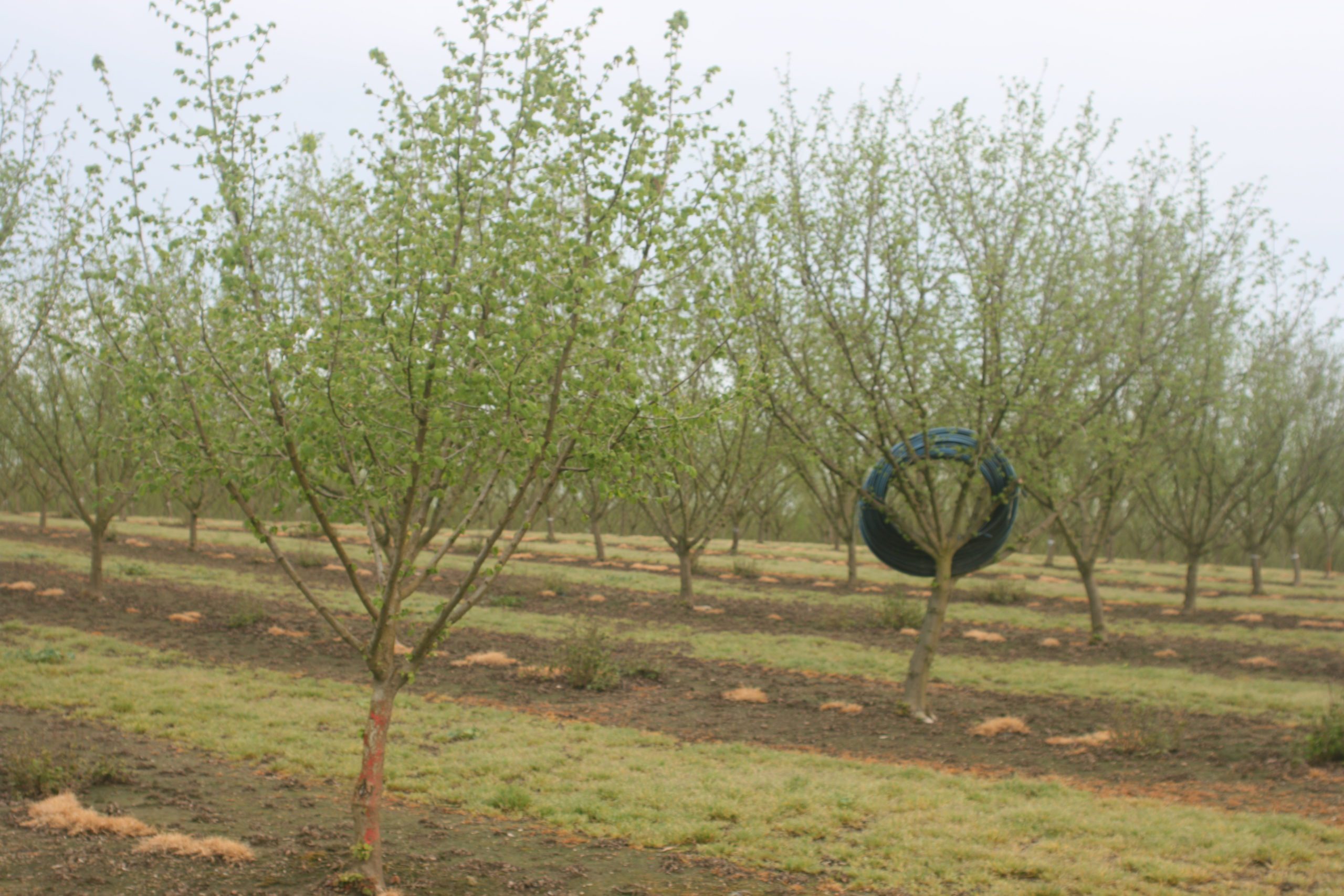
Orchard planting techniques in Chile involve use of electroconductivity meters to measure soil differences as part of efforts to dial in irrigation needs and gauge soil preparation needs. If soil is too compact, growers will use an excavator to break up the compaction. If soil is too shallow, growers will utilize berms to build up soil height.
Varietal selection is based on several factors, including market forces.
“I always say, we should produce what the market demands,” Mohr said.
He advises growers to focus on growing cultivars that produce kernels of between 11 and 13 millimeters, typically the most popular sizes for hazelnuts used as ingredients. He noted that 90% of hazelnuts today are sold as kernels and more than 70% of those are used as ingredients.
Differences in climate, soil types and irrigation and nutrition practices create differences in kernel sizes between varieties grown in Chile and varieties grown in Oregon, Mohr said. Yamhill, for instance, typically produces larger kernels when grown in Chile than when grown in Oregon.
Chilean hazelnut growers typically mechanically prune, usually around October, which has a climate consistent with April in Oregon. And growers have begun using plant growth regulators (PGRs) to help control tree vigor. The PGRs are increasing the number of internodes in trees and flowers, which is helping boost productivity.
“People with this technique are even reaching very close to 6 tons a hectare (or 5,350 pounds per acre) today in Chile,” he said.
Typical yields in Chile are around 4,000 pounds per acre for fully mature orchards, he said.

Future Challenges
Mohr highlighted management of newly emerging fungal diseases and native insects as significant future challenges confronting the Chilean hazelnut industry. He noted that while growers are fortunate in that they are not having to manage for brown marmorated stink bug, which is a huge concern for growers in many other production areas, the industry still has issues with insects.
Sustainable plant nutrition and maintaining soil health are other areas of future concern, he said, as is a need for more utilization of training systems for high-density planting. Current goals are to increase planting density to as high as 2,000 plants per hectare.
Pruning and canopy management are other areas of future concern for the industry, he said. And standardizing production practices, which can vary extensively depending on whom a grower is relying on for crop advice, is another area of concern.
The industry also needs to focus on increasing cleaning and drying capacity to ensure it can meet its future production volumes and work on developing new markets to maintain in-shell prices while diversifying its market reach, he said.

Vertically Integrated Company
Nefuen Trading is a vertically integrated company that operates nurseries, owns and manages orchards, and runs processing facilities in Chile. The company also provides representation for the Oregon State University breeding program. Its nursery, Viveros Nefuen, holds the exclusive license agreement to propagate OSU hazelnut cultivars for South America and Europe. The company has provided the university more than $3.5 million in royalties, according to Mohr.