


Listen to the audio version of this article. (Generated by A.I.)
Resistant rootstocks are a key management tool for oak root fungus in almond orchards. This wood decay fungus, Armillaria, poses an ongoing challenge for almond production in California, causing slow decline in tree health and production. Reports from UC researchers and farm advisors note oak root fungus is a chronic issue in the Central Valley and is a significant factor in tree decline for some growers.
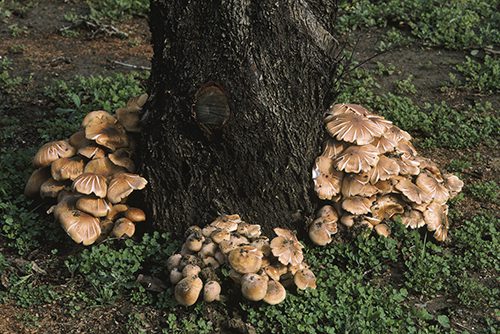
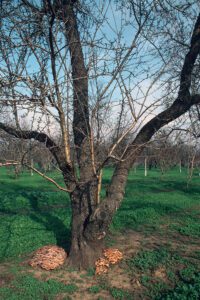
Armillaria is found in all almond production areas of California. The fungus Armillaria mellea colonizes and kills tree roots and then decomposes the root wood as its source of nutrition. As the disease progresses, it reduces crop yield and growth and inhibits nutrient and water uptake from the soil. The trees eventually collapse and die.
UCCE orchard systems advisor Luke Milliron in Butte and Glenn counties noted that the pathogen remains in the orchard soil and will infect subsequent generations of trees unless preventative measures are taken. Soil fumigation and removal of root material from dead trees and even removal of nearby trees that may be infected is one approach. Milliron noted that using resistant rootstocks is a key part of the strategy.
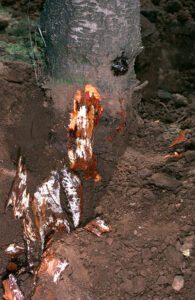
Almond Pest Management Guidelines from the UC IPM program note that the fungus Armillaria mellea survives on and in dead roots. The fungus spreads from one tree to another as roots from a healthy tree come in contact with diseased roots of a nearby infected tree. This fungus has a wide range of hosts. Infected roots have white to yellowish fan-shaped mycelial mats between the bark and the wood. Dark brown to black rhizomorphs can sometimes be seen on the root surface. These thick, rootlike fungal structures are highly resistant to desiccation and can survive in the soil for many years, even decades.
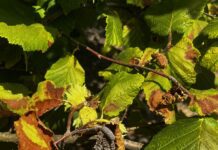
Symptoms of infected trees resemble other problems that affect root health, such as gophers, Phytophthora or saturated soil. Armillaria disease usually starts with a tree here and there in an orchard and then pockets of dying trees begin to form and enlarge each year from those spots. Infected trees slowly begin to develop pale, small leaves. There is a lack of new growth and the canopy thins. Within a year or two of showing symptoms, trees can collapse with the onset of warm weather.
In a Growing the Valley podcast episode, Milliron and Stanislaus County UC farm advisor emeritus Roger Duncan noted that oak root fungus infections can be triggered by environmental conditions where the pathogen and a susceptible host are present. Soil that is wet for long periods of time can tip the scales in favor of the fungal infection, Milliron said.
Management is Prevention
Once a tree is infected with oak root fungus, there are no topical fungicides you can spray that will slow the decay. Preplant soil fumigation with chloropicrin can reduce but not completely eliminate the fungus from the soil.
“Even when methyl bromide fumigation was allowed, it still wasn’t completely effective. The fungus can grow deep into large roots and the crown of infected trees where fumigants won’t reach,” Duncan said.
Removing symptomatic trees as well as apparently healthy trees adjacent to infected trees can slow the spread of oak root fungus in the orchard. Growers should try to remove as many large roots as possible before replanting.
“Genetics is the solution,”
– Luke Milliron
Subsurface ripping or deep plowing are not recommended as these practices may move inoculum throughout the orchard and spread the disease when new trees are planted.
“Genetics is the solution,” Milliron said.
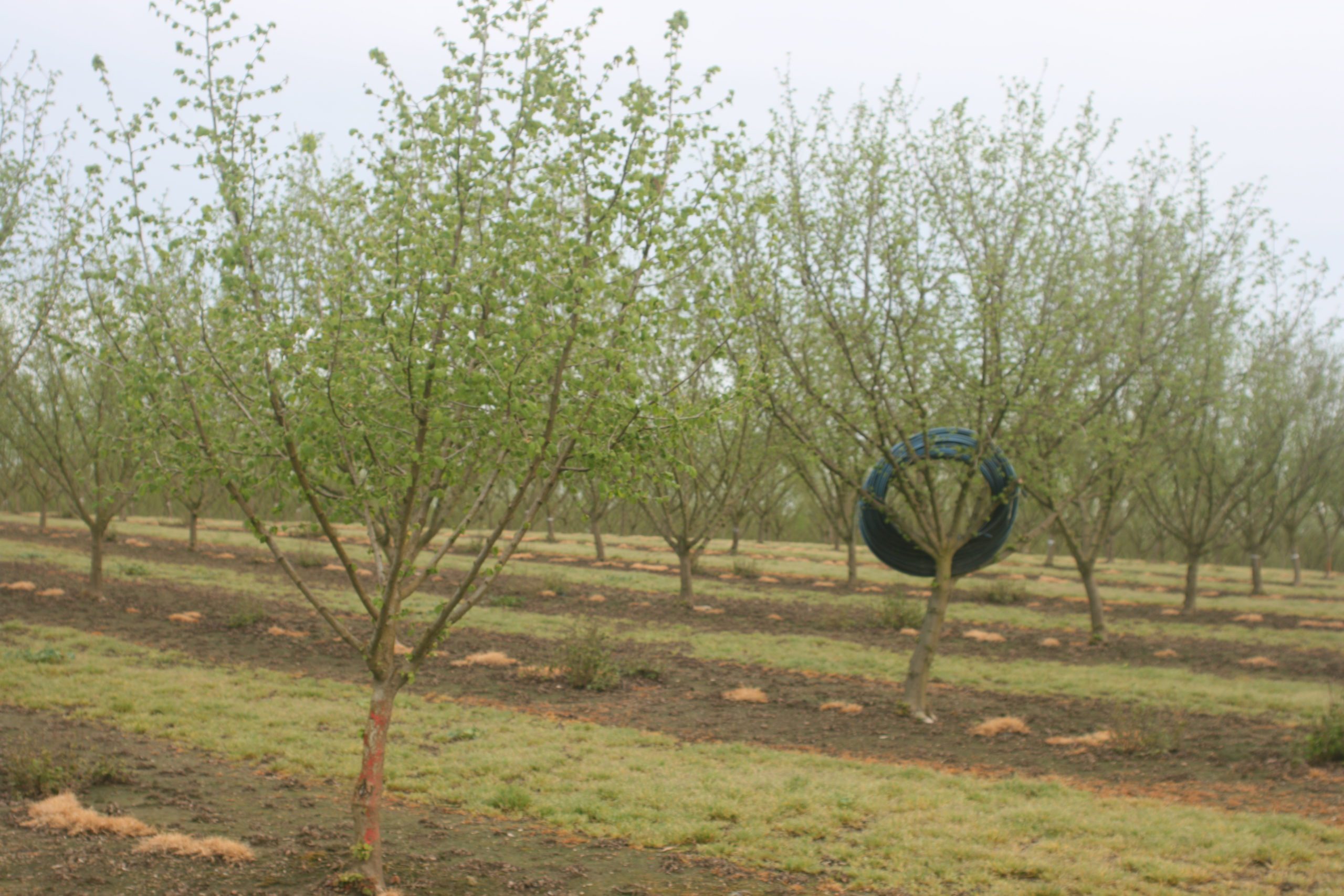
A Patterson area site with a history of Armillaria is being monitored to determine resistance to oak root fungus in new rootstocks as well as other desired and undesired traits. Last year the trial was only in the third leaf and Duncan noted that there have already been a few trees killed by Armillaria. It will take several years before conclusions can be drawn from this trial.
Resistant Rootstocks
Resistant rootstocks are a key tool in management of oak root fungus when replanting an orchard.
Plum genetics, particularly the plum species Prunus cerasifera, in almond rootstocks has been a standard answer when replanting an orchard with a history of oak root fungus. Milliron said there are some serious incompatibility issues with the historic choice Marianna 2624. It is considered to be incompatible with Nonpareil and Butte. Extensive suckering from the crown and roots, along with lower vigor, have led to rejection of this rootstock for replanting by many growers.
The long-term Patterson rootstock trial, in the third leaf in 2025, is aimed at determining the best choices for replanting where oak root fungus is present in the soil. Milliron and Duncan note that it will be several years before planting recommendations can be made based on the results of the trial.
Duncan said while assessing resistance, they are also noting tree vigor and signs of rootstock incompatibility with the almond scions Butte and Padre.
In the meantime, they reported that growers are planting Krymsk 86, a plum x peach rootstock, as a preventative in known Armillaria spots. It is not known if Krymsk 86 will deliver the same level of resistance as Marianna 2624. USDA and UC farm advisors note that it offers higher survival rates against oak root fungus than Lovell and Nemaguard. According to Milliron, the downside of Krymsk 86 is that it appears to be not fully compatible with all almond varieties, including Independence and the new self-fertile varieties Lassen and Pyrenees. There are self-fertile varieties that will work with Krymsk 86, including Yorizane and Parpareil.
Milliron and Duncan said that if oak root fungus is a concern where a new orchard is to be planted, Krymsk 86 is the rootstock that carries the most evidence of success at the moment. Rootpac R is another alternative rootstock that is assumed to have some resistance because of its P. cerasifera plum parentage, although it is also half almond, which is very susceptible, and there are no data yet to support the assumption. Relatively low vigor can be a concern with Rootpac R, particularly if planted in a sandy or sandy loam soil or paired with a low-vigor variety. This rootstock can also cause yellowing with young Monterey trees.
Almond Rootstock Database
UC Davis has an extensive, searchable, online rootstock database at its Fruit and Nut Center and can be accessed at https://fruitsandnuts.ucdavis.edu/rootstocks. Growers also can download a copy of a UC ANR almond rootstock guide at https://fruitsandnuts.ucdavis.edu/almond-rootstock-comparison-chart. The Almond Rootstock Database can be used to gather information about rootstocks. The database can be searched by name or by rootstock characteristics of interest. The research used to develop these tools was performed by UC ANR scientists and supported by the Almond Board of California.

Cecilia Parsons | Associate Editor
Cecilia Parsons has lived in the Central Valley community of Ducor since 1976, covering agriculture for numerous agricultural publications over the years. She has found and nurtured many wonderful and helpful contacts in the ag community, including the UCCE advisors, allowing for news coverage that focuses on the basics of food production.
She is always on the search for new ag topics that can help growers and processors in the San Joaquin Valley improve their bottom line.
In her free time, Cecilia rides her horse, Holly in ranch versatility shows and raises registered Shetland sheep which she exhibits at county and state fairs during the summer.