

Listen to the audio version of this article. (Generated by A.I.)
Four years ago, Asa Robinson had a steady, tenured teaching position in Etna, California, when he and his wife, Samantha, decided to buy 5 acres of the family farm in Red Bluff, California, and move their young family into the house where his grandfather had lived for 70 years. It was a big decision, but he is glad they took the opportunity.
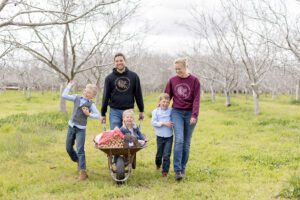
“Farming is just part of life,” he says. “I’ve got four kids, ages 10 down to about 2, and it’s a good place to grow up.”
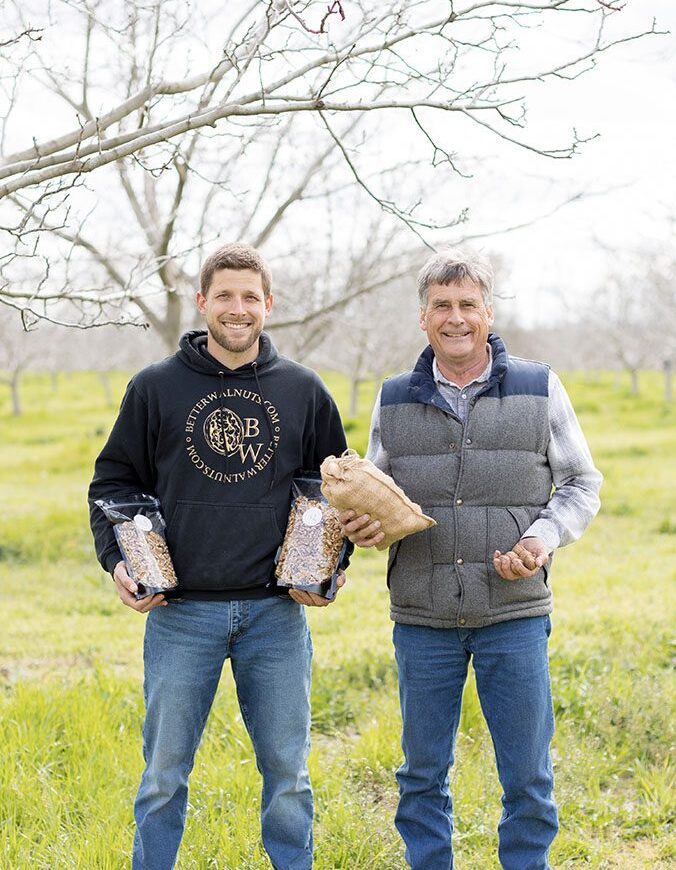
With the help of his uncle, John, who planted and owns 17 acres of walnuts on the family farm, Robinson founded Better Walnuts, a direct-to-consumer sales company born out of the need to move walnuts at a better price than they were getting at the wholesaler.
Today, Better Walnuts moves about 4,000 pounds of light halves and pieces from his uncle’s orchard, with the rest of the crop going to wholesale.
We asked Robinson to share his thoughts on the nut industry from a small farm perspective:
Family Roots and a Return Home
Tell us about the history of your company.
Asa Robinson: My grandfather was probably the most influential person in my life as far as consciously looking at someone’s life and seeing it as a model to aspire to. He was a real Christian in terms of not just talking about it but also living it. The property I live on now was his house. When I was a kid, that’s where I used to go and spend time with him and Grandma.
Those are really the roots of it. It wasn’t necessarily about farming at first. Growing up, I didn’t think there was enough money in farming to pay the bills, and in a way, I was right. But I saw the life that he lived and who he was, and that was what was attractive to me.
One of the last things he said to me before he passed away was, “We were never big shots, but we always made a living.” He told me it had been a good life and that he was “going to God who brought us all the way.” When you’ve been around that, you know it’s just something you want.
The very last thing I remember him saying was, “Praise the Lord. Do those trees need water?”
In 2022, I sold the house we were living in, liquidated everything I had, bought five acres of the family farm with my grandfather’s house and moved my own family back. It wasn’t really a farming decision; it was more of a life decision.
How much background did you have in nut farming before you moved back?
I moved hand lines, mowed with a tractor and pruned sometimes. I worked for pay in the summers here and there as a teenager in the orchard. And as a kid, when you went over to visit Grandpa, you always went out to the orchard. That was how you spent time. Four-wheeler rides, then you’d end up cutting suckers or painting trees. There was always work to do. It was that kind of farming where the work is just part of your life a little bit at a time. So I’d been around it. I knew it, but I wasn’t an expert at all.
Better Walnuts was mostly built on my uncle John’s expertise and connections, not mine. With his wife and four kids, he planted a 17-acre orchard on the family farm, and when my grandfather was alive, they were in the walnut business together. He also managed commercial orchards for a living. In addition to the 27 acres of walnuts on the farm at its peak, I think he was in charge of maybe 1,000 or 1,500 acres of walnuts and prunes for a larger landowner. He’s also a licensed pest control adviser, so if I need to know something on the farming side, I ask him. We’re a good team with different skills and personalities but similar values.
A lot of what we were doing, especially getting access to our own walnuts from our sheller, which is not an easy thing to do, came through his connections. He used those same shellers when he was managing orchards for larger growers, and he had relationships with those guys.
Initially, I wasn’t even planning to move down. I was just going to help him a little bit with the marketing side and some of the business.
Going Direct to Consumer
How did you decide to focus on direct sales?
Asa Robinson: I believe that God works through circumstances. Our initial thought was that we were just going to start selling a little bit at a time and build it slowly. It was something my uncle John was already doing a little for friends and family.
Then the market got really bad. The year we started, we pulled about 4,000 pounds, and on the rest of my uncle’s walnuts he was getting paid 19 cents a pound. When I found that out, I said, “Well, I’ll buy every one of his nuts right now for 19 cents a pound.”
They couldn’t sell them to me because they’d already gone into the pool, but that was kind of a pivotal moment. At 19 cents a pound, you’re not risking much by taking them and trying to sell them yourself. So that’s why it grew. It was a huge amount of work, and I’ve scaled it back some since then.
“It was never about building an empire. The end goal was the relationships, the family and the life you lived.”
Why did you decide to offer organic walnuts?
This year was a little different. Organic walnuts came into the picture. One of the neighbors offered me the chance to take over managing a 10-acre orchard he had managed for many years. It was another example of getting a lot of help and favor from people since I’ve moved back.
I thought about the offer, did the math and realized that conventional production wasn’t going to pay.
That orchard hadn’t been sprayed in three years. Around here, if you don’t have the money for a good spray rig, you’re wasting your money spraying. Honestly, if you don’t know what you’re doing or don’t have the equipment, it doesn’t make sense.
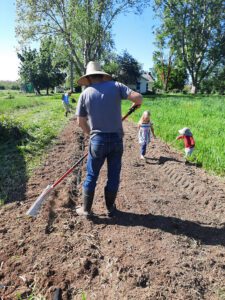
Personally, I’m committed to stewarding the land well. For me, the safest way to do that is not to put a lot of chemicals on it. Even if it hadn’t been a financial decision, I probably would have gone organic. There’s a lot of paperwork that goes with organic certification, but it’s manageable. So I decided to take it on and see if we could get it certified. I had to figure that whole process out.
Now we’re selling in-shell organic walnuts direct to consumers, and we’ve wholesaled some as well. So far, it looks good.
Sometimes it makes more sense, dollar-wise, to lose a few black nuts and sell them organically than it would be to spray. So a lot of what I’ve done has been asking people questions, thinking through the options, praying about it and then making a decision. That’s basically been the last three years, constantly.
Industry Outlook and Small-Farm Strategy
Talk a little about the state of the walnut industry. Do you see any future in walnuts?
Asa Robinson: I don’t think walnuts are going away, but I do think it makes sense for small farms to diversify away from relying on them. Forty years ago, walnuts were a high-value crop.
What’s changed is that you used to only be able to grow walnuts on certain types of ground, and we happen to live on one of those places. Now, with microirrigation, fertigation and all the technology that’s out there, you can grow walnuts on ground that used to be marginal.
I think the trend across a lot of ag industries is consolidation and thinner margins. Diversification and direct-to-consumer sales are ways for a small farm to deal with that.
I think prices are going to stay right at the edge of where people can still produce at scale and make money. And where people can produce at scale and make money is lower than where you can produce at small scale and make money.
That could change if the dollar weakens. If your market is built on exports and the dollar weakens, you could see higher prices, not because walnuts are more valuable, but because the dollar is worth less.
What I come back to is what my grandfather said: we were never big shots, but we always made a living.
By diversifying, you’re not farming to get rich. You’re farming to live this way. Even if we could become a big nut grower, would we want to? Would we want to be sitting in an office all day or driving around on the phone telling laborers what to do?
I want to farm. I need to make a certain amount per hour to pay the bills, but beyond that, it’s about how I want to spend my time.
This farm wasn’t always in nuts. Seventy or 80 years ago, the ground was leased for watermelon. Grandpa grew hay and had animals. When orchard crops came in, he went to prunes, then walnuts.
It was never about building an empire. The end goal was the relationships, the family and the life you lived. That’s more valuable than stacking up the money or land.
Lessons in Direct Marketing
What was the learning curve like on selling direct?
I really had to learn walnut marketing fast. I was on the phone and internet, trying to figure things out and get walnuts sold. I learned Google Merchant Center, Google Console, Facebook ads, basically everything I could because I had to move product.
So if someone else wanted to do this, I’d honestly be happy to talk to them. I could help them understand whether it would make sense for them or not, and what it would actually take. I’ve even thought about whether there could be some collaboration.
At this point, most parts of the business make some money. It’s just a question of how much per hour and how much I enjoy doing it.
For example, if we had a good almond grower, or a pistachio grower, or a pecan grower locally, there might be some opportunity there. We did sell some local pecans for a while. A lot of people who want to buy walnuts also want to buy other nuts.
The challenge is consistency. With our walnuts, they’re very consistent because they come from the same field, the same grower, the same sheller, the same harvest. So when people buy them, they’re getting the same thing every time.
It’s hard to replicate that consistency with other crops unless you know the grower really well and have that same level of control.
What advice would you give to other small growers?
Asa Robinson: One thing I’d emphasize is that money shouldn’t be the No. 1 thing. Considering other factors in your decision-making is really important.
I also think it’s important not to try to copy large operations. You can look at what they’re doing, but you have to ask whether it makes sense at a smaller scale.
Start small. Test things. The conditions forced us to go all in for a short time, but normally it makes sense to test whether something is viable before committing fully.
Think about timing. Winter is lower labor time, so it makes sense to spend that time on sales. Summer is when I need to be in the fields, so I don’t want to be focused on selling then.
Diversification matters. The land doesn’t really care what crop it grows. This land was here before walnuts, and it can be here after walnuts.
Avoid debt and leverage if you can. If you don’t have the money, find another way to do it. That’s how my family has always operated.
You’ll probably never have fancy stuff, but you can make a living. Think about how you want to spend your time. We could have sold more walnuts direct to consumer this year, but packaging, paperwork, sales calls and marketing campaigns weren’t how I wanted to spend my time.
That work is also isolating. It’s harder to involve other people on the farm in that kind of work. Hand-rolling walnuts, drying them on screens and selling them in small batches is something we can do together.
So it’s not just about the dollars. It’s about how to involve people, how to do things with what you have and whether there’s another way to do it without spending $80,000 on equipment.
I haven’t been here very long, but that’s what I’ve learned so far.