

Listen to the audio version of this article. (Generated by A.I.)
Pollination in pistachio production is a process, not an event. Floret maturity, pollen availability and viability, and pistil receptivity are critical parts of the process.
A dioecious crop, the male and female flowers are borne on separate trees. Female flowers are wind-pollinated, but there are many factors involved in successful pollination, meaning a good crop yield and nut quality. Duration of bloom, timing of pollen release, pollen longevity, stigma receptivity and environmental conditions can all affect crop outcome.
In a presentation at the UC Statewide Pistachio Day, UCCE orchard systems advisor Elizabeth Fichtner explained pollen biology and the pollination process. While overlap of pollen release and flower receptivity are critical for crop pollination, there are other challenges to a successful pollination and harvest of a quality crop.
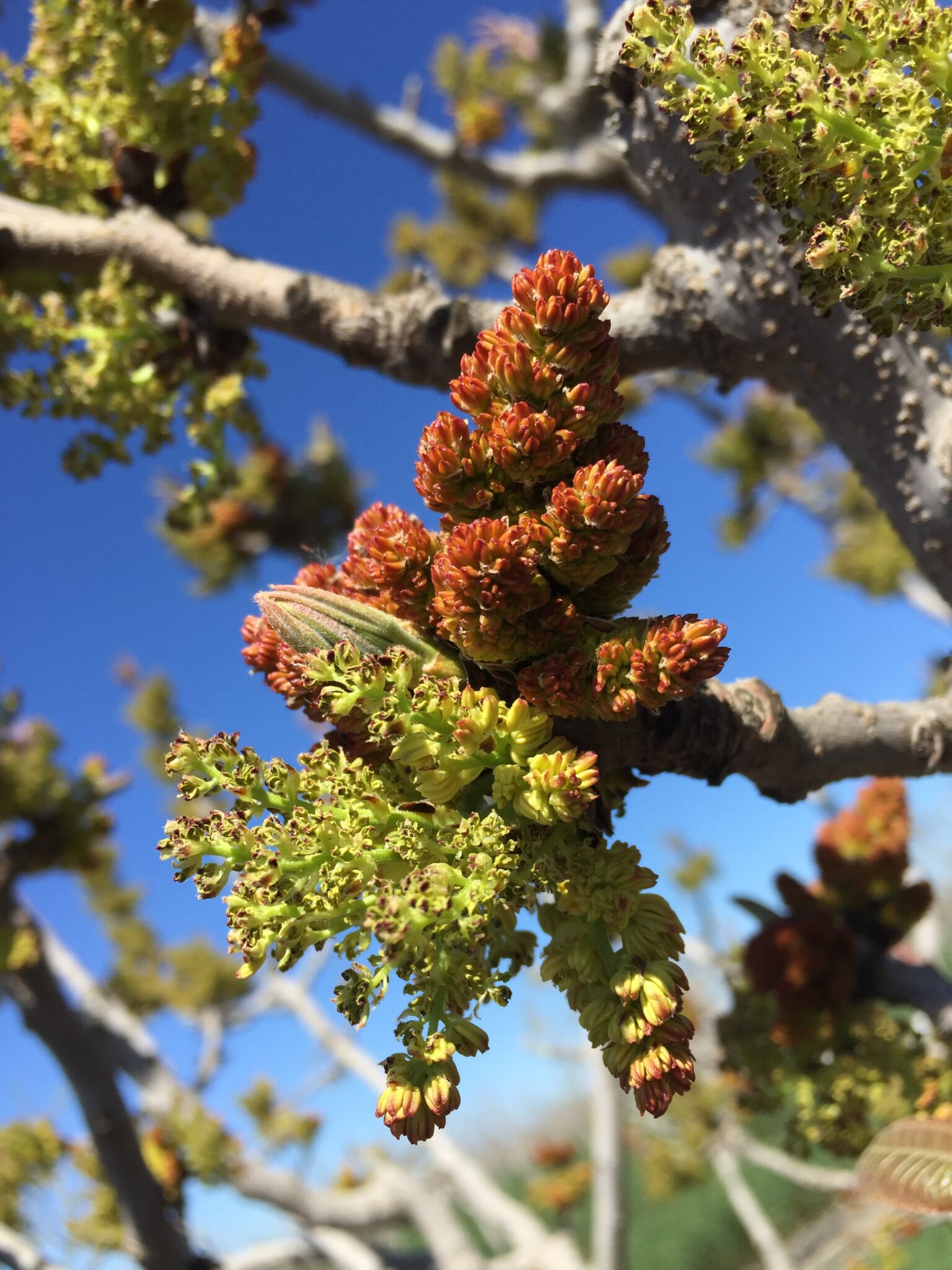
Flowers are borne in inflorescences on rachises. The female, or pistillate, flowers are 2 to 3 millimeters in size and there are about 300 flowers per inflorescence. There is a three-lobed stigma in each flower. On the male side, the flowers have around five anthers, which are the pollen-producing parts. Flower maturation is staggered within inflorescences. Apical buds open earlier. Basal flowers open earlier than distal flowers.
When it comes to pollen, Fichtner noted that their size, at around 20 micrometers, causes the grains to clump. Clumped pollen moves through the air differently than individual pollen grains. Researchers have noted that clumping may impede the use of some supplemental pollination efforts.
Dispersion of the pollen throughout an orchard depends on wind movement. Fichtner said the established minimum distance from pollenizers is 20 meters, or 66 feet. The current ratio of female to male in orchards is 24 female trees to every male. Male trees are typically planted in every fifth row and every fifth tree.
Studies have shown that pollen longevity relates to moisture content. As pollen desiccates, it loses viability. Longevity in the environment is hours, not days, with a time frame of 12 to 18 hours under normal environmental conditions. Pollen is shed for two weeks with the majority moving in seven to eight days. Timing of pollen shed is also notable, with 73% shed between 9 and 11 a.m. Fichtner explained that pistachio flowers have adapted over time to release in the morning when conditions are more favorable for pollen viability.
Pollen viability is critical to nut set and quality. As pollen viability decreases, non-splits and blanks percentages rise.
Wind enhances stigmatic pollen capture. Older inflorescences receive more pollen than younger inflorescences. Windward orientation receives more pollen than leeward. Fichtner noted that unclumped pollen moves erratically in spiraling trajectories on the leeward surface. Terminal flowers receive more pollen than lateral flowers.
“Based on atmospheric conditions and dispersal gradients, pollination efficiency is likely higher during morning hours,” Fichtner said.
Upon deposition, pollen germinates in two hours. As few as 14 to 15 pollen grains per flower are required for fertilization. Too much pollen on the stigma causes flower abscission. Pollination increases stigmatic secretion and accelerates stigma degradation.
Studies have shown that pollen germination varies with flower age. Pollen germination and tube penetration are highest on two- and three-day-old flowers. Successful germination is lower on four-day-old flowers. Peak pistil maturity is up to two days. Three-day-old pistils produced mainly misshapen and beyond that fruits mostly abscised before maturity.
Supplemental Pollen
Fichtner said that when pistachio prices are up, there is an incentive to increase yields with supplemental pollenization. There are benefits, including a reported 12.7% yield increase when male and female bloom are asynchronous and more split nuts, but research has shown that higher pollen levels may also reduce yields.
One study of supplemental pollination saw increased yields in one plot, but no effect at a second site. There was no effect in the following year. Fichtner cited another study done in Tulare County in a Kerman/Peters block with a history of low yields. Supplemental pollination applied had no effect on blanks or yield.
There is a place for supplementation, Fichtner noted. An isolated planting may have insufficient pollen movement or in a low chill year with asynchronous bloom. It could also be used to thin a crop in an on year to mitigate alternate bearing.
Research on mechanical harvest of pollen has been done. Fichtner said it requires different parameters than trunk shaking due to lack of leaves during bloom. This can also be an opportunity for development of pollenizer plantations as pollen sources, she added.
Pollen from Pistacia atlantica may affect nut quality, Fichtner warned. Pollen from P. atlantica male trees can cause low fruit set, reduced split percentage and reduced nut size.
Blanks can be a result of poor pollination. Blank pistachio nuts appear to result from both parthenocarpy, which is shell/hull development without fertilization, and from stenospermy, post-fertilization embryo abortion.
“Pollination in pistachio production is a process, not an event.“
– Elizabeth Fichtner, UCCE orchard systems advisor
Dust’s Role
Fichtner said that research conducted by Lu Zhang and others has shown that parthenocarpy can be caused by dust. Cultural activity in orchards during bloom can send dust up into trees, which induces stigma wilting and results in lower yields. Dust and herbicide residue blowing in the orchard during bloom had an even more serious effect on pollination. Damage to stigmatic surface resulted in less than 5.2% fruit set and 100% nut drop by harvest. The recommendation is to minimize any dust-inducing orchard operations during bloom.
Male and Female Synchrony
Male and female synchrony can be affected in low chill years, Fichtner said, as male pollenizers tend to be later than females. Supplemental pollenizers may be planted to enhance pollination and nut set. She cited work done by UC farm advisor Craig Kallsen and UC Davis plant scientist Dan Parfitt in development of a new male pistachio to replace Peters in California Kerman plantings. Kerman does not always flower on the same dates as Peters when chill is limited. Famoso flowers about the same time as Peters in adequate chill years, but its bloom better overlaps the receptivity of Kerman flowers in both low and high chill years.
In low chill years, Golden Hills and Lost Hills may benefit from supplemental early male trees like Tejon, whereas the standard pollinizer for these early varieties is Randy.

Cecilia Parsons | Associate Editor
Cecilia Parsons has lived in the Central Valley community of Ducor since 1976, covering agriculture for numerous agricultural publications over the years. She has found and nurtured many wonderful and helpful contacts in the ag community, including the UCCE advisors, allowing for news coverage that focuses on the basics of food production.
She is always on the search for new ag topics that can help growers and processors in the San Joaquin Valley improve their bottom line.
In her free time, Cecilia rides her horse, Holly in ranch versatility shows and raises registered Shetland sheep which she exhibits at county and state fairs during the summer.