


Listen to the audio version of this article. (Generated by A.I.)
Even as almond prices show signs of stabilization, many growers are finding that improved pricing alone isn’t enough to restore margins. Rising input costs, expanding pest pressure, regulatory demands and global trade uncertainty are converging and reshaping how growers make decisions as the season moves beyond bloom and into the critical spring management window.
As the industry moves through what she called the most complex environment in years, Alexi Rodriguez, who leads policy and advocacy efforts for the Almond Alliance, said those layers of pressure have become increasingly difficult to manage as multiple challenges arrive simultaneously.
While any one issue might be manageable on its own, she said the compounding effect is what continues to strain grower confidence.
“A single policy or market event is not likely to sink you,” Rodriguez said. “But when it’s compounding, the effect squeezes margins and erodes market confidence.”
Rodents Are a Costly Reality
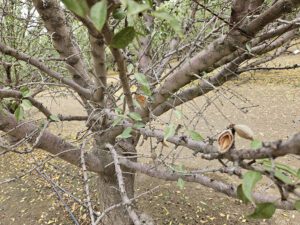
On the ground, one of the most visible examples of compounding pressure is rodent damage tied to abandoned and stressed orchards across the Central Valley. As water availability, economics and regulatory pressure push acreage out of production, unmanaged orchards have become a growing source of pest pressure for neighboring operations.
“Rodent pressure is one of the most persistent and costly challenges that growers are facing right now,” said Katie Staack, grower relations and safety coordinator for Grizzly Nut in Waterford.
Staack, who works closely with growers and regulators on pest mitigation issues through her work at Grizzly Nut and as a member of the Almond Alliance board of directors, said the issue has intensified in recent years as unmanaged acreage expands. Once orchards are no longer maintained, they can quickly become breeding grounds for rodents that don’t remain confined to a single property. And the damage extends beyond yield loss. Staack said rodents chew through irrigation systems, compromise berms and hit young plantings particularly hard, turning what was once considered a nuisance into millions of dollars in damage.
The problem isn’t confined to one county or region either, Staack said, with rodent pressures increasing across large parts of the Valley, especially in areas where water stressed orchards and SGMA-related challenges have left orchards extra vulnerable.
She added that addressing rodent pressure requires coordination among growers, regulators and agencies, particularly as the issue overlaps with broader invasive species challenges the industry faces. They have worked with USDA and NRCS to make the Environmental Quality Incentives Program more flexible to help with the costs of orchard removal, while also helping policy makers understand the real economic consequences of unmanaged ground and pushing for accountability and tools to address it. She added that the Almond Alliance is also working with CDFA, DPR, UCCE and other partners through the statewide working group to drive coordinated action.
“And that’s key, coordinated action,” she said. “This isn’t a local issue. It’s regional, interconnected and accelerating very quickly.”
Trade Volatility
While rodent pressure squeezes costs from below, trade dynamics shape the ceiling for almond profitability. With a substantial share of California’s almond crop exported, shifts in tariffs, shipping rules and buyer sentiment can ripple quickly through the market.
“Trade is arguably the single biggest factor that can impact profitability,” Rodriguez said.
She said tariff exposure remains one of the largest threats to price stability and market growth, especially as almonds compete in global markets where policy decisions can shift demand fast. Past trade disruptions have also demonstrated how quickly market share can be lost and how difficult it can be to regain.
Even short-term policy decisions, Rodriguez said, can have long-term consequences if competitors move quickly to fill gaps in key markets.
“When trade policy moves in a favorable direction, it’s something our industry feels almost immediately,” she said, adding that it’s one of their highest priorities this year.
Beyond tariffs, shipping and logistics are still a critical component of market access. Transportation variability, regulatory communication and international buyer confidence all influence how effectively almonds move through the supply chain.
Tackling Regulations an Uphill Battle
At the state level, regulatory activity continues to add cost, complexity and uncertainty for growers. Erin Norwood, a partner at Norwood Associates, which represents the Almond Alliance in Sacramento, said much of the work at the Capitol remains defensive.
“One of the biggest wins is often what we stop,” Norwood said.
She said agriculture frequently responds to proposals that were not designed with farming realities in mind, from groundwater policy to labeling and labor regulations. While many of those proposals never advance far enough to become law, the effort required to engage early and consistently remains substantial and time consuming.
“We’re playing defense 99% of the time,” she said.
Norwood said California’s legislative environment has become increasingly challenging as turnover among lawmakers increases and regulatory agendas accelerate. Building relationships and educating new legislators about what agriculture is actually facing, has become a growing priority as policy discussions move faster and become more complex.
Beyond policy and production costs, market signals themselves have become another source of volatility. The almond objective estimate has drawn scrutiny in recent seasons as abandoned acreage, reduced inputs and structural shifts challenge traditional forecasting models.
“Their statistical models simply cannot keep up with the changes that are occurring in the industry right now,” Rodriguez said.
Abandoned acres are likely to remain a factor, she said, while widespread input reductions may further complicate yield expectations. As water availability reshapes orchard management and some growers opt to reduce spending, the assumptions underlying long-standing estimation models become harder to apply.
Rodriguez said the issue is not whether forecasting tools have value, but whether their limitations are clearly communicated to the industry.
“If a model has limitations, there has to be a willingness to talk about them so that the industry members who use the reports understand where the potential for blind spots are,” she said.
Market participants rely on early estimates to guide contracting, inventory decisions and risk management. When uncertainty isn’t well defined, volatility can increase rather than decrease.
The comments came during a recent discussion at The Almond Conference, hosted by the Almond Board of California, but reflect broader challenges growers and handlers are navigating as the 2026 season takes shape.
Across all of these issues, Alliance leaders said engagement and coordination matter as much as any single policy outcome. Building relationships with regulators, lawmakers and industry partners has become critical as pressures stack and decisions are made earlier in the policy process.
“Policy is not made in a vacuum,” Rodriguez said. “It is shaped by who sits at the table, who brings the data, and who applies the pressure.”