


Listen to the audio version of this article. (Generated by A.I.)
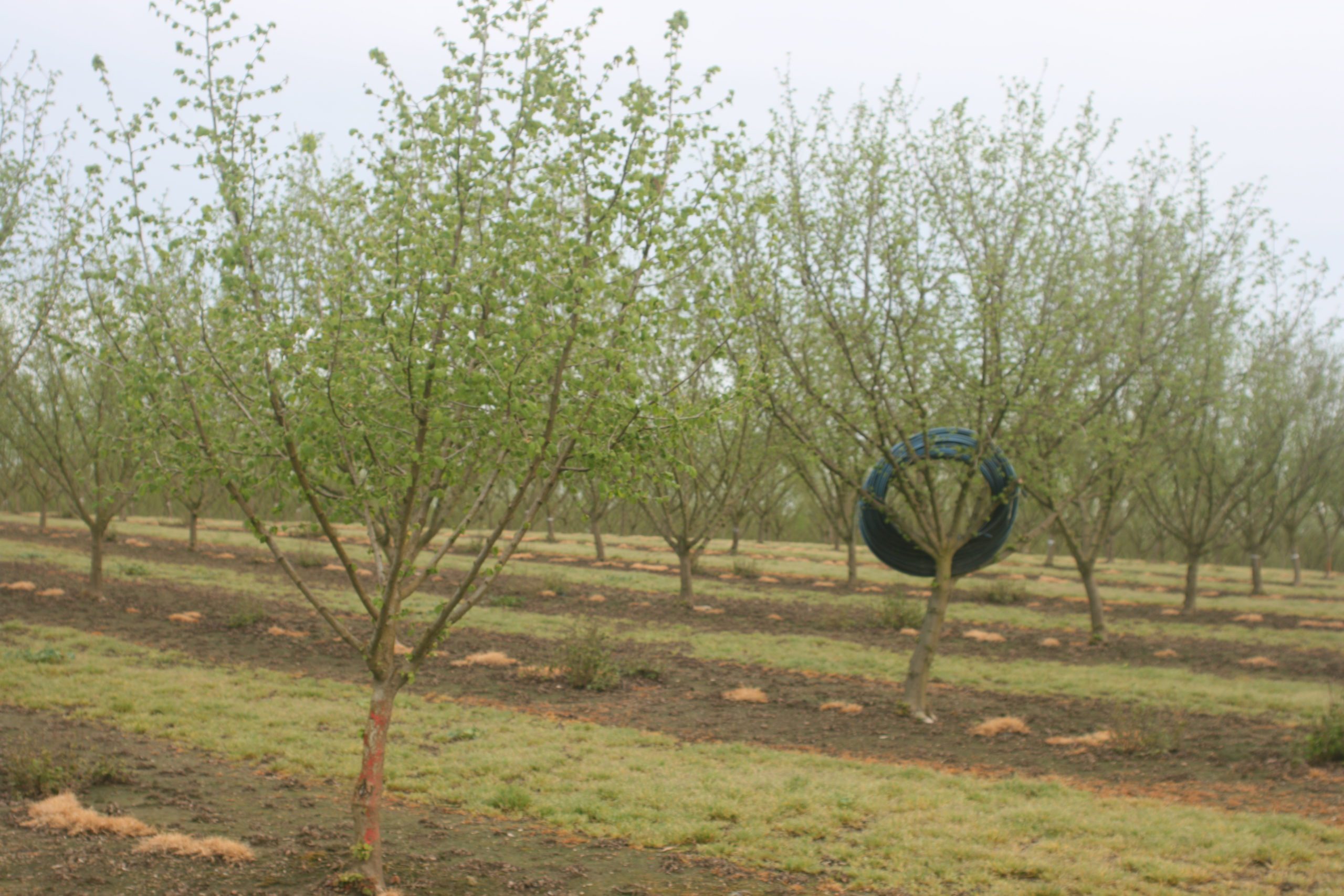
Lush, green cover crops on orchard floors in March make it difficult to envision the dry, dusty and hot days of summer, but they are inevitable, and so are web-spinning mites in your orchard.
Raymond Mireles, UCCE fruit and almond production advisor in Tulare and Fresno counties, said spider mite outbreaks are not uncommon in most orchards statewide, with southern outbreaks most likely. Water stress, hot temperatures and dust drive mite populations upward during the summer.
Web-spinning mites are tiny arachnids that can multiply quickly in hot, dry conditions and can cause severe tree defoliation if not controlled by insect predators or spray applications. Two-spotted and Pacific mites are the two common web-spinning mite species found in almonds. Female mites overwinter in orchards in the soil under leaf litter, under rough tree bark or in winter weeds. As weather warms and trees leaf out, they move up into trees, changing color depending on the food source. Early in the growing season, mites can be found in the lower to central areas of the tree. Dust movement in the orchard can move mite eggs into the tree canopies. With favorable environmental conditions and lack of control by predators or miticides, eight to 10 generations of web-spinning mites can be produced during the growing season.
Web-spinning mites feed on the leaves of almond trees, causing stippling, yellowing and eventually leaf drop. Severe infestations can lead to reduced photosynthesis, weakened trees and lower yields the following year due to reduced carbohydrate storage. Mireles said early-season mite infestations and subsequent tree defoliation cause the most harm. Tree health can be impacted by high levels of mite feeding, leading to lower fruit set and yields the following year. Late defoliation has a lesser impact on trees.
Web-spinning mites can be found in all almond orchards in all years. Significant differences in mite densities can vary from year to year depending on environmental conditions.
“If last season was a bad mite year, and conditions are conducive, expect the mites to come back,” Mireles said.
Monitoring and Sampling
Mireles recommends monitoring for spider mites beginning in April and May to make control decisions early in the season and prevent tree defoliation. Monitoring should continue into the summer to see if control measures were effective or if predator populations are building. When monitoring reveals mite presence in an orchard, a grower or pest management consultant can decide to wait and see if the mite predator population builds or make a timely spray application. Treatment is not necessary after August because mites begin to migrate off trees to prepare for overwintering.
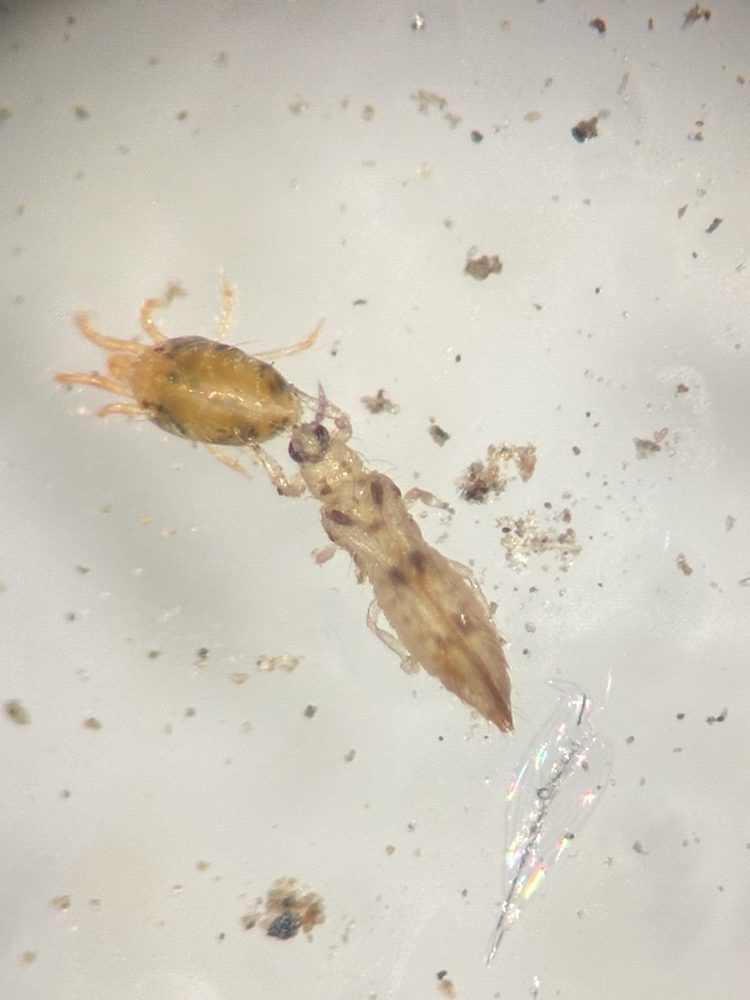
The UC IPM guidelines suggest monitoring for mites once a week. Problem areas with stressed trees or those adjacent to dirt roads should be sampled more frequently as weather warms. Initial monitoring and sampling include checking for predatory mites and sixspotted thrips on the same leaves as mites. Samples of leaves should come from a minimum of five trees, selecting 15 leaves from each, from inside and outside the canopy on all sides of the trees. Using a hand lens, check the underside of leaves for mites, eggs and predators. Count the number of leaves with pest mites or eggs and the number of leaves with predators. If leaf samples show that 38% of the leaves have spider mites, it is time to consider control before mite populations reach damaging levels.
“It may take time for beneficial populations to grow in the orchard, but if you are finding them when sampling, they can provide control,” Mireles said.
The goal of biocontrol with predatory insects is to maintain a balanced ratio of predators to spider mites that will allow the beneficial predators to suppress spider mite populations. When monitoring for the presence of beneficials, Mireles said to expect a lag time between spider mite outbreaks and a rise in the predator population. Finding one or two thrips on leaves in April may be a signal that sufficient thrips populations in the orchard can combat mite infestation.
If no thrips are found by late May and leaf monitoring shows that the threshold for spider mites has been reached, Mireles said orchard environmental conditions must be considered. Higher temperatures and dusty conditions can trigger a serious outbreak.
The UC publication Sac Valley Orchards notes that a basic rule of biological control is to not starve or kill the beneficials. Early-season destruction of natural enemies or their food sources with insecticides will mean fewer beneficials in the orchard to keep spider mites below economically damaging levels.
Predatory mites can be purchased from insectaries and released when spider mites are present to make sure there is a food source. This should be done prior to reaching treatment thresholds. Predatory mite releases are not advised in areas where sixspotted thrips are present, since the predatory thrips are known to eat both spider mites and predatory mites.
Threshold and Biological Control Approach
The decision must be based on field parameters, Mireles said.
Timing of outbreaks is critical. Increasing mite numbers in field samples, lots of webbing observed and water-stressed trees. Early defoliation of trees by spider mites leaves them without critical carbohydrate reserves for the next growing season. Spider mite feeding robs trees of chlorophyll, and defoliation reduces photosynthesis.
With the threshold approach, spider mites are not chemically treated until economic thresholds are reached, with the goal of maintaining a balanced ratio of natural enemies to spider mites that will allow suppression of spider mites.
Almond Board of California notes that the practice of early-season preventive sprays for spider mites has been common for many years, but changes in thrips populations over time have made prophylactic sprays unnecessary and actually damaging to a balanced, integrated program. Prophylactic early-season sprays often prompt pest mite flare-ups. First, they are toxic to predators, and second, they wipe out existing low-level spider mite populations so predators starve. Instead, the Almond Board recommends that growers monitor and spray only if spider mites exceed a 25% to 40% infestation threshold.
Almond pesticides and their impact on beneficials, including predatory mites and sixspotted thrips, can be found at http://ipm.ucanr.edu/PMG/r3900311.html.

Cecilia Parsons | Associate Editor
Cecilia Parsons has lived in the Central Valley community of Ducor since 1976, covering agriculture for numerous agricultural publications over the years. She has found and nurtured many wonderful and helpful contacts in the ag community, including the UCCE advisors, allowing for news coverage that focuses on the basics of food production.
She is always on the search for new ag topics that can help growers and processors in the San Joaquin Valley improve their bottom line.
In her free time, Cecilia rides her horse, Holly in ranch versatility shows and raises registered Shetland sheep which she exhibits at county and state fairs during the summer.