 TM
TM
Silverleaf nightshade (Solanum elaeagnifolium) is a perennial broadleaf weed that is widespread in California and has become a concern for pistachio growers in the southern San Joaquin Valley. This weed has been reported in pistachio orchards across Fresno, Kings, Tulare and Kern counties. Managing this weed can be challenging because it spreads through underground rhizomes and root fragments, and mature plants produce many seeds. Silverleaf nightshade emerges from seeds and rhizomes in the spring and grows actively from summer through early fall. In the fall, the plant stores carbohydrates in its roots and rhizomes, allowing it to survive winter and regrow the following season.
Seeds can remain viable in the soil for several years. In addition, the plants produce extensive lateral root growth that can produce new plants and allow weeds to spread rapidly. Silverleaf nightshade tolerates harsh environmental conditions, including high temperatures, drought and saline soils. It can grow in a wide range of soil types but prefers sandy soils over compacted soils.
During the summer months, plants can grow up to 3 feet tall and compete with young trees for resources. Once established, silverleaf nightshade is difficult to control because it can resprout from stored carbohydrates in its roots and rhizomes. Tillage is generally not suggested, as it can spread the weed by moving rhizomes and root fragments. Mowing can help manage populations in row middles if done before weeds set seeds. Herbicides are primarily used to control weeds growing between trees or on berms. Many of the pre-emergence herbicides used in pistachios are not effective on established plants, as they only control weeds emerging from seed. Currently, postemergence herbicides are being evaluated for control of silverleaf nightshade.
Postemergence Herbicides for Silverleaf Nightshade Management
There are several postemergence herbicides available for weed control in pistachios. To reduce the risk of herbicide resistance, growers should use tank mix combinations and rotate herbicides with different modes of action. It is also important to review the product label to ensure it is appropriate for tree age and to follow preharvest interval restrictions.
Systemic herbicides are generally more effective on established perennial weeds because they are absorbed through foliage and translocated into roots and rhizomes. Glyphosate is one of the most widely used systemic herbicides. However, glyphosate should be tank mixed and rotated with other herbicides with different modes of action to reduce the risk of weeds developing resistance. Controlling escapes after applications is also critical to prevent further spread.
Current Research on Silverleaf Nightshade
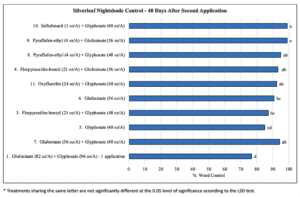
In research studies conducted on silverleaf nightshade, postemergence treatments were evaluated to control silverleaf nightshade in pistachios. This included the newly registered herbicide florpyrauxifen-benzyl (Hulk), which has demonstrated good control of broadleaf weeds such as hairy fleabane and marestail in other studies. Tank-mix combinations in the study included florpyrauxifen-benzyl (Hulk, 21 fl oz/A), saflufenacil (Treevix 1 oz/A), pyraflufen (Venue, 4 fl oz/A), and oxyfluorfen (Goaltender, 24 fl oz/A), with glyphosate (Roundup PM3, 48 fl oz/A) and glufosinate (Rely 280, 56 fl oz/A). A tank-mix combination of glyphosate and glufosinate was also included in this study.
Sequential applications were made 28 days after the initial application to assess control of newly emerged weeds as well as regrowth from established silverleaf nightshade plants. In addition, a sequential tank-mix application of glyphosate and glufosinate at a lower labeled rate was compared to a single application of these herbicides at a higher labeled rate.
‘Sequential
applications can exhaust root carbohydrate reserves and
ultimately lead to plant death.’
Can Sequential Treatments Provide Long-Term Control on Silverleaf Nightshade?
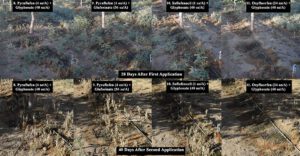
Many of the treatments provided 88% or greater control four weeks after the initial application. Florpyrauxifen-benzyl applied alone provided the lowest level of control, suggesting it has low activity on silverleaf nightshade when used alone. When tank mixed with glufosinate, however, control improved to 93%, and regrowth was reduced compared to either herbicide applied alone.
At four weeks after the initial treatment, a sequential application was applied on the emerged seedlings and new growth from established weeds. Forty days after the second application, all sequential treatments provided greater than 85% control. Little to no regrowth was observed in treatments that included saflufenacil, pyraflufen-ethyl or oxyfluorfen. Roots of some established plants were completely necrotic, indicating plants were dead. All treatments fully controlled seedlings that were less than 4 inches tall.
When comparing glyphosate plus glufosinate treatments, two sequential applications at lower rates provided better control compared to a single high-rate application of these herbicides. In the sequential treatment, the aboveground parts of established plants were completely burned down, with necrotic roots resulting in plant death. However, the single high-rate treatment caused defoliation in plants, with many green stems remaining and a high potential for regrowth.
These results highlight the importance of application timing. Sequential applications increased weed control by targeting weeds when they were smaller and before producing significant regrowth. This resulted in better spray coverage and canopy penetration compared to single applications made on larger plants.
The main takeaway from this study is that tank-mix combinations of postemergence herbicides can effectively control silverleaf nightshade. Seedlings are more susceptible to herbicides, but established plants with large root systems require follow-up applications.
To be more effective, applications should be made when plants are less than 6 inches tall. At this stage, plants are more susceptible, and better spray coverage, canopy penetration and herbicide absorption can be achieved.
Tank-mix combinations of herbicides with different modes of action should be used to reduce the risk of herbicide resistance development. Sequential applications can exhaust carbohydrate reserves stored in the root system by forcing the plant to use these reserves to resprout after each herbicide application, reducing its ability to recover over time and eventually leading to plant death.
A proactive and integrated weed management approach needs to be considered for managing perennial weeds like silverleaf nightshade. Plants should not be allowed to set seed or spread vegetatively. Mowing should be done before seed set, and hand weeding is most effective when plants are small and roots are removed. Regardless, control practices must be implemented in a timely manner to prevent establishment and spread of silverleaf nightshade.