

Earlier than normal emergence of insect pests can mean higher pressure through the growing season and earlier vigilance. UC IPM specialist Jhalendra Rijal noted that navel orangeworm and brown marmorated stink bugs emergence this year marked the earliest he has seen in the past 10 years. All pest insect species are at least 7 to 18 days ahead of normal emergence time.
Monitoring for the presence of true bugs, including leaffooted bugs in addition to BMSB, typically begins in early March. The warm weather accelerated emergence. In the case of BMSB, Rijal said it emerged a month earlier than normal. Last year, leaffooted bugs emergence was marked April 8, this year he found his first LFB in a trap on March 18.
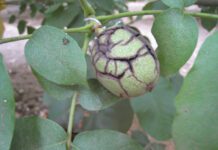
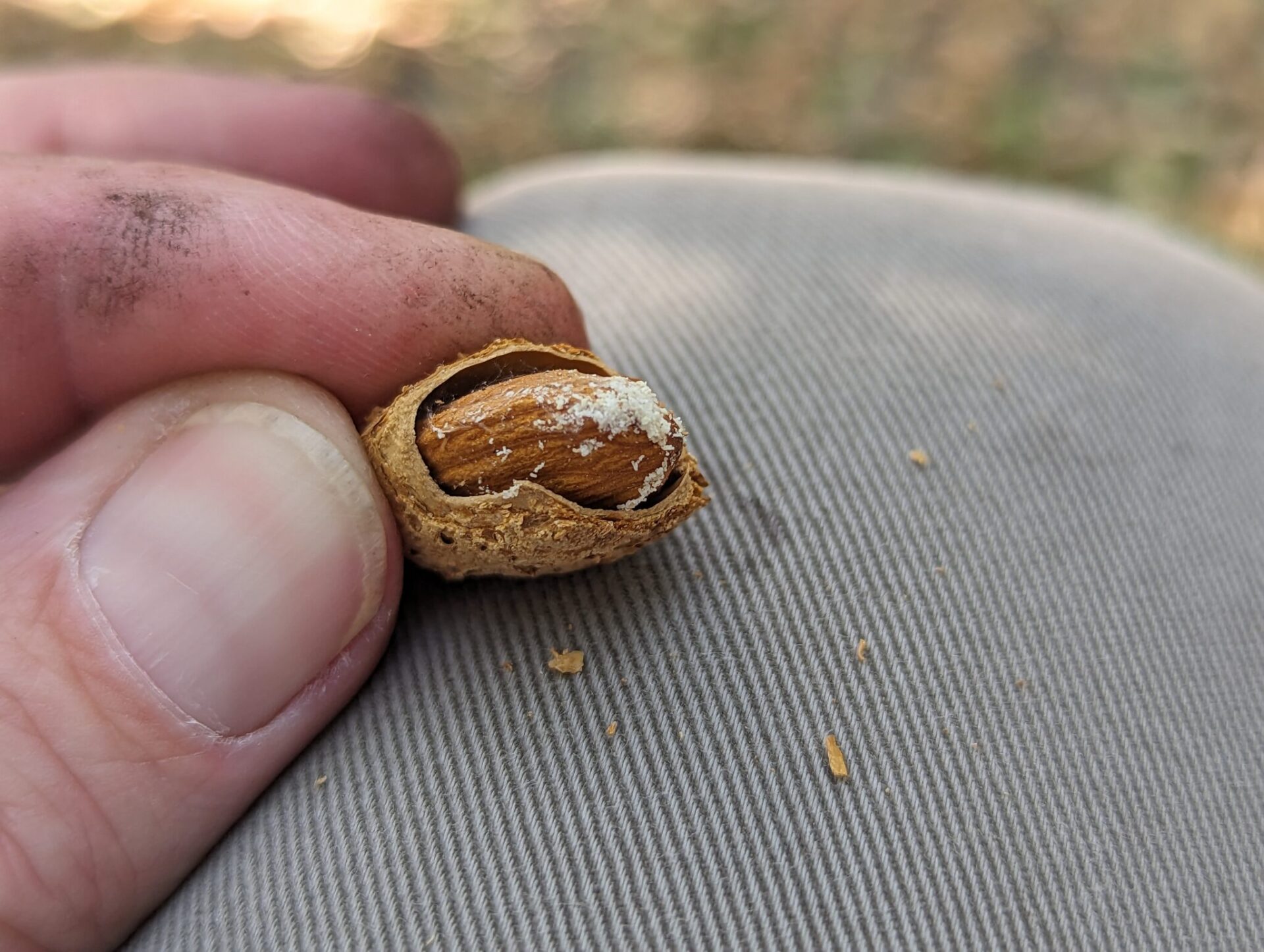
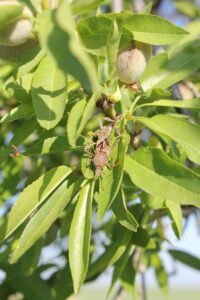
Large bugs are significant, but sporadic pests in almond and pistachio orchards. Their feeding causes nut drop early in the season. Later feeding causes kernel damage or brown spot. Leaffooted bugs are often found in the upper canopy of trees, and their feeding results in gummosis and early nut drop. In almonds, after shell hardening, their feeding results in brown spots on kernels.
Green stink bug is the most common native stink bug and is known to migrate into orchards later in the season.
Early Season Damage
Brown marmorated stink bug, prevalent in the northern San Joaquin Valley, is an invasive species that can cause early season damage similar to true bugs. This pest can also penetrate the almond shell and damage kernels after shell hardening.
Signs of orchard infestation are nut gummosis, feeding punctures and presence of bugs.
Rijal noted BMSB has an effective pheromone trap for this pest detection, and are commercially available. Installing clear sticky traps with pheromone lures in an orchards edge is best way to detect this pest. For leaffooted bug, he said there was no available trap until recently. There is a new trap and lure for leaffooted bug which can be a useful detection tool in the early season when migrating insects can be intercepted as they move into almonds.
There are no economic thresholds established for true bugs. However, traps should provide the beginning of their activities in the orchard. In addition to traps, Rijal recommends scouting, looking for signs of dropped nuts, and adult bugs, nymphs or egg masses. While scouting for LFB and BMSB should have begun last month, especially this year, scouting for green stink bugs and other native stink bugs is recommended to begin in May.
Decisions to apply pesticides to control these pests should be based on crop damage history in the orchard and current season bug activity. Rijal said use of indoxacarb-containing insecticides has been effective against true bugs and has less impact on natural enemies than pyrethroids. Both products are found to be effective. He noted that pyrethroid products can also kill mite predators, so the decision to spray should be weighted carefully with the possible need for a miticide spray later in the season.
Not All Little Black Bugs Are Bad
The invasive Carpophilus beetle continues to be studied for best control practices. Houston Wilson, UC IPM specialist, said this pest becomes active in early to mid-April in almonds and can produce multiple generations per year. It is important to note that there are multiple species of this beetle and only the truncatus species is capable of damage in tree nuts. Carpophilus truncatus has been found in all San Joaquin Valley counties and as far north as Colusa County. Wilson said surveys have shown that in the Stanislaus-Merced area a good fraction of the sample beetles collected in orchards have been truncatus. In the southern part of the SJV, they are a smaller fraction.
Wilson noted that his laboratory has been processing samples sent in by growers and pest control advisors, and it has taken time to train technicians to distinguish different Carpophilus species.
Wilson and Rijal are both testing the experimental carpophilus pheromone lure in the San Joaquin Valley in collaboration with Australian researchers. The lure is not yet commercially available for grower.

Cecilia Parsons
Cecilia Parsons has lived in the Central Valley community of Ducor since 1976, covering agriculture for numerous agricultural publications over the years. She has found and nurtured many wonderful and helpful contacts in the ag community, including the UCCE advisors, allowing for news coverage that focuses on the basics of food production.
She is always on the search for new ag topics that can help growers and processors in the San Joaquin Valley improve their bottom line.
In her free time, Cecilia rides her horse, Holly in ranch versatility shows and raises registered Shetland sheep which she exhibits at county and state fairs during the summer.